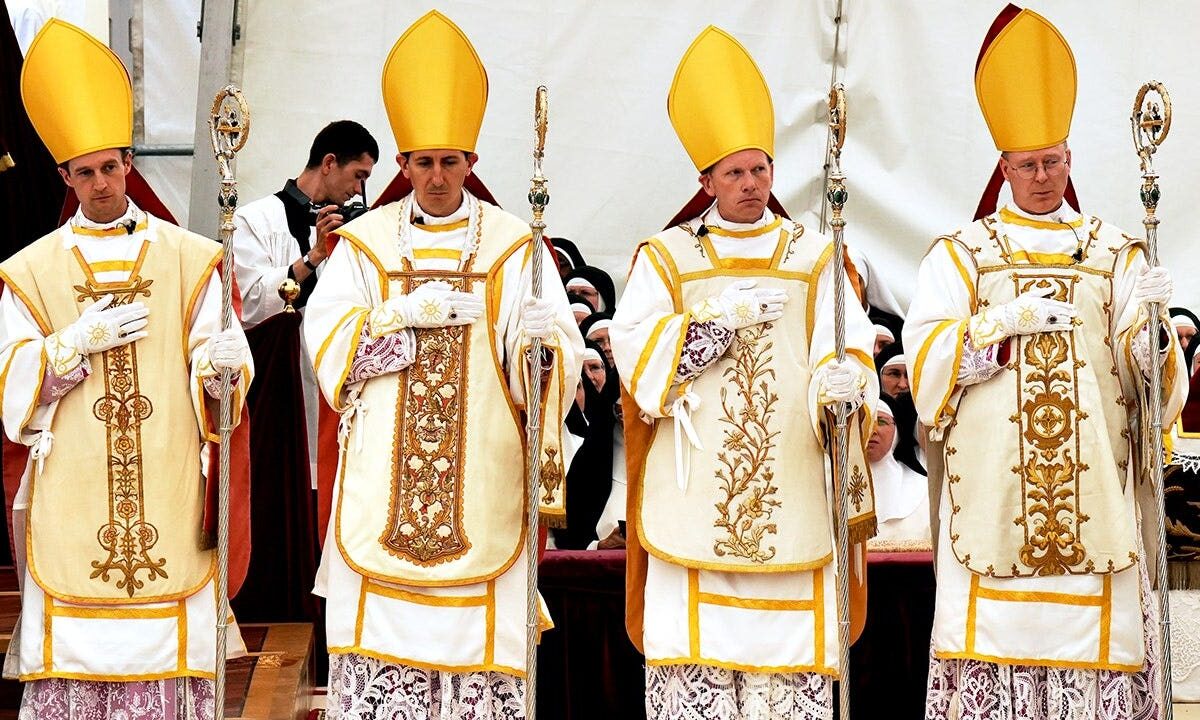
The Holy See issued a decree Thursday declaring the Society of St. Pius X in schism and pronouncing excommunication on bishops and priests who took part in recent, unauthorized episcopal consecrations at the SSPX seminary in Écône, Switzerland. The decree says the ordinations were carried out without papal mandate and constitute a deliberate rupture with the Catholic Church. The Vatican decree is posted by the Holy See.
What the Vatican decree says about the Society of St. Pius X
The decree names those involved in the Écône ceremony and applies canonical penalties, including excommunication, to the bishops and priests found to have participated in the unauthorized consecrations. It frames the action as an act of schism that undermines ecclesial communion and the unity of apostolic governance.
According to the Holy See text, the consecrations violated the Church’s requirement that episcopal ordinations be granted with the pope’s explicit approval. The decree states the measures are intended to defend canonical order and to protect the faithful from pastoral acts performed outside full ecclesial communion. The Vatican text is explicit that sacramental faculties and canonical status are affected for those directly involved; readers can consult the full wording on the Holy See site for the precise canonical citations and penalties: Holy See bulletin.
Who was consecrated at Écône and what was said
The ceremony at the SSPX’s Écône seminary produced four newly consecrated bishops. The society’s superior, Rev. Davide Pagliarani, presided over elements of the event and defended the decision as a pastoral response to what the group describes as a crisis in parts of the Church.
Pagliarani and other SSPX leaders have publicly argued the consecrations were meant to preserve sacramental ministry in communities attached to the society’s traditionalist practices. Reporting by news agencies conveyed the society’s position that the act was not intended to declare a formal break with the pope, though Rome treated the ceremony as an intentional and public act beyond acceptable canonical limits (Associated Press reporting).
In a personal appeal quoted by Vatican officials ahead of the ceremony, Pope Leo XIV urged the SSPX leadership to desist, writing, “I plead with you and ask you with all my heart: please turn back!” The plea was cited in the Holy See’s public communications as evidence of Rome’s preference for reconciliation over disciplinary action.
What this means for followers and sacraments
The Holy See’s decree says that, because the ordinations were unauthorized and constitute schismatic acts, certain sacramental ministries performed by those involved are canonically affected. The Vatican specifically noted limits on the ability of the implicated clergy to validly and licitly exercise faculties related to confession and marriage in contexts where those faculties depend on communion with the pope. The decree advises local ordinaries and bishops to provide pastoral guidance to the faithful who worship with or rely on SSPX ministers.
Practically, the decision creates immediate pastoral questions for Catholics who attend SSPX Masses or seek sacraments from society priests. The Holy See urged pastors to make provisions so that the faithful can access validly conferred sacraments in full communion with diocesan structures. The decree frames these steps as measures to safeguard the sacramental life of the Church and the canonical rights of Catholics.
The Society of St. Pius X reports a membership that includes priests, seminarians and lay faithful across many countries. Because of that network, the Vatican said the canonical measures could have broad pastoral consequences and stressed the need for clear local guidance from diocesan bishops.
Historical context of the SSPX split
The Society of St. Pius X was founded in 1970 by Archbishop Marcel Lefebvre in reaction to liturgical and theological changes emerging after the Second Vatican Council. Lefebvre and his followers rejected several post-conciliar reforms, most visibly the wider use of vernacular languages at Mass and other adaptations of liturgy and discipline.
The conflict with Rome deepened in 1988 when Lefebvre consecrated four bishops without papal approval; the act led to synodal-level disputes and canonical penalties at the time, including excommunications. Those specific penalties were later lifted in 2009 by Pope Benedict XVI as part of gestures intended to open a path toward reconciliation, but the SSPX did not return to full canonical communion and many disputes remained unresolved.
Efforts by successive popes and Vatican offices sought over the years to regularize the SSPX’s status, offering pastoral concessions while asking for doctrinal and disciplinary commitments. The new decree marks a clear reversal in tone and represents a significant setback for those reconciliation efforts.
Reaction, guidance and what comes next
Vatican officials framed the decree as a protective measure for church unity and for the pastoral care of Catholics. The Holy See asked Catholics to be mindful of the canonical status of clergy and to seek sacraments from ministers in full communion with their dioceses when questions arise about validity or licitness.
Observers say the immediate focus will be pastoral and juridical: how bishops worldwide respond in parishes where SSPX activity occurs, whether the society seeks formal talks under conditions set by the Holy See, and whether individual priests or communities affiliated with the SSPX pursue reconciliation. Analysts also expect the Vatican to continue offering channels for dialogue even while it enforces canonical norms.
The Associated Press provided reporting used in this article; for further context and contemporaneous coverage see the AP’s Vatican reporting page and the Holy See’s bulletin linked above. Additional coverage and reporting on the decree and the Écône consecrations is available from international news organizations.
The Associated Press contributed to this report.