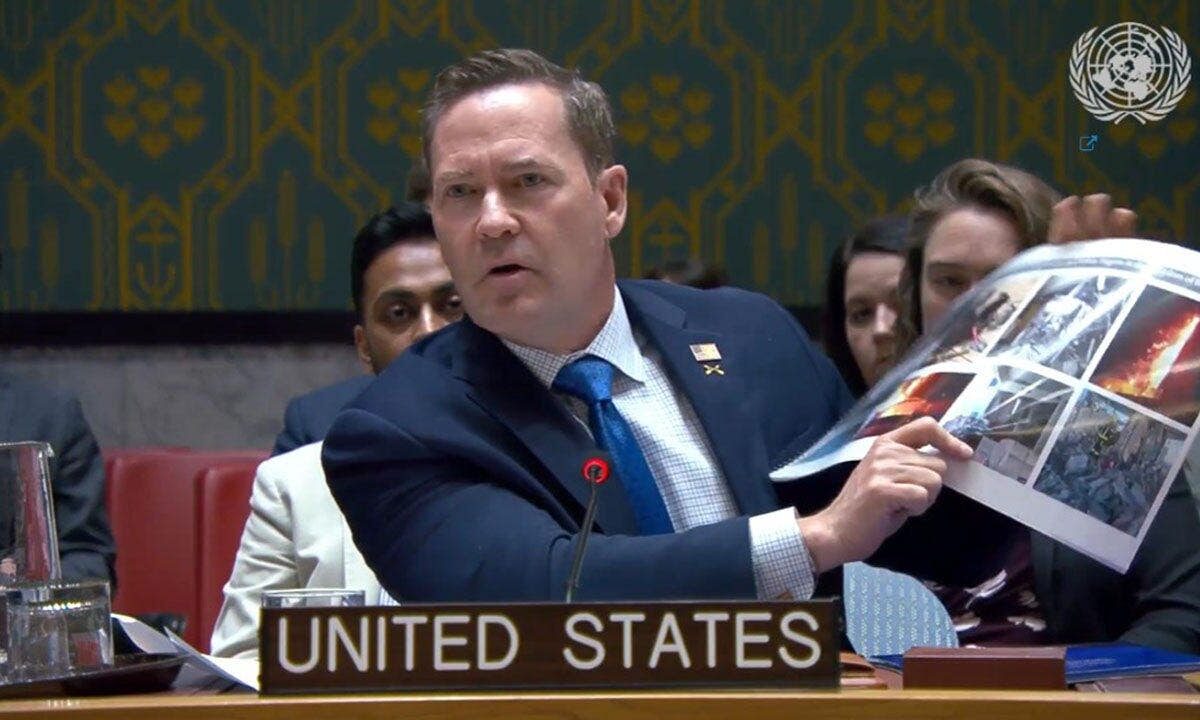
Mike Waltz opened an emergency U.N. Security Council session by holding up photographs he said showed the aftermath of drone and missile strikes on Bahrain, directly challenging Iran’s denials and urging council action.
What Mike Waltz said at the U.N.
At the Security Council meeting, Mike Waltz displayed images he described as evidence of civilian damage in Bahrain, including a damaged residence, a hotel hit by a Shahed drone and a facility used by first responders. He used the visuals to press Iran’s representatives for answers and to keep the focus on the humanitarian impact of the attacks.
Addressing Iran’s envoy, Waltz warned that the council would not be silenced, saying, “Let me remind you where you are. This is the United States of America. This is the United Nations Security Council. You will not silence this body.” His remarks aimed to frame the strikes as deliberate attacks on civilian sites and to push for international scrutiny of the incidents shown in the images.
Bahrain tally and reported civilian toll
Speaking to the council, Bahrain’s foreign minister, Abdullatif bin Rashid Al Zayani, said his government recorded what he described as 808 attacks since Feb. 28, which he said included 203 ballistic missiles and 605 armed drones. He presented those numbers as Bahrain’s official count.
Al Zayani also said, as Bahrain reported to the council, that three civilians had been killed and 465 others injured. These figures are labeled here as claims made by Bahrain’s foreign minister to the Security Council and have not been independently verified in this report.
Waltz framed the photographs he showed as illustrative of the pattern Bahrain described, pressing council members to weigh the human impact alongside the technical tallies presented by the Bahraini delegation.
Iran’s response and council exchanges
Iran’s U.N. envoy, Amir Saeid Iravani, forcefully rejected the meeting’s premise and accused the U.S., Bahrain and other Western delegations of spreading what he called “lies and disinformation” to justify aggressive acts against Iran.
Iravani told the council that remarks accusing Tehran were part of a broader campaign of misinformation and defended Iran against direct attribution for the strikes. The session featured blunt exchanges: delegations offering evidence and denunciations on one side, and Tehran’s representatives offering denials and counter-accusations on the other.
Delegates at the meeting repeatedly cautioned that many claims remained contested and emphasized the need for careful assessment of competing accounts even as they pressed for follow-up and clarification.
U.S. strikes, merchant vessel hit, and escalation risk
The emergency session followed a series of confrontations across the Gulf. U.S. officials, as referenced during the council exchanges, said American forces carried out strikes on June 27 targeting Iranian missile and drone storage sites and coastal radar positions. U.S. officials framed those strikes as responses to perceived violations of a fragile ceasefire and threats to regional shipping and forces.
Council discussion also referenced an incident in which a merchant vessel was struck off the coast of Oman, which participants described as part of a pattern of attacks and retaliations. Delegates characterized the sequence — merchant vessel struck, retaliatory strikes, public accusations at the U.N. — as raising the risk of a broader military confrontation in the Gulf region.
Speakers warned that continued tit-for-tat actions and disputed attributions increase the chance of miscalculation. Some delegates urged restraint and calls for independent investigation; others argued for stronger deterrent measures to prevent further attacks on civilian and commercial targets.
Why the U.N. session matters
The Security Council meeting became a high-profile venue for competing narratives: government delegations presenting evidence of civilian harm and alleging Iranian responsibility, and Iran denying those allegations and criticizing Western responses. For diplomats and regional observers, the immediate concerns are preventing further civilian harm and stopping an escalation that could draw additional militaries into direct conflict.
Beyond the immediate rhetoric, the session underscored the challenge of establishing independent, verifiable accounts of attacks amid fast-moving incidents and sharply polarized political positions at the U.N.
What comes next
Council members are likely to continue monitoring developments closely and to call for investigations or clarifying exchanges in the days ahead. Any new strikes, verified attributions, or major incidents at sea could prompt further U.S. or allied responses and raise diplomatic pressures at the Security Council.
At the same time, the meeting highlighted competing priorities inside the council: some delegations pressing for immediate punitive measures, others urging patience and verification to avoid widening the conflict. How those divisions translate into collective action will shape near-term diplomatic and security dynamics in the Gulf.
FAQ
Who is Mike Waltz and why did he speak at the U.N.?
Mike Waltz is the U.S. ambassador to the United Nations. He addressed an emergency Security Council meeting to present images he said showed damage from recent drone and missile strikes on Bahrain and to press Iran over accusations of responsibility.
What did Bahrain report about the attacks and casualties?
Bahrain’s foreign minister told the council his government recorded 808 attacks since Feb. 28, including 203 ballistic missiles and 605 armed drones, and reported three civilian deaths and 465 injuries. Those numbers were presented to the council as Bahrain’s official claims and are reported here as such; they have not been independently verified in this report.
Did the U.S. carry out strikes in response and when?
U.S. officials said American forces struck Iranian missile and drone storage locations and coastal radar sites on June 27, citing violations of a ceasefire as the rationale. That action was referenced repeatedly during the council exchanges as part of the recent escalation.
Source attribution
This article is based on reporting from Fox News on the U.N. Security Council emergency session. Specific attributions in this report include:
- Bahrain figures and casualty counts: Statements by Abdullatif bin Rashid Al Zayani, Bahrain’s foreign minister, to the U.N. Security Council, as reported by Fox News.
- Quotes and images shown by Mike Waltz: Sourced to the U.N. Security Council session and described in the Fox News report.
- Iran’s responses: Statements by Amir Saeid Iravani, Iran’s U.N. envoy, as reported by Fox News from the council exchanges.
- U.S. strikes and the merchant-vessel incident: Referenced in council discussion and reported by Fox News; dates and details in this piece reflect those reports.
Primary source: Fox News – Waltz calls out Iranian diplomat at UN following drone strikes on Bahrain and Kuwait.