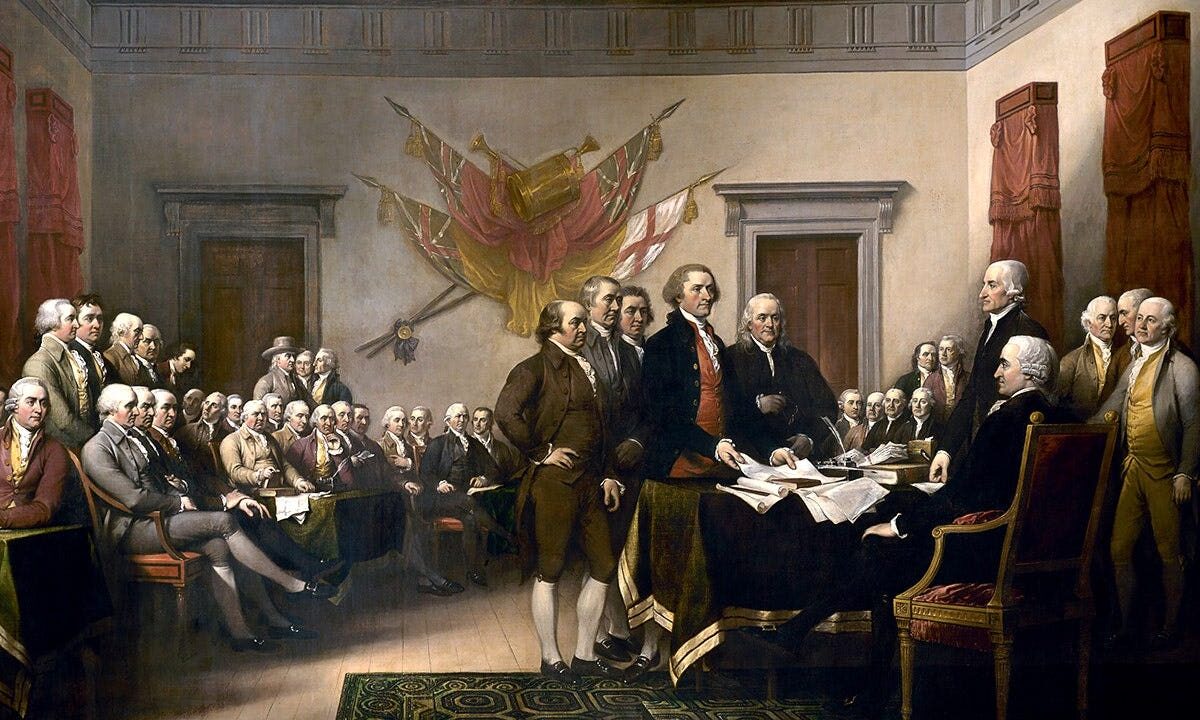
The Fourth of July is a reminder that two hundred and fifty years ago a group of colonists put their names to a declaration that could have been a death warrant. The holiday asks us to recall what was risked, who stood beside the leaders we remember, and how later generations were urged to complete the nation’s promise.
This short guide explains the holiday’s meaning, the military odds the founders confronted, a human vignette from Mount Vernon, and the thread from Gettysburg to our present civic obligations. (See sources at the end for primary documents and scholarly accounts.)
What the Fourth of July marks
The Fourth of July marks the formal assertion — in a declaration adopted 250 years ago — that the American colonies would no longer accept rule by a distant monarch. The Declaration of Independence set forth grievances and a statement about government by consent that has been repeatedly cited since as the republic’s founding political claim (National Archives, Declaration of Independence).
Signing that document carried real risk: signers exposed reputation, property and, in extremis, life. The act was both a legal and symbolic break and remains central to how the nation recalls its origins.
The odds the founders faced
Militarily, the Revolution began as a David-and-Goliath contest. Contemporary and later estimates note that British regulars supplemented by hired Hessian troops formed a well-armed imperial force that, at various points in the conflict, numbered in the tens of thousands across North America; some summaries place the British and Hessian contingent above 50,000 when measured against rebel units and garrisons (see Britannica, American Revolutionary War).
By contrast, the Continental Army was often smaller, more localized and periodically depleted by short enlistments and supply problems. Historians and contemporary records place effective Continental forces in many campaigns in the low tens of thousands; some campaign rolls and modern accounts estimate effective field strength as often no more than 10,000–15,000 on particular campaigns, though numbers shifted by year and theater (Britannica, Continental Army; see also David Hackett Fischer and John Ferling for campaign-era estimates).
These disparities help explain why skillful leadership, timing and diplomacy — notably turning allies and foreign aid in later years — proved decisive.
Washington’s defining acts
George Washington’s leadership altered the strategic balance at critical moments. The December 1776 crossing of the ice-choked Delaware River and the surprise attack at Trenton disrupted Hessian expectations and bolstered Continental morale. Contemporary accounts and battlefield studies underline how surprise, speed and discipline allowed a smaller army to achieve an outsized effect (Britannica, Battle of Trenton).
Those operations did not win the war by themselves, but they kept the cause viable until alliances, most notably French military aid after 1778, and later campaign successes converged to bring British surrender at Yorktown. Military historians stress that Washington’s steady application of limited resources, alongside political and diplomatic strategy, was central to the eventual outcome (see Ron Chernow, Washington biography).
Billy Lee and life at Mount Vernon
Remembering the Fourth of July also means remembering the people who lived and labored alongside the leaders. William “Billy” Lee was an enslaved Black man who served as George Washington’s personal servant and accompanied him during parts of the war, including campaign seasons that encompassed the Delaware crossing and Yorktown. Mount Vernon and archival records document Lee’s presence in Washington’s household and wartime entourage (Mount Vernon, William Lee).
Washington was a slaveholder. His 1799 will included provisions intended to manumit the people he enslaved after his death; historians note complexity in those arrangements because some people at Mount Vernon were dower slaves owned by Martha Washington’s estate and could not be freed by him (Mount Vernon, slavery and Washington’s will). The historical record indicates that William Lee is recorded in sources as a person who later lived as a free man, but the timing and legal details are subject to archival nuance and scholarly discussion. In short: primary documents show Washington’s will included manumission language, and Mount Vernon scholars have compiled the estate records and correspondence that trace outcomes for named individuals.
From Gettysburg to the present
Nearly a century later, the Civil War forced a national reckoning over the republic’s founding claim. At Gettysburg in 1863, Abraham Lincoln framed the struggle in terms that explicitly invoked the Declaration’s proposition that “all men are created equal,” urging the nation to see the Union’s survival as necessary to secure that promise. The text and context of the Gettysburg Address link Revolutionary principles to the moral purpose Lincoln articulated (Library of Congress, Gettysburg Address).
Lincoln’s address did not erase the country’s failures, but it reframed the Revolution’s political claim as a continuing work — a standard by which the nation would be judged and a reason the Fourth of July is often read as a charge to improve the union rather than as a simple celebration of the past.
Why this Fourth of July should matter
The founders and their contemporaries often invoked what they called “virtue” — a public-spirited willingness to place common goods above private interest — as central to republican governance. That rhetoric reflected a civic ideal rather than an uncontested historical fact; historians caution that the nation’s founders lived with deep contradictions between rhetorical commitments and social practices, including slavery.
This Fourth of July, the civic prompt is concrete: participate in public life, study the era’s documents and contested legacies with attention to primary sources, and support institutions that teach civic literacy. Acts such as voting, volunteering, and supporting balanced civic education are practical ways to engage the responsibilities Lincoln and others identified as necessary for self-government.
FAQ
What does the Fourth of July commemorate?
It commemorates the adoption of the Declaration of Independence in 1776, when delegates declared the colonies independent and articulated a claim about government by consent (National Archives).
Who was Billy Lee and why is he notable?
William “Billy” Lee was an enslaved man who served George Washington as a close attendant and accompanied him during parts of the Revolutionary War. Mount Vernon and archival sources document his role in Washington’s household (Mount Vernon).
Did Washington free the people he enslaved?
Washington’s will included provisions to manumit the people he owned upon his death; the legal and personal outcomes for individuals at Mount Vernon are documented in estate records and have been the subject of detailed historical study (see Mount Vernon and primary will documents linked below).
Sources and further reading: National Archives, Declaration of Independence (archives.gov); Britannica entries on the American Revolutionary War and Battle of Trenton (britannica.com, britannica.com); Britannica, Continental Army (britannica.com); Mount Vernon, William Lee and Washington’s slavery records (mountvernon.org, mountvernon.org); Library of Congress, Gettysburg Address context (loc.gov); Ron Chernow, Washington: A Life (biographical context).