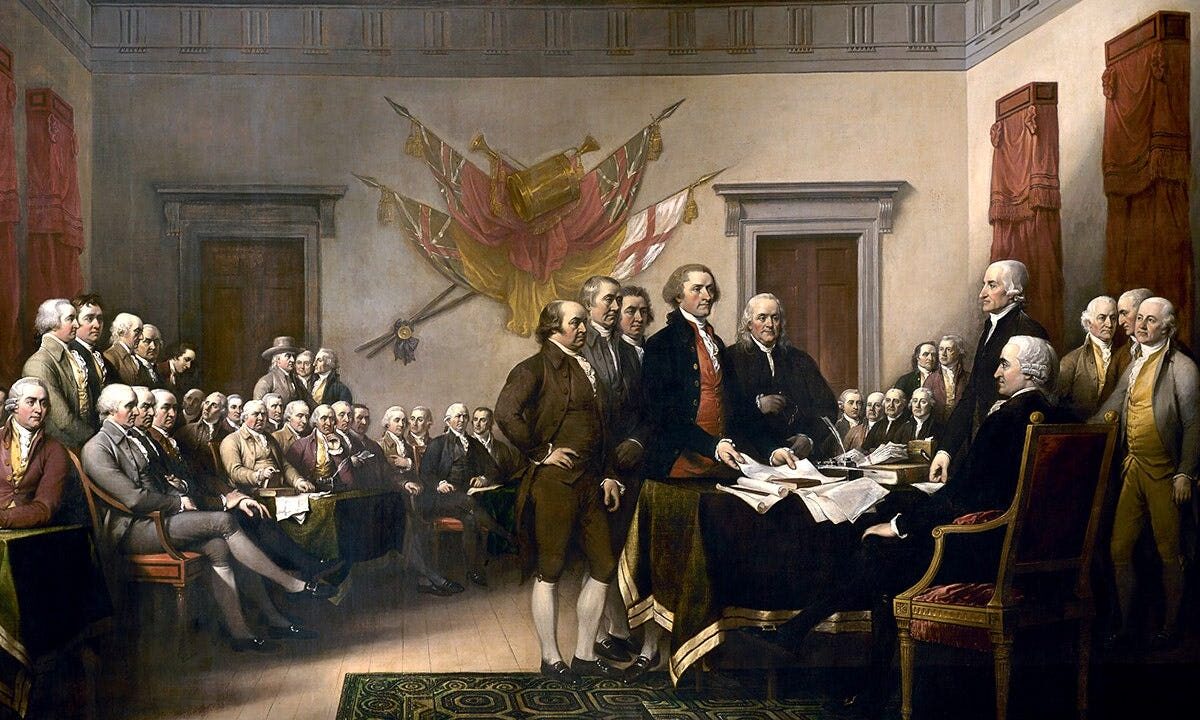
The phrase founders fire connects the rhetorical energy of 1776 to the legal and institutional steps that followed. In the decades after the Declaration of Independence, framers and lawmakers created a framework — including constitutional authority and early patent statutes — that many historians and commentators argue helped make invention a central engine of American economic growth.
Founders fire and the founding idea
Invoking the founders fire is a way to link two strands of the early Republic: the broad normative claims made in the Declaration of Independence around rights and self-determination, and the concrete, enumerated powers in the Constitution that enabled federal policy. Together they provide a rhetorical and legal backdrop for arguments that the founding era created space for invention and enterprise.
This linkage is part narrative and part institutional history. The Declaration supplied a public language celebrating individual initiative; the Constitution gave Congress tools to promote commerce and learning. Scholars caution that drawing a direct causal line requires care: rhetoric shaped public culture, while laws and policy created incentives that operated alongside markets, capital formation and social institutions.
Patents, Article I Section 8 and the Patent Act of 1790
The Constitution empowers Congress to “promote the progress of science and useful arts,” a clause found in Article I, Section 8. Legal commentators and courts have long treated that language as the constitutional basis for federal patent law — a public-policy power to grant time-limited exclusivity in exchange for disclosure.
Acting on that authority, Congress passed the first federal patent statute in 1790. The Patent Act of 1790, signed into law during George Washington’s presidency, created a process for examining and granting patents and established an early model for balancing inventor incentives with public disclosure. Washington’s administration and later lawmakers built on that framework as the industrializing nation expanded.
While the text of Article I provides the constitutional hook, the 1790 Act illustrates how early federal policy translated that authority into institutions. Historians note that patents were one among several mechanisms — including state law, financial markets, and educational institutions — that influenced where and how technology developed.
Immigrant founders and inventions tied to U.S. patent law
Accounts of American innovation frequently pair immigration with entrepreneurial dynamism. Historical inventors such as Samuel Morse (telegraph), Thomas Edison (light bulb developments), Henry Ford (automobile manufacturing innovations) and later figures linked to computing are commonly cited when tracing technological change.
Contemporary lists of influential founders often highlight immigrant-born leaders. For clarity: Andrew Carnegie was born in Scotland; Elon Musk was born in South Africa; Jensen Huang was born in Taiwan. Commentators use these examples to illustrate how migrants have contributed to U.S. industry and institutions — not to claim that patent law is the sole explanation. Migration, access to capital, networks, education and regulatory context all matter.
It is important to attribute claims: published commentaries use these names to show patterns (see Source attribution below). Researchers studying innovation stress multicausal explanations. Patent regimes can alter incentives for disclosure and investment, but their impact varies across sectors and over time.
Why this history matters for today
Invoking the founders fire to describe modern policy debates highlights continuity in American political economy: a founding era that emphasized both rights and delegated powers; a patent system intended to spur invention; and successive waves of migrants who engaged with those institutions. Proponents argue that this historical thread helps explain U.S. leadership in many technologies.
At the same time, policymakers and analysts point to limits and trade-offs. Debates about patent quality, the pace of litigation, and how exclusive rights affect follow-on innovation are central in discussions about AI, biotech and pharmaceuticals. Those who place emphasis on the founders fire often stress cultural and institutional continuities; critics warn that such narratives can underplay distributional issues and regulatory choices that also shape outcomes.
Key takeaways
- The phrase founders fire links 1776-era rhetoric and later constitutional and statutory steps that shaped incentives for invention.
- Article I, Section 8 of the Constitution and the Patent Act of 1790 are factual anchors in the legal history of U.S. patents.
- Immigrant founders — including historically prominent figures and modern entrepreneurs — illustrate patterns of migration and innovation, but patents are only one factor among many.
FAQs
What does founders fire mean in this context?
Here, founders fire is a shorthand for the rhetorical energy of 1776 together with the institutional choices made by the early Republic that helped shape incentives for invention and enterprise.
How did the Patent Act of 1790 affect U.S. innovation?
The Patent Act of 1790 created a federal mechanism for granting patents, making intellectual property protection a national matter. Scholars treat the Act as an early institutional step that, combined with other economic forces, influenced inventors’ decisions to disclose and commercialize new ideas.
Which inventors and immigrant founders are cited?
Examples often named in commentary include inventors such as Samuel Morse, Thomas Edison, Henry Ford and Steve Jobs, and immigrant founders such as Andrew Carnegie (born in Scotland), Elon Musk (born in South Africa) and Jensen Huang (born in Taiwan). These names are illustrative rather than definitive proof of any single causal mechanism.
Source attribution
This analysis draws on commentary published at Fox News and on primary legal texts. Primary documents referenced here include Article I, Section 8 of the U.S. Constitution and the Patent Act of 1790. The original commentary is available at: Fox News. For scholarly analysis of patents and innovation, consult academic histories and law reviews that examine institutional effects over time.