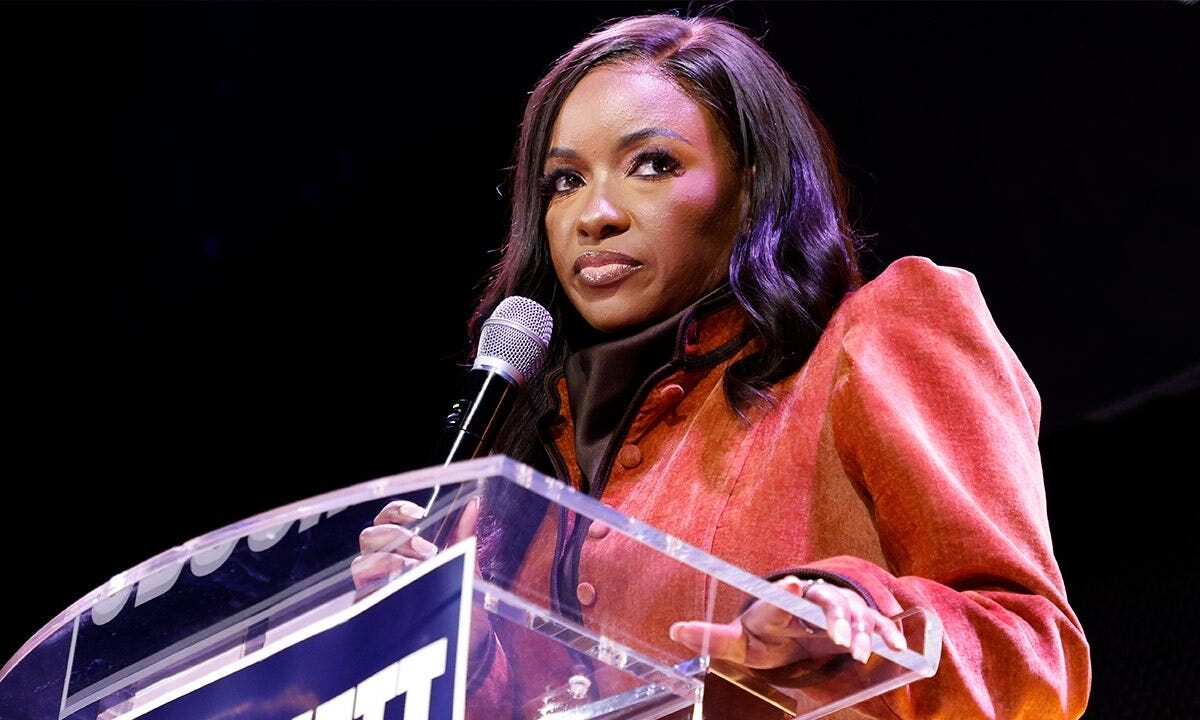
“If there’s any group of people that the party should be most loyal to and most vocal about, it’s Black people,” Rep. Jasmine Crockett told The Root during an interview at the Essence Festival in New Orleans. Her blunt critique opened a larger warning: Democrats risk losing reliable Black voters if the party fails to make concrete policy and outreach commitments.
Jasmine Crockett at Essence Festival
The Root interview framed Crockett’s comments around both loyalty and frustration. Crockett, a Texas Democrat and member of the party’s progressive wing, said Black Americans feel overlooked even as they remain a core part of the Democratic base. She pressed party leaders to establish a clear “baseline” of commitments for constituencies that have historically carried the coalition.
She contrasted the predictability of Black voters’ Democratic support with the uncertainty of outreach to White voters: “When you walk into a room full of Black people, you can almost guarantee that they believe in the Democratic ideals. When you walk into a room full of White people, you don’t know what you walking into.” That line framed her argument that acknowledgment must be paired with action.
What Crockett says Black voters want
Crockett named several concrete issues she said Black voters and organizers are pressing for: fuller political representation, reductions in Black maternal mortality, and protections for Black women’s employment. She said these topics are not abstract policy points but matters tied to daily survival and dignity.
She described constituents asking, “Are y’all going to say anything about our representation that is being deleted like, in a very sinister and calculated way?” Crockett said that question captures a raw sense of being sidelined even as Black communities continue to deliver votes.
Why Crockett says Democrats are misreading voters
Crockett faulted what she described as misaligned priorities within the party, including a critique of “White leftists” who can focus on single issues while broader material concerns go unanswered. “You’re talking about the White leftists that are doing the most in this moment,” she said, adding that progressive identity and single-issue focus sometimes miss the economic and service needs of many voters.
She also warned about turnout dynamics from 2024. Crockett pointed to a large number of potential voters who sat out the election and said Democrats risk further erosion if people continue to feel unchanged by either party. “People need to understand that there are certain people that say, ‘It doesn’t matter if it’s a Democrat or a Republican, my life has never changed,’” she said.
Implications for Democratic strategy and elections
Crockett’s critique raises tactical and strategic questions for the Democratic Party. Politically, a perception of neglect could depress turnout among groups the party depends on in close races. Tactically, it suggests a shift from broad national messaging to targeted, constituency-specific commitments tied to measurable outcomes.
Her call for a baseline of commitments — covering Black Americans, Latinos, women and LGBTQIA communities — implies that party leaders might need to translate promises into clear policy benchmarks and local organizing efforts. That could include measurable goals on representation, health outcomes, job retention for Black women and investments in communities often left out of high-profile policy debates.
For the progressive wing and the party establishment, Crockett’s stance is both a critique and a roadmap: maintain core progressive values while sharpening delivery on basic services and protections that voters see in day-to-day life. Failing to do so could cost the party margins in swing districts and complicate coalition management heading into future elections.
What comes next
Crockett urged deeper civic engagement beyond presidential cycles, encouraging people to participate at the city council and state legislature level. That emphasis points to a dual strategy for Democrats who want to repair trust: national commitments plus local empowerment that addresses immediate needs.
Party leaders may respond by elevating targeted policy proposals and clearer public commitments to issues like maternal health and employment protections. How they balance appeals to persuadable voters with obligations to their traditional base will be a test of both messaging and legislative priorities.
FAQs
What did Jasmine Crockett say about the Democratic Party?
Crockett said Democrats are overly focused on trying to win over White voters and can appear to ignore Black voters’ needs. She urged the party to set a baseline of commitments that acknowledges and protects historically marginalized constituencies.
Could her comments change party strategy before the next elections?
Her remarks contribute to ongoing internal debates. They may push leaders to make clearer, measurable commitments to core constituencies and to emphasize local outreach to boost turnout, but strategic changes will depend on broader party discussions and electoral calculations.
Which issues did she say matter most to Black voters?
Crockett highlighted representation, Black maternal mortality and job security for Black women, alongside economic concerns such as the cost of food, housing and healthcare.
Source attribution: This report is based on Rep. Jasmine Crockett’s interview with The Root at the Essence Festival and related coverage by Fox News. Read The Root’s coverage at The Root and the Fox News report here.