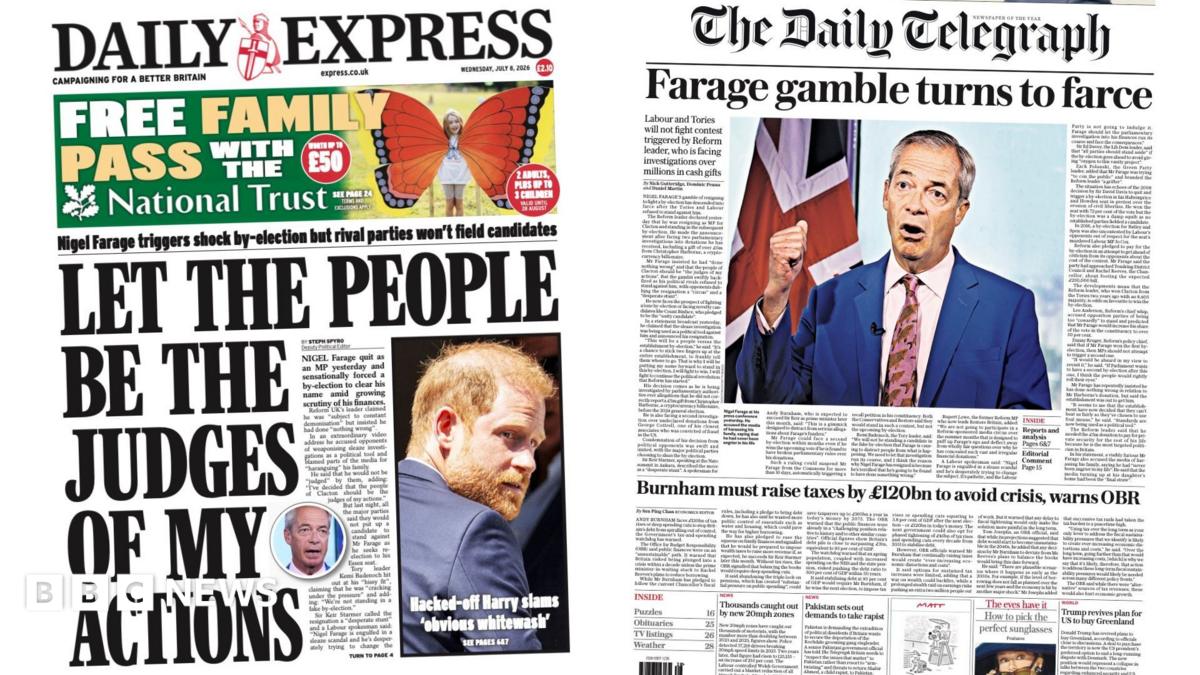
Nigel Farage has announced he is resigning as an MP, triggering a by-election in his constituency and sending Wednesday’s national front pages into a flurry of coverage. The decision was presented by different papers as either a bold political gambit or a risky retreat; voters in the constituency will now have the chance to pass judgement at a by-election.
The move produces an immediate local vacancy and sets a compressed timetable for parties and election officials. Reporting from BBC News has driven much of the initial national reaction and framed how editors and commentators approached the story on the day of publication.
What Nigel Farage announced
Farage publicly said he would stand down as the MP for his constituency, thereby triggering the statutory process that leads to a by-election. The announcement left little doubt about his intent to prompt a fresh poll so constituents can decide whether to restore or withdraw their support.
BBC News reported the resignation as the central fact and noted that it became the lead story for many papers. The broadcaster described the resignation as a deliberate act to force a by-election, reporting that Farage said he would step down and return to the electorate for a renewed mandate.
How the papers covered it
Newspaper front pages approached the story in markedly different ways. Some tabloids emphasised the drama of a high-profile MP quitting amid controversy, while several broadsheets used the resignation to interrogate political strategy and the implications for the emerging parliamentary arithmetic.
Opinion pages and columnists used the opportunity to debate timing and motive, with some writers asking whether the move would consolidate support or expose the seat to challenge. Headlines and leader columns varied from framing the resignation as an accountability exercise to describing it as a high-stakes gamble.
Editors’ choices about prominence and tone offer an early read on how the broader media narrative may shape public impressions in the run-up to the by-election.
What the by-election means
Procedurally, a by-election is the mechanism to fill the vacancy created when an MP resigns. Election officials will follow established rules to accept the formal writ, set nomination deadlines and declare a polling date. That timetable compresses campaigning into a much shorter window than a general election allows.
Politically, the contest carries multiple implications. For the constituency, voters will have a direct opportunity to respond to Farage’s decision. For national parties, the seat offers a testing ground: it may indicate whether personal support for Farage translates into continued success for his allies, or whether the absence of an incumbent advantage makes the seat vulnerable.
Parties are likely to weigh resource allocation carefully. A headline by-election can prompt national leaders to intervene, sending senior figures to campaign and diverting staff and funds. Conversely, if a party judges the seat unwinnable, it may conserve resources for more favourable contests.
Turnout will be a key variable. By-elections often produce lower participation than general elections, and which voters show up can tilt outcomes in unexpected ways. Local issues, national mood, and the clarity of campaign messaging will all matter in determining the result.
Timeline of key events
- Announcement: Nigel Farage publicly confirmed he would resign as an MP, prompting immediate national coverage.
- Media reaction: Wednesday front pages across the UK ran the story with varied editorial framings.
- BBC report: BBC News covered the resignation and the press response on 2026-07-08, providing the primary national account of events.
- Formal vacancy: Parliamentary procedure requires the formal acceptance of the resignation and the issuing of a writ to set a by-election.
- Candidate selection: Parties are expected to select candidates in the days and weeks after the writ is issued; nomination deadlines will be set under the by-election timetable.
- Polling date and campaigning: Once a polling date is announced, an intense short campaign period will begin, with postal ballots, hustings and local advertising forming the bulk of activity.
What to watch next
Immediate items to monitor include the date the writ for the by-election is moved and the names of candidates chosen by each party. Those announcements will shape whether the contest becomes a national proxy fight or remains dominated by local issues.
Watch for early indicators such as local campaign launches, endorsements from prominent figures and any initial constituency-level polling. Pay attention to turnout signals during the campaign: postal ballot requests and early canvass reports often provide an early sense of which way momentum is moving.
Also observe how national party leaders respond. Their level of engagement can convert a local contest into a national talking point and influence how much coverage the seat receives in the weeks before polling day.
The story is likely to evolve fast. Official dates and candidate lists will clarify the contours of the contest, and subsequent BBC reporting and press coverage will track how the by-election shapes perceptions of both local representation and national political dynamics.
Source: BBC News reported the resignation and the press reaction; for the original BBC account see: https://www.bbc.co.uk/news/articles/c1ky1wxg98ko?at_medium=RSS&at_campaign=rss