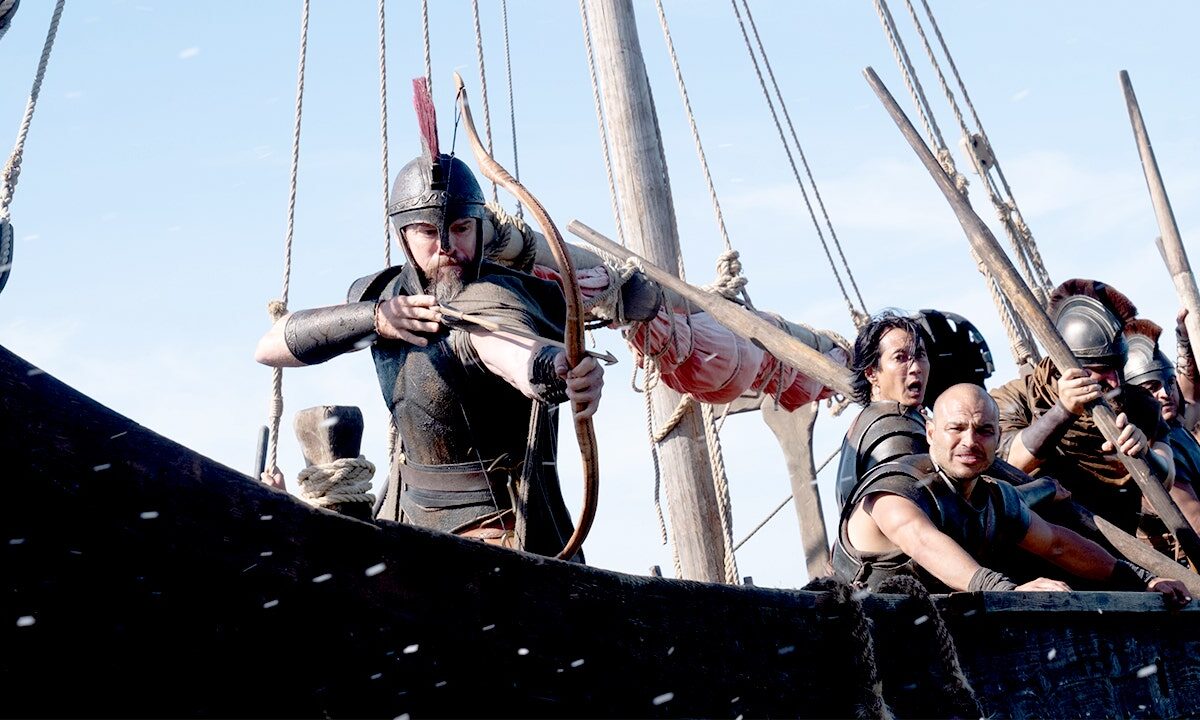
The Odyssey lands as Christopher Nolan’s most ambitious film in scope and spectacle, and the quick verdict is simple: The Odyssey is in theaters now and worth seeing in IMAX for viewers who prioritize immersive filmmaking.
Quick take on The Odyssey
The Odyssey is Nolan’s large-scale adaptation of Homer’s epic about Odysseus’s long journey home after the fall of Troy. Anchored by Matt Damon as Odysseus, the film folds in a wide ensemble while keeping Nolan’s rigorous, design-first instincts at the center of the storytelling. The result is a cinematic event that privileges scale, texture and craft over star-driven vanity.
If you prefer visual and tactile cinema — work that rewards a big screen and careful attention — this is a theatrical release to prioritize in person. Casual viewers may still find much to admire, but the film’s full impact is calibrated for larger-format exhibition.
How Nolan made The Odyssey
Reviews and reporting note that Nolan built the production around large-format capture and practical filmmaking choices designed to maximize theatrical presence. Fox News Digital reports the production was built around IMAX large-format capture and describes the shoot as being “shot entirely on IMAX film,” a technical commitment cited to emphasize the film’s theatrical-first approach. That phrasing reflects reporting about the production; readers should understand it as a report about Nolan’s technical approach rather than an independently verified studio technical dossier included here.
Hoyte van Hoytema is credited as the cinematographer, bringing a long-standing collaborative rapport with Nolan to bear on the film’s compositions and palette. Ludwig Göransson supplies the score, lending a muscular, thematic underpinning that helps the film move between intimate beats and sprawling set pieces. Production design, costume work and practical effects are consistently foregrounded across coverage as contributors to a tactile ancient world that favors hands-on texture over CG gloss.
Those technical choices shape not only the film’s look but how sequences land emotionally: sea voyages feel physically perilous, confined interiors register with weight, and set-piece confrontations with mythic figures are staged with an emphasis on scale and kinetic clarity. Whether every theater will render those details identically depends on screen size and projection, which is why the IMAX argument matters to the viewing recommendation below.
Cast and standout performances
The Odyssey assembles a broad ensemble cast. Principal credits include Matt Damon as Odysseus and Anne Hathaway as Penelope, with Tom Holland appearing as Telemachus. Robert Pattinson, Zendaya and Charlize Theron are also listed among the film’s marquee names. Several supporting actors draw specific praise in published reviews: Samantha Morton is noted for her turn as Circe and Bill Irwin is mentioned for a distinctive, physically transformative role linked to the Polyphemus material.
Across those performances, Damon’s Odysseus is steadied by a restraint that suits Nolan’s larger thematic focus, while Pattinson’s portrayal of Antinous is repeatedly flagged as a memorable, texture-rich contribution. The ensemble nature of the piece means some high-profile actors have relatively limited screen time; that is presented in coverage as a compositional choice rather than a shortcoming, one that emphasizes thematic orchestration over individual star arcs.
Tone, rating and running time
The film’s tone is solemn and often intense, leaning into peril and mythic danger. The Odyssey is rated R for violence and some language and runs approximately 2 hours and 52 minutes. Expect sustained sequences of battle violence and tense encounters rooted in the source material’s more brutal episodes.
Because of its length and weightier material, the film asks for patient viewing: many sequences are drawn out to build atmosphere, which benefits from a theater environment that supports focused attention. Content warnings therefore emphasize depictions of violence and scenes of physical peril tied to the epic’s mythological confrontations.
Verdict: who should see it and why
Bottom line: The Odyssey is worth seeing in IMAX for cinephiles and fans of Nolan’s craft. The film’s visual ambition and reported large-format shooting are central selling points that translate into a different, often more immersive theatrical experience than a standard auditorium showing can deliver. For viewers eager to feel the scale of Odysseus’s journey — the heaving seas, the claustrophobic ship interiors, the mythic confrontations — IMAX screenings are the recommended way to experience the film.
That said, if your priority is a strictly literal, line-by-line fidelity to Homer, bear in mind Nolan’s adaptation reshapes material for cinematic pacing and thematic focus. The film aims to capture the spirit and scale of the source rather than function as a page-to-screen documentary of the ancient text. Fans of adaptations who appreciate interpretive reshaping will likely find much to admire; viewers seeking a schoolroom-accurate retelling may find the approach less satisfying.
Key takeaways
- Directed by Christopher Nolan; a large-scale adaptation inspired by Homer’s Odyssey.
- Reportedly built around IMAX large-format capture and described in coverage as “shot entirely on IMAX film” — phrased here as a report on the production’s technical approach.
- Principal cast includes Matt Damon, Anne Hathaway, Tom Holland and Robert Pattinson; Samantha Morton and Bill Irwin are noted supporting standouts.
- Running time: approximately 2 hours, 52 minutes. Rated R for violence and some language.
- Reviewer recommendation: worth seeing in IMAX for viewers who prioritize cinematic craft and immersive scale.
FAQ
Is The Odyssey worth seeing in IMAX?
Yes — for viewers who prioritize immersive, large-format cinema. The film’s reported large-format approach and production design are best realized on the biggest screens, where detail, scale and sound combine for a markedly different theatrical experience.
Is the film faithful to Homer’s poem?
The Odyssey is an adaptation that draws on Homeric episodes and characters while reshaping them for cinematic pacing and thematic unity. It aims to capture the epic’s spirit and scale rather than provide a literal, line-by-line translation.
Who plays Odysseus and Penelope?
Matt Damon plays Odysseus and Anne Hathaway plays Penelope in this adaptation.
Source and credits
This review is based on reporting and criticism published by Fox News Digital. The film is released by Universal Pictures and is directed by Christopher Nolan, with cinematography by Hoyte van Hoytema and music by Ludwig Göransson. For the original review, see: Fox News Digital.