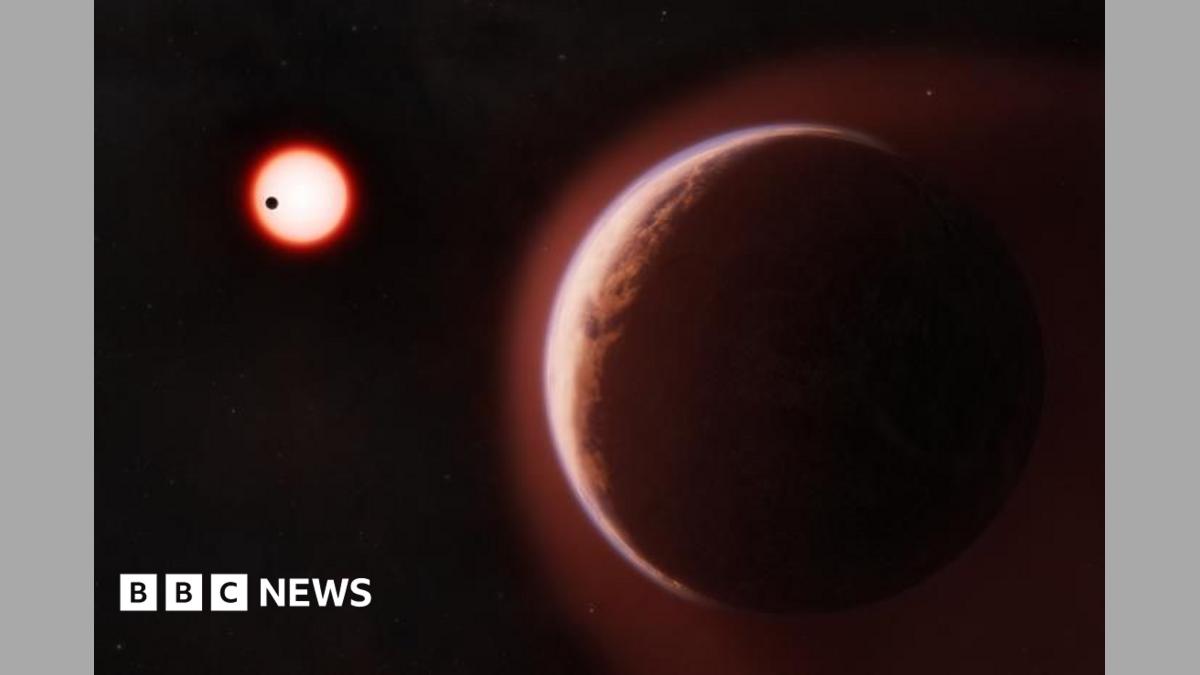
Researchers have reported a preliminary detection of an atmosphere on an Earth-like planet orbiting a distant star — a result described by BBC News and presented as an early finding that requires independent confirmation.
The announcement centers on observations interpreted as signatures of a gaseous envelope surrounding a small, rocky exoplanet located within its star’s habitable zone. The research team emphasized the provisional nature of the result and said further independent analyses and follow-up observations are needed before the detection can be considered definitive.
Atmosphere on Earth-like planet: what was detected
According to the reporting, astronomers used transit spectroscopy and related measurements to look for changes in starlight as the planet passed in front of its star. Those measurements can reveal absorption features that point to gases in a planet’s atmosphere. The team described spectral patterns and light-curve variations consistent with the presence of an atmospheric layer around a rocky, Earth-size world.
The reported signals are the kind astronomers expect when light filters through an atmosphere during transit, but they do not on their own provide a full chemical inventory or confirm the thickness or habitability of the gas envelope. The researchers described the result as an initial detection that points to an atmosphere, while underscoring unknowns about composition, pressure and temperature.
Orbit and habitability context
The planet orbits within the habitable zone of its host star — the region where, in principle, surface temperatures could allow liquid water if other conditions (like atmospheric pressure and composition) are right. The BBC News coverage notes the planet’s size and rocky nature, which is why it is described as “Earth-like” in composition rather than in climate or ecology.
Being inside the habitable zone is an orbital classification, not a direct statement about surface conditions or life. Many factors beyond orbital distance — including atmospheric makeup, greenhouse effects and geological activity — shape whether a world could actually support liquid water at its surface.
Limits and scientific caution
The research team and external scientists have urged caution. The announcement explicitly frames the finding as preliminary: the detection needs independent confirmation by other teams and instruments before it can be accepted as the first clear atmosphere detected on an Earth-like, rocky world in a habitable zone.
Potential sources of uncertainty include instrument noise, stellar activity that can mimic atmospheric signals, and model assumptions used to interpret the spectra. The “Earth-like” label in headlines refers to a rocky, similar-sized planet, but does not confirm Earth-equivalent surface conditions, climate or the presence of water.
Independent experts routinely reanalyze such data to test whether alternative explanations — for example, starspots or data-processing artifacts — could produce the observed signals. Only repeated, independent detections with complementary methods will build a robust case.
What comes next
The team has outlined next steps that include repeat observations, cross-checks by other groups and targeted measurements designed to narrow down atmospheric composition and structure. Planned work will aim to improve signal-to-noise, search for specific molecular signatures and rule out non-atmospheric explanations.
- Repeat spectroscopic transits with the same and different telescopes to test reproducibility.
- Independent analyses by other research groups to verify the original team’s interpretation.
- Follow-up observations targeted at known molecular bands to constrain composition and possible surface conditions.
The researchers and the broader community expect a sequence of studies over months to years before the claim is elevated from an initial detection to a widely accepted discovery.
Background
Detecting atmospheres around small, rocky exoplanets is technically challenging because those worlds block only a tiny fraction of their star’s light and any atmospheric signature is correspondingly faint. Historically, atmospheres have been easier to detect around larger gas giants and warm sub-Neptunes. A reliable atmospheric detection around an Earth-size, rocky world would mark significant progress in observational capability.
Agencies and observatories including NASA have documented the difficulties and the methods used to probe exoplanet atmospheres; repeated, multi-instrument campaigns are a common path to verification. For general context on the challenges and methods of atmospheric detection, see NASA’s exoplanet resources.
FAQ
Does this mean the planet has life?
No. A detected atmosphere alone does not indicate life. Atmospheres can arise and persist through geological or photochemical processes without biology. Identifying life would require specific biosignature gases or patterns and substantial additional evidence.
What does habitable zone mean?
The “habitable zone” is the range of orbits where conditions could allow liquid water on a planet’s surface, given an atmosphere with suitable pressure and composition. It is a useful selection criterion for follow-up observations but not proof of habitability.
Is this confirmed as the first atmosphere on an Earth-like planet?
Not yet. The team’s announcement is an initial detection that will need independent confirmation by other research groups and instruments. The finding is presented as preliminary and must be verified before being called a definitive first.
Source: BBC News – First atmosphere found on Earth-like planet in habitable zone of distant star; context on detection challenges: NASA Exoplanet Exploration.