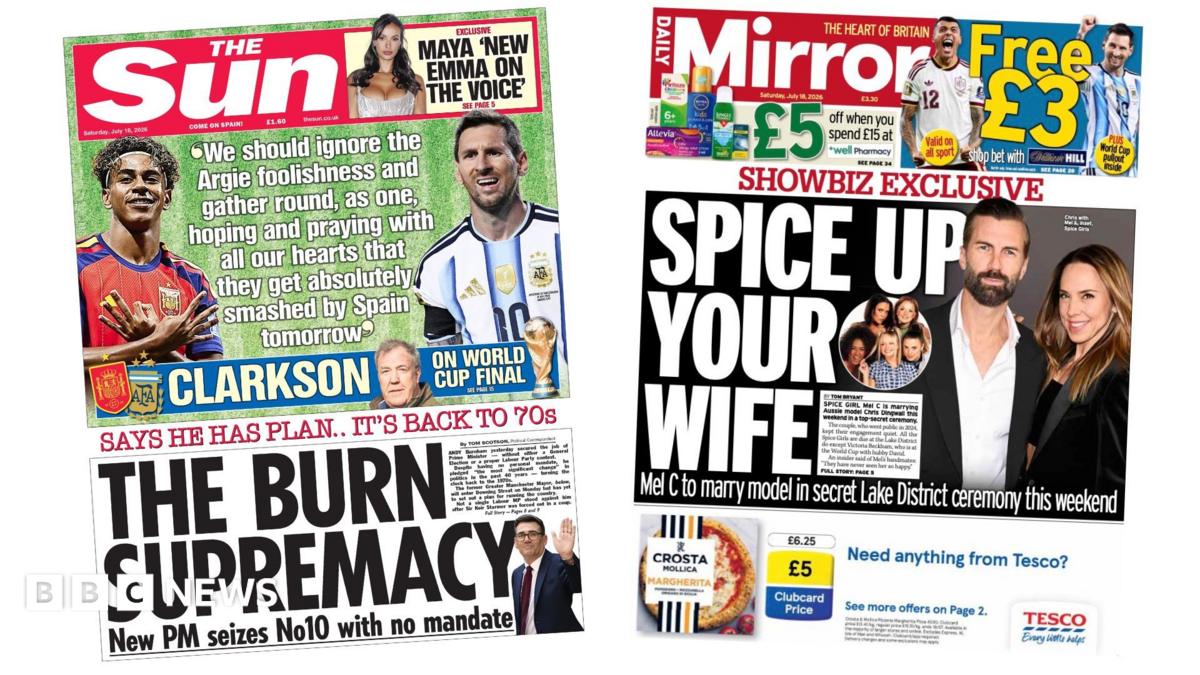
Andy Burnham is the dominant figure across Saturday’s national front pages, with splash lines ranging from “The Burn supremacy” to a quoted, provocative front-page line reading “Spice up your wife”. The BBC’s round-up lists the new prime minister and those striking headlines in its coverage.
Editors across the political spectrum used bold type and compact headlines to stamp Burnham as the defining political figure of the day. This quick update summarises the main lines, how titles framed Burnham’s arrival, the context for the quoted front-page phrase, and why these covers matter for public perception.
Top lines on the front pages
Across tabloids and broadsheets the dominant headline theme is Andy Burnham’s elevation to the role of prime minister. “The Burn supremacy” appears as a prominent splash on several front pages, setting a triumphant tone in some titles and signalling editorial judgement about immediate momentum.
Other covers emphasised domestic and cultural angles, favouring short, attention-grabbing copy. One front-page line reproduced in the BBC round-up reads “Spice up your wife”; that phrase appears as front-page copy rather than as a clearly attributed quote from the prime minister and has been widely flagged for its provocative wording.
Beyond single lines, many papers coupled headlines with strong images or concise summaries to set the day’s agenda. The overall picture is one of papers choosing simple, emotive shorthand to communicate a complex political transition to busy readers.
How papers framed Andy Burnham
Titles took different editorial lines on Andy Burnham, ranging from celebratory profiles to sceptical or analytical pieces. Some tabloids leaned into a triumphant narrative, using the “supremacy” framing to suggest a commanding political entrance.
Broadsheets generally opted for more measured language, prioritising quick analysis and quotes from commentators about what Burnham’s leadership could mean for policy and governance. That contrast between punchy tabloid shorthand and cautious broadsheet framing gives readers two very different first impressions of the same event.
Editors’ choices on what to emphasise — personality, perceived mandate, or immediate policy questions — will affect the headlines and the short-term narrative. For readers scanning the papers, the variety of frames shows how the same individual can be presented as both dominant and contested, depending on editorial priorities.
Front pages compress complex political shifts into a single image or headline — and that compression often shapes the day’s conversation.
Notable front-page quotes and context
The quoted front-page line “Spice up your wife” has been widely flagged because of its stark wording. As presented on a cover, it functions as front-page copy; the BBC reproduces the line as it appears on the paper’s front, but that presentation does not substitute for on-the-record sourcing.
Notably, the BBC’s original feed briefly used the misspelling “Britian”; this article corrects that to Britain and notes the BBC’s reproduction of the quoted front-page copy. The important distinction is that front-page copy often serves an editorial function — to provoke, summarise or entertain — and may not be presented as a verbatim, attributed quote from a named, on-record source.
Without on-page attribution or a clear link to a sourced interview, readers should treat such front-page lines as part of a paper’s headline strategy rather than a confirmed utterance by the person named alongside them.
Why the front pages matter today
Front pages shape first impressions and can help set the media agenda for hours after publication. A dominant splash or a provocative headline can drive broadcast discussion, social media sharing and public reaction long before detailed reporting filters through.
For the new prime minister, that means the way papers choose to package Andy Burnham — as triumphant, controversial, or consequential — can colour early perceptions of his mandate and priorities. Editors’ shorthand choices also highlight the themes likely to surface in follow-up coverage, from domestic policy to cultural debates.
Readers who want more than a headline should look beyond covers to full reporting and verified sources. Front pages are a starting point for conversation, not a substitute for in-depth analysis or polling that measures public opinion.
Source attribution
This round-up is based on the BBC’s collection of Saturday front pages and its short summary. For the original piece and full context, see BBC News – Top Stories: https://www.bbc.co.uk/news/articles/cwyq978dxwqo?at_medium=RSS&at_campaign=rss
For follow-up reporting and fuller reaction, readers should consult the BBC’s longer articles and other verified sources reporting on Andy Burnham’s early days in office.
FAQs
Why do papers call it “The Burn supremacy”?
“The Burn supremacy” is an editorial headline used by some titles to convey a strong, dominant arrival for Andy Burnham. It is shorthand intended to signal perceived momentum, not a literal assessment of unanimous public support.
Is “Spice up your wife” an actual quote from Andy Burnham?
The phrase appears as quoted front-page copy on at least one paper and is reproduced in the BBC round-up. That reproduction reflects how the headline appears on the cover; it does not, by itself, confirm the words were spoken by Andy Burnham.
Do the front pages reflect public opinion about Andy Burnham?
Not directly. Front pages reflect editorial choices and news judgement. They can influence public conversation but do not substitute for public-opinion polling or substantive reporting across multiple outlets.