
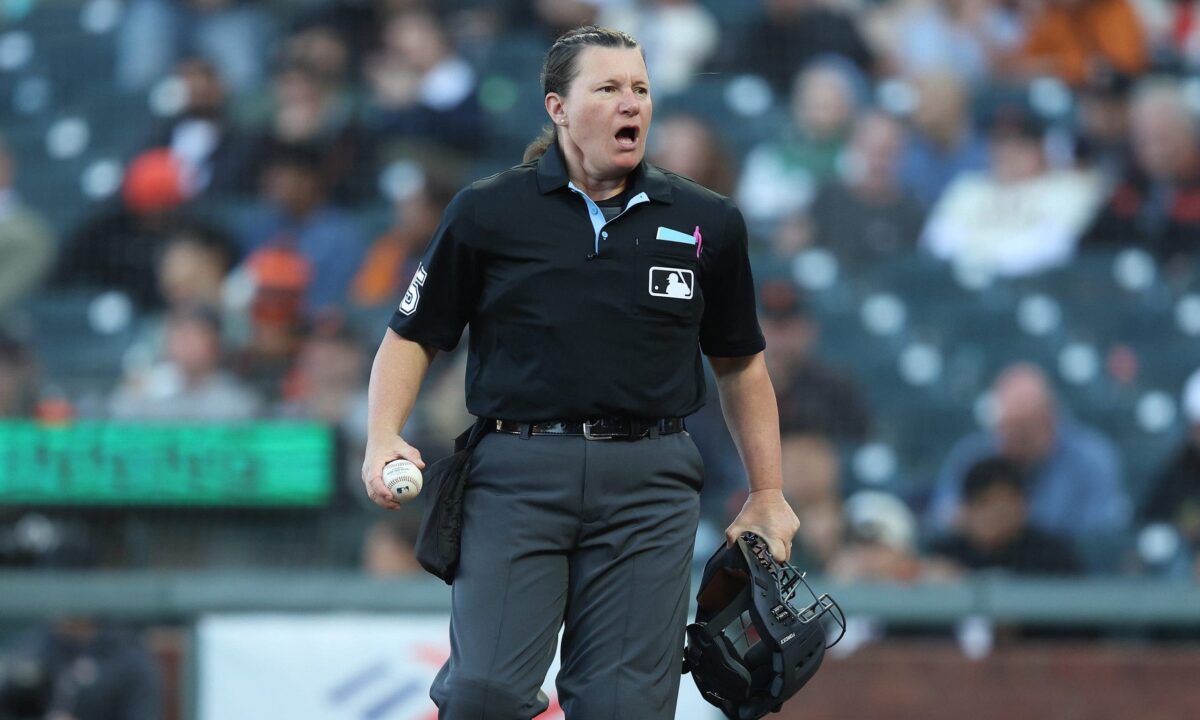
Jen Pawol’s 2026 season draws scrutiny after UmpScorecards data places her near the bottom of Major League Baseball umpires for ball-and-strike calls. UmpScorecards records an overall accuracy rate of 91.8% for Pawol and flags several high-profile overturned calls that have circulated as video evidence.
Quick summary — Jen Pawol at a glance
– Source metrics: UmpScorecards compared Pawol’s called balls and strikes to Statcast.
– Top metrics: 91.8% overall accuracy, 93.1% consistency, and an accuracy-above-expected of -1.6% for the 2026 season (as reported by UmpScorecards).
– Ranking: UmpScorecards lists Pawol 89th out of 91 qualified MLB umpires for ball-and-strike accuracy.
– Notable games referenced in coverage: June 16 (St. Louis vs. Minnesota), a 2026 spring-training challenge (Cincinnati vs. Cleveland), and July 13 (San Diego vs. Toronto), as reported in source articles and tracking posts.
Jen Pawol’s 2026 accuracy in context
Pawol’s 91.8% accuracy figure is the headline number most cited in coverage. UmpScorecards also reports a consistency rating of 93.1% and an accuracy-above-expected value of -1.6%, which attempts to account for pitch difficulty and expected call rates. Taken together, those metrics place her toward the lower end of the qualified group for 2026.
Context matters: single-game volatility and a handful of viral clips can shape public perception even when season-long metrics aggregate hundreds or thousands of rulings. Umpire rankings that rely on aggregate data aim to reflect overall patterns across many games; they are not immune to the influence of a few conspicuous reversals that attract attention on social platforms and broadcast replays.
Key game incidents and video evidence
Coverage and social video have focused on several incidents that critics cite as evidence of problematic calling. On June 16, in St. Louis vs. Minnesota, replay reviews and tracking data showed multiple ball calls that were later recorded as incorrect relative to Statcast’s electronic zone; those reversals generated widely shared clips.
Earlier in the spring, a Cincinnati vs. Cleveland spring-training challenge was cited in broadcast commentary as an example where a pitch called a ball by the umpire was judged a strike by the electronic zone. On July 13, reporting indicated a San Diego–Toronto game in which Pawol’s game decisions — including a balk ruling that allowed a run to score and a challenged call — were highlighted in postgame analysis and tracking summaries; UmpScorecards listed lower consistency for that appearance.
These clips are useful to illustrate discrete errors or differences in adjudication, but they represent snapshots. UmpScorecards’ strength is aggregating every called pitch; an individual overturned call may be memorable but is only one data point in a season-long record.
How UmpScorecards and Statcast measure calls
UmpScorecards evaluates each called ball or strike against Statcast’s tracking of pitch location relative to a defined electronic strike zone. The site publishes three primary metrics: accuracy (the percentage of called pitches that match Statcast’s classification), consistency (how stable an umpire’s strike zone is across pitches), and accuracy-above-expected (an adjustment intended to account for the mix and difficulty of pitches an umpire faces).
Important methodological notes: accuracy-above-expected is not a single definitive truth but an attempt to normalize for pitch attributes and situational mix. Statcast provides consistent, high-frequency tracking data, but it simplifies the strike zone into a standardized box and does not capture every nuance of an on-field interaction — for example, catcher framing, batter posture or subtle movement at the moment of the pitch can affect human perception but may not be reflected in a single x-y/z coordinate used by an electronic zone.
Because of those limits, UmpScorecards is best understood as a repeatable, objective comparator between human calls and Statcast definitions rather than a full measure of an umpire’s situational judgment, positioning, game management or non-ball-strike decisions.
Context, caveats and what comes next
Reporting has also discussed personnel and optics. Some coverage notes that Pawol was the first female home plate umpire in MLB in 2025 and that commentators have viewed her presence through the lens of inclusion efforts. Those characterizations are reported opinions in the coverage and are presented here as such rather than as independent fact. Observers have also pointed to CB Bucknor’s reported buyout and retirement as context for conversation about performance and roster moves; reporting describes those moves, but specific personnel decisions and any future buyouts or reassignments are handled internally by MLB.
What to watch next: trend lines across multiple series and opponents are more informative than isolated clips. If UmpScorecards continues to record similar accuracy and consistency values for Pawol across several weeks, that pattern will carry more weight than one-off reversals. Conversely, a move toward league-average metrics over time would moderate the current narrative.
Readers should weigh aggregate metrics alongside game context and treat suggestions of motive, promotion or personnel action as reported commentary unless accompanied by official statements from MLB or the parties involved.
Source attribution
This analysis relies on UmpScorecards’ published metrics for accuracy, consistency and accuracy-above-expected and on reporting compiled by Fox News. For the specific reporting that highlighted Pawol’s ranking and the cited game incidents, see the Fox News article linked below.
Fox News: MLB’s first female home plate umpire statistically ranks among 2026’s worst
FAQ
What is Jen Pawol’s 2026 accuracy rating?
UmpScorecards reports an overall accuracy rate of 91.8% for Pawol in 2026 and ranks her 89th out of 91 qualified MLB umpires for ball-and-strike accuracy (as reported by UmpScorecards).
How does UmpScorecards measure accuracy?
UmpScorecards compares each called ball and strike to Statcast’s electronic strike zone and reports accuracy, consistency and an accuracy-above-expected metric to account for pitch difficulty and the mix of pitches an umpire faces.
Could Pawol face discipline or reassignment?
Personnel decisions are made internally by MLB and are not publicly detailed in the source reporting. Continued below-average metrics could lead to additional scrutiny, but available reporting frames potential actions as speculation rather than confirmed plans.


