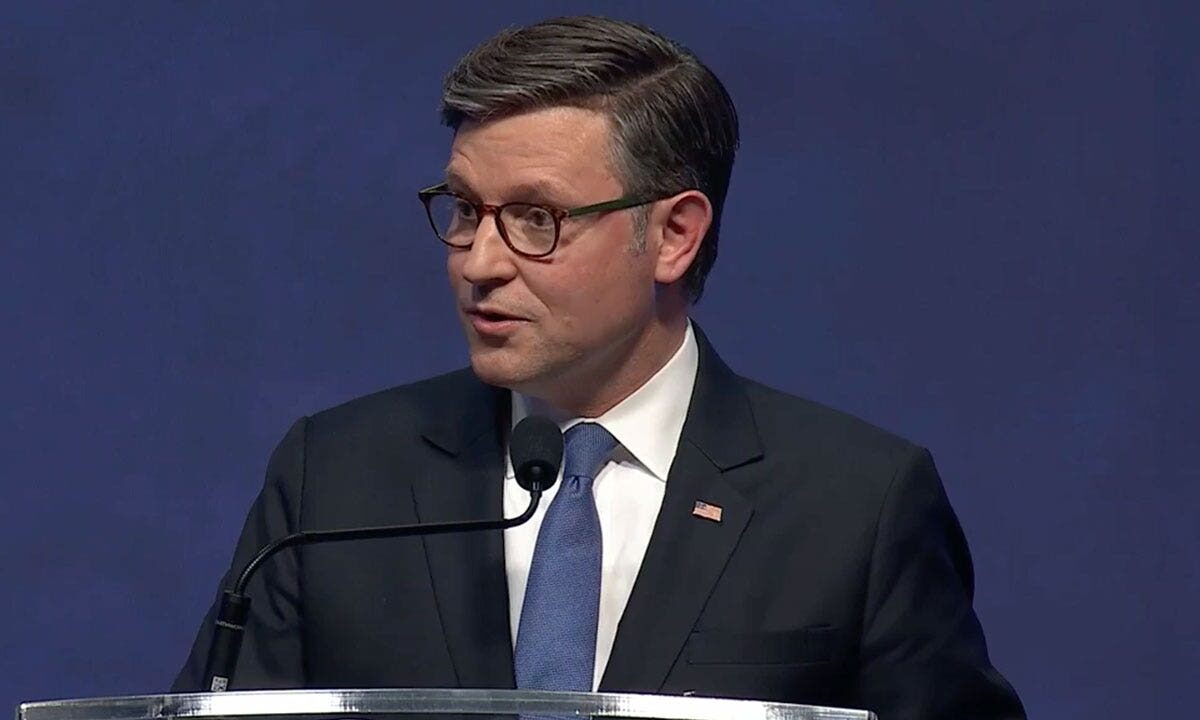
House Speaker Mike Johnson used a prominent platform at the Alliance Defending Freedom (ADF) summit in San Diego to cast the upcoming midterm elections as an ideological contest, saying the nation faces a “battle” against Marxism and related doctrines and urging conservative activists to rebut what he described as corrosive influences in education and civic life.
What Mike Johnson said in San Diego
Johnson told attendees at the ADF summit that political debate is not merely partisan but touches on the nation’s moral and civic foundations. Reporting on the event lists attendees including West Virginia Attorney General JB McCuskey, Idaho Attorney General Raul Labrador and conservative commentator Allie Beth Stuckey, among others; the attendee list is drawn from the original coverage and may not be exhaustive.
“We are in a confrontation, in a battle against a very dark philosophy — Marxism, and its deviations, communism and socialism.” — Mike Johnson
Johnson framed his remarks around the idea that faith and an understanding of America’s founding principles are essential to preserving constitutional order. He urged activists and conservative institutions to emphasize those themes in civic education and public messaging.
How he tied faith to the founding
Throughout the speech Johnson repeatedly linked religious language to the nation’s founding, invoking John Quincy Adams and echoing phrases associated with Abraham Lincoln’s Gettysburg Address to argue that American liberty is rooted in a moral vocabulary tied to a Creator. He contended that restoring that moral framing would counter tendencies that, in his view, concentrate power in ways that threaten individual rights.
That linkage—placing religious conviction alongside civic instruction—reflects a long-standing theme in parts of the conservative coalition that prioritize religious liberty and a Judeo-Christian civic narrative as bulwarks against what they describe as ideological extremes. Johnson’s presentation was explicitly his interpretation and intended as a rallying argument for sympathetic audiences at the summit.
Claims about Marxism and educational indoctrination
Central to Johnson’s remarks were warnings about Marxism, socialism and what he described as indoctrination in some classrooms. He argued that some students are being taught frameworks that present the United States in a consistently negative light and urged conservative leaders to provide alternative civic narratives.
These assertions are presented in this article as the speaker’s view. The Fox News coverage that forms the basis for this summary references an unlinked poll Johnson cited showing diminished national pride; the underlying methodology and results were not provided in that reporting. Readers should treat the polling reference and allegations of widespread indoctrination as claims made by Johnson at the summit and not independently verified here.
Midterm context and recent primary results
Johnson tied his warnings directly to midterm messaging, arguing that cultural and civic education are relevant to voters’ choices. He pointed to gains by candidates backed by the Democratic Socialists of America (DSA) in recent primaries as evidence of ideological movement on the left. The coverage noted several DSA-backed primary victories in New York City and specifically referenced figures such as Zohran Mamdani as examples used in the speaker’s argument.
His broader line was strategic: portray the coming elections as a contest over the nation’s founding principles and competing visions of civic education. How persuasive that framing will be to general-election voters remains uncertain; primary outcomes often reflect distinct electorates and local dynamics that do not always translate into wider general-election success.
What comes next for the GOP message
The speech functioned as both exhortation and blueprint. For House Republican leadership, the messaging task laid out by Johnson is straightforward: emphasize faith-informed civic instruction, spotlight local examples of ideological change, and cast policy debates as defensive measures to preserve constitutional order.
Whether this framing will shift undecided voters or sway swing constituencies depends on many factors, including campaign execution, competing narratives from Democrats, and how voters weigh economic and pocketbook issues relative to cultural and civic arguments. Analysts caution that campaign-level polling can be volatile and early claims about trends should be treated with caution.
Source and reporting notes
This article is based primarily on reporting by Fox News, which provided direct quotes from Johnson and a list of attendees. Where the speaker cited polling or made broader claims about education and ideological trends, those elements are presented here as his assertions; the reporting did not supply full independent documentation for those specific claims.
Readers seeking the summit organizer’s perspective may consult Alliance Defending Freedom’s public materials for event context. Additional independent reporting may offer further corroboration of attendee lists and quoted lines; this article does not attempt to independently verify every named attendee or every claim made onstage.
Source: Fox News
FAQ
What did Mike Johnson say about Marxism?
At the ADF Summit Johnson said the United States is in a “battle” against Marxism, communism and socialism, arguing those ideologies threaten individual liberty and the nation’s constitutional order. Those comments were presented as his assessment and tied to concerns about education and civic instruction.
What is the Alliance Defending Freedom summit?
The ADF Summit is an annual gathering of legal, faith and policy leaders focused on religious liberty, free speech and allied priorities. It serves as a platform for conservative legal and faith-oriented figures to outline strategic priorities.
How did socialist-backed candidates do in recent primaries?
Reporting cited in this piece noted several primary victories for candidates supported by Democratic Socialists of America in New York City, and the speaker referenced those outcomes to illustrate the trends he warned about. Specific primary details were taken from the original coverage and readers should consult local election reporting for complete results.
Implications: Johnson’s framing aims to sharpen midterm messaging around values, faith and civic education. Voters and political operatives should expect this theme to feature in Republican campaigns, though its electoral effectiveness will depend on how competing messages and local issues play out on the ground.