
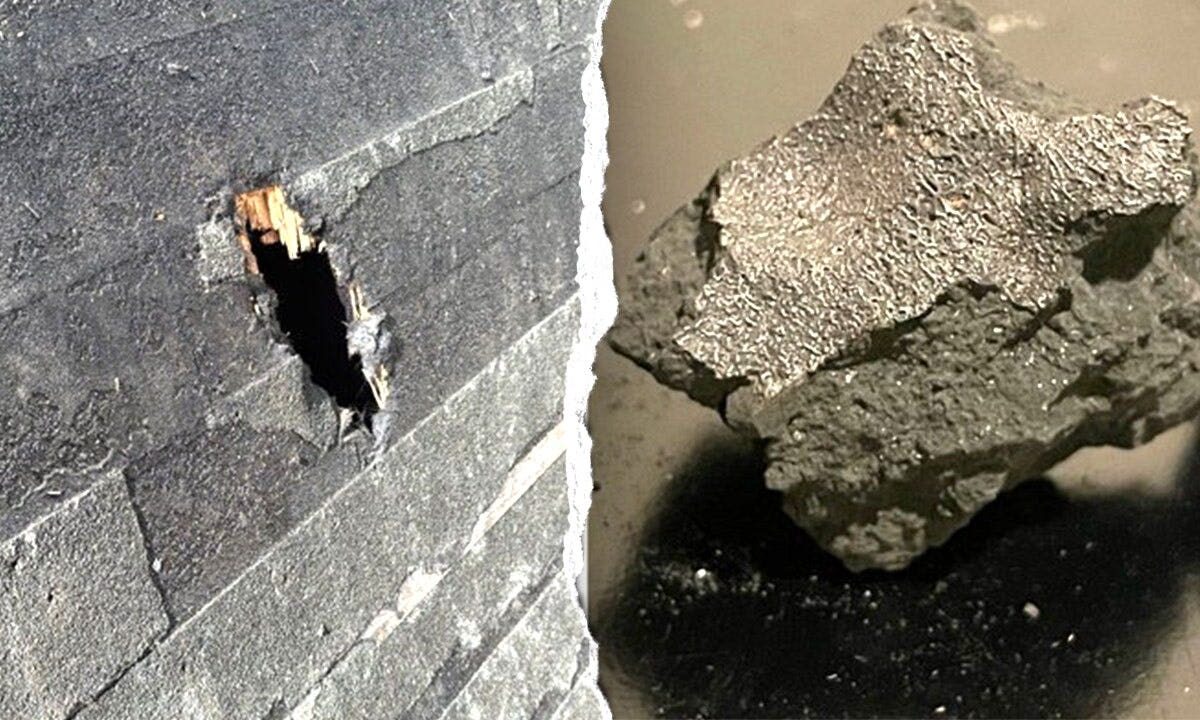
The Hillsborough meteorite crashed into a bedroom in Hillsborough, New Jersey, on July 16, 2024, leaving a hole in the ceiling, scattering fragments and damaging property. Homeowners described a “loud crash” when the rock struck; no one was injured. Photos show damage inside the Hillsborough home after the meteorite fall, and the witnessed, well-documented recovery gave scientists unusually clean material to study.
Observers and researchers secured fragments quickly, limiting terrestrial contamination and preserving fragile organics for analysis. That rapid chain of custody — including an amateur collector who handled pieces with gloves and stored fragments wrapped in aluminum foil and in glass — is central to the sample’s scientific value.
What happened in Hillsborough, New Jersey
On July 16, 2024, residents reported hearing a “loud crash” as the fireball streaked over the region. The rock pierced the roof and ceiling before coming to rest on a bed and carpet inside the bedroom, leaving black fragments and a sulfur-like smell described by the homeowner. Local responders confirmed there were no injuries but noted localized property damage where the meteorite struck.
Cameras and eyewitness accounts documented the fall immediately. That documentation allowed teams to secure the site and recover fragments within hours of the landing, an unusually quick recovery that helps protect sensitive chemical signatures from weathering and human contamination.
Hillsborough meteorite: what scientists found
Researchers report in Science Advances (published July 15, 2024) that the Hillsborough meteorite is an intermediate CM1/2 carbonaceous chondrite. That classification indicates a primitive, chemically rich rock that shows both very fresh, primitive components and signs of aqueous alteration — a combination that makes it valuable for studying early solar system chemistry.
Laboratory analyses identified a complex suite of amino acids and a variety of organic compounds in the recovered fragments. Danny Glavin, a co-author of the study and senior scientist at NASA’s Goddard Space Flight Center, called the diversity and complexity of the amino acids and associated organics a notable result. The team frames these findings as evidence that prebiotic compounds can be delivered to Earth by carbonaceous asteroid fragments, while emphasizing caution about any claims regarding life.
Scientists are careful to distinguish between detecting organic molecules and finding biological material. As Glavin noted in the study coverage, the presence of amino acids supports delivery of chemical building blocks relevant to prebiotic chemistry, not evidence of extraterrestrial biology.
Trajectory, camera footage and recovery
The fireball was recorded by networks and cameras monitored by the SETI Institute and the American Meteor Society. Mike Hankey of the American Meteor Society said cameras in Northford, Connecticut, and Douglassville, Pennsylvania, plus a doorbell camera in Wayne, New Jersey, captured the event; researchers used those multiple viewpoints to triangulate the path and measure its trajectory back toward a low region of the asteroid belt.
Those triangulation data let scientists estimate the meteorite’s pre‑entry orbit and probable source region in the asteroid belt. Observers and an amateur collector recovered fragments promptly; NASA indicates the amateur handled pieces with gloves and stored them wrapped in aluminum foil and in glass containers to reduce contamination — steps that preserve materials for contamination‑sensitive chemical and isotopic work.
Why this meteorite matters for early solar system chemistry
Because it was observed falling and recovered quickly, the Hillsborough meteorite preserves water‑altered minerals and delicate organic inventories that are often lost or altered in finds that sit on Earth’s surface for long periods. NASA notes that carbonaceous chondrites like this record chemical processes that occurred more than 4.5 billion years ago and can therefore provide direct evidence about the early solar system’s chemistry.
Peter Jenniskens, a meteor astronomer associated with NASA’s Ames Research Center and a co‑author on the study, said combining a well-documented fireball with rapid recovery lets scientists tie composition to origin. He said the work will help researchers “build one of the clearest pictures yet of how primitive asteroids such as the asteroid Erigone evolved chemically over billions of years.” Such comparisons are crucial for testing models of how organic molecules and water were processed on small bodies and redistributed across the inner solar system.
Next steps for study and preservation
Researchers plan further chemical and isotopic analyses to refine the molecular inventory and thermal history of the Hillsborough meteorite. Immediate priorities include more detailed amino acid characterization, chondrule and matrix studies to assess textural relationships, and isotopic work that can better constrain formation conditions and link the material to specific regions of the asteroid belt.
Teams at NASA laboratories, collaborators at the SETI Institute, and other research groups will run targeted analyses using contamination‑aware protocols. The already-documented preservation steps — gloved collection and storage in aluminum foil and glass — mean the sample can be revisited with improving laboratory techniques in years to come.
Scientists repeatedly stress measured conclusions: the detection of amino acids and organic compounds supports the idea that primitive asteroids can deliver prebiotic ingredients to Earth, but the results are not evidence of past or present life in the rock itself. Ongoing work will place the Hillsborough meteorite in context with other primitive samples to refine our understanding of chemical evolution on small bodies.
Source: Fox News — Meteorite that crashed into NJ home holds building blocks of life, scientists say. Study published in Science Advances, July 15, 2024.


