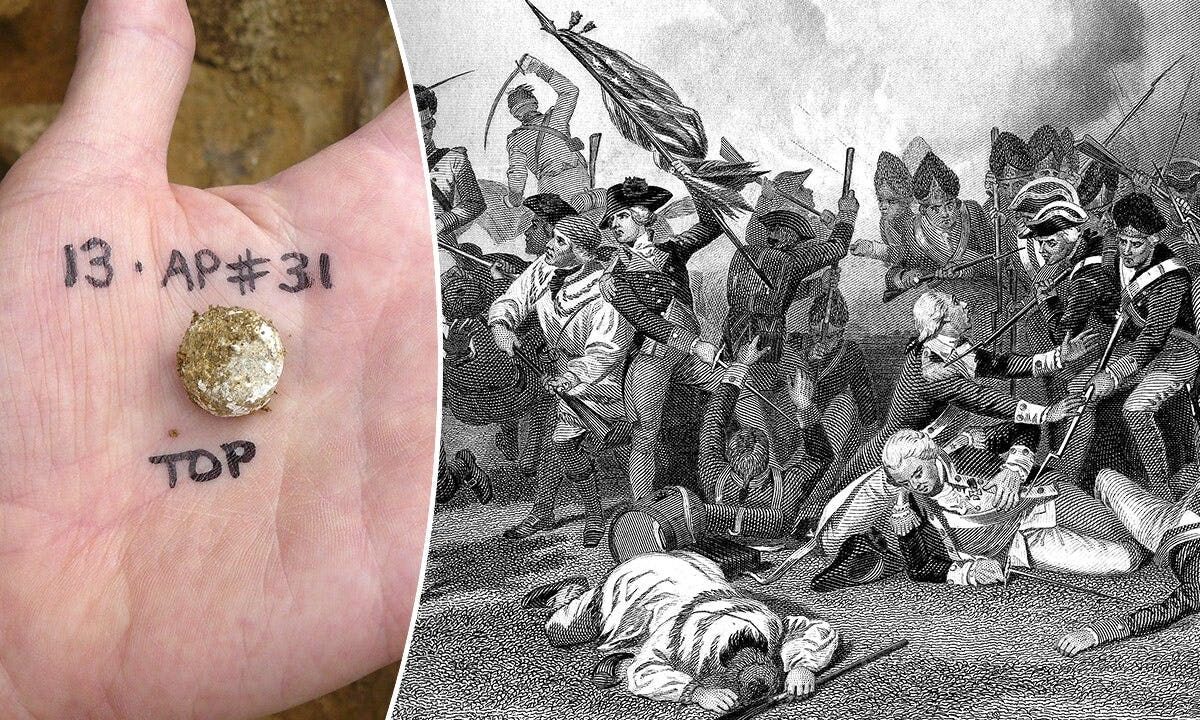
Researchers announced a likely identification of Revolutionary War remains as Private John Pumphrey using advanced DNA analysis and forensic genetic genealogy. The conclusion, reported in June, traces back to a very small piece of skull recovered from a mass grave at the Battle of Camden; project leaders say the evidence points to Pumphrey but acknowledge limits to absolute certainty.
The remains were uncovered during a University of South Carolina excavation in 2022 and were reburied with military honors in 2024. The case highlights how modern genetic tools, combined with archival research, can restore individual stories to large-scale military losses.
How researchers identified John Pumphrey
FHD Forensics led laboratory work on the case. Scientists used sensitive extraction methods optimized for degraded bone to recover genetic markers from a tiny fragment of skull. That genetic profile was then used in forensic genetic genealogy: genealogists built family trees from distant DNA matches and compared those trees to historical records to narrow candidates.
The chain of evidence the team describes includes laboratory DNA results, genealogical connections and archival records such as county documents and probate files. Allison Peacock, president of FHD Forensics, has described the process as one where laboratory science and archival research had to converge to reach the most likely identification.
Project leaders say this may be the first time a Revolutionary War soldier has been identified through DNA and forensic genetic genealogy; they qualify that claim as their understanding based on available records and note it has not been independently verified by a separate laboratory or outside body. That hedged wording reflects the unusual nature of applying modern forensic genealogy to 18th-century remains and the difficulties of proving identity beyond reasonable doubt across centuries.
Who John Pumphrey was
Genealogical research indicates John Pumphrey likely enlisted in 1777 as a youth, when he may have been roughly 13 to 15 years old, and died at the Battle of Camden on Aug. 16, 1780, at about 16 to 18. That age estimate is drawn from a mix of anthropological assessment and documentary records rather than any contemporary statement from Pumphrey himself.
The Pumphreys appear in county records from Anne Arundel County, Maryland, with ties to lumber, building and land ownership. Those details made the potential identification notable to historians: members of that social milieu were not always assumed to serve as teenage enlistees in frontline Continental units, though exceptions did occur.
Genealogists working with FHD Forensics also flagged complexities around probate and family movement that could help explain why a young man from a relatively prominent family ended up in a Southern campaign. Those lines of documentary evidence helped strengthen the genealogical case built around the DNA matches.
Why this identification matters
If confirmed through further review, the identification has two kinds of importance. Practically, it demonstrates that forensic genetic genealogy can sometimes reach back far beyond recent centuries to name individuals from early American conflicts. Historically, attaching a name, age and family background to one of the Camden dead changes how historians can think about recruitment, civilian-military ties and who fought in that engagement.
“We’re already rewriting the story of the battle,” Peacock said, noting that DNA and genealogy revealed personal details historians could not recover from battlefield records alone. Project leaders and collaborating historians emphasize caution, however: the claim that this is the first DNA identification of a Revolutionary soldier is presented as a qualified, project-level conclusion pending independent verification.
What comes next for Camden remains
Investigators are optimistic that additional Camden soldiers might be identified using the same combination of archaeology, laboratory sequencing and genealogical reconstruction. Success will vary: preservation of remains, the amount of recoverable DNA and the availability of genealogical matches all determine whether a chain of evidence can be built for another individual.
The 2022 excavation by the University of South Carolina recovered multiple sets of remains from what archaeologists believe to be a mass burial of Continental soldiers. Each skeleton presents distinct preservation challenges—soil chemistry, burial disturbance and the passage of time all affect DNA survival—so some remains will yield richer genetic data than others.
Scaling the work will require sustained funding, coordination between archaeologists and labs such as FHD Forensics, and cooperation from genealogical repositories and descendant communities. Project leaders say ethical considerations—respectful treatment, descendant consent where possible, and transparent reporting—will guide future efforts.
Expert reaction and historical context
Historians and scientists involved in or observing the project urge careful interpretation. While documented cases exist of young boys serving in Revolutionary forces, the identification of a specific teenager from Camden offers a rare, humanizing data point rather than a definitive demographic shift on its own. The combined genetic and documentary approach gives the team confidence, but experts note that independent review and replication are standard parts of scientific validation.
As a wider point, the Camden find underscores how battlefield archaeology and modern forensic methods can complement traditional historical sources to produce new narratives about well-studied events.
FAQs
How did scientists extract usable DNA from the remains?
Teams used protocols designed for highly degraded bone: strict contamination control, specialized chemical extraction, and sensitive sequencing methods. Small internal skull fragments can sometimes preserve DNA better than larger, exposed bones.
Was John Pumphrey really a teenager when he enlisted?
Researchers estimate he enlisted in 1777 at about 13 to 15 and died in 1780 at roughly 16 to 18. Those ages are inferred from osteological analysis and historical records rather than a signed enlistment document from Pumphrey himself.
Can other Revolutionary War soldiers be identified the same way?
Potentially. The same forensic genetic genealogy techniques can help identify other remains from Camden and similar sites, but success depends on DNA preservation, the presence of genealogically informative matches, and funding for detailed laboratory and archival work.
Source and credits: Primary laboratory work and genealogical analysis were led by FHD Forensics (Allison Peacock). The excavation that recovered the remains was conducted by researchers at the University of South Carolina in 2022. Initial public reporting on the identification appeared in Fox News: Fox News. The project’s characterization that this identification “may be the first” of a Revolutionary War soldier by DNA comes from the FHD Forensics team and has not been independently verified by a separate institution, according to project statements.