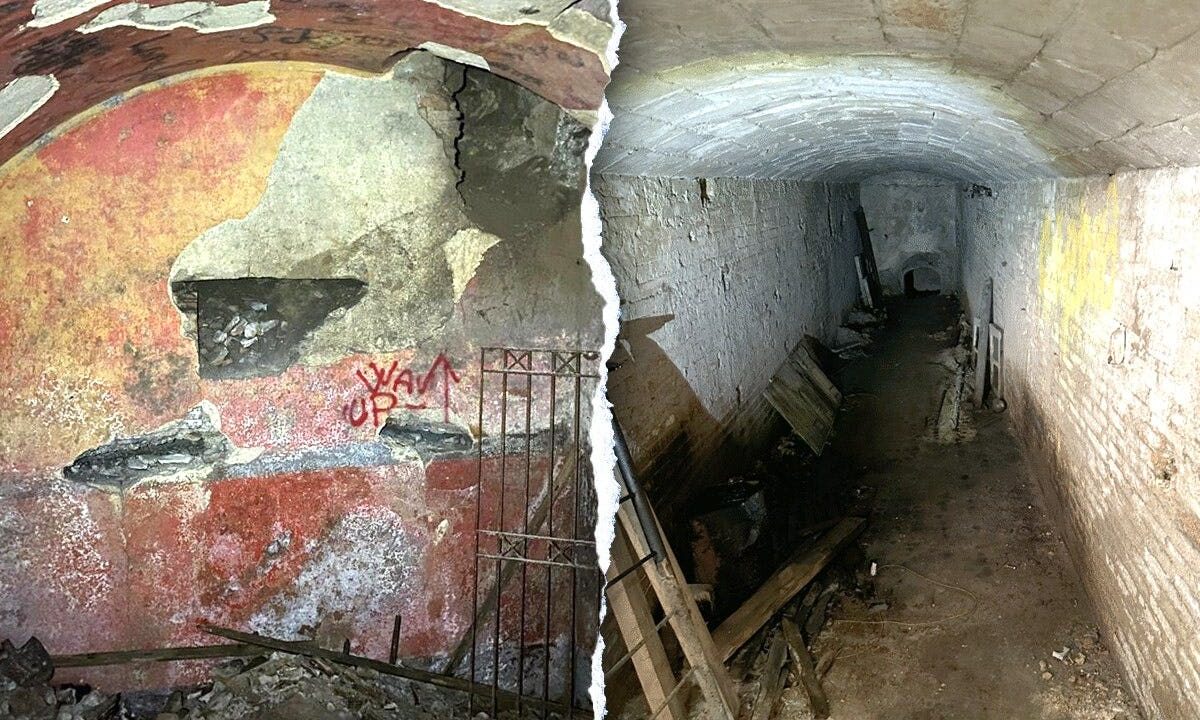
Rome, June 26, 2026 — Archaeologists have revealed the remains of an Ancient Roman villa beneath the gymnasium of Cavour High School, a short walk from the Colosseum. Officials say the domus was uncovered “by chance” and that work to remove later fill began in January 2026 as a preparatory step for a formal excavation.
The disclosure, shared with teachers and students in early June, shows a series of vaulted rooms with faded frescoes, decorative plasterwork and traces of 20th-century graffiti. Rome’s Special Superintendency is overseeing the site and coordinating initial conservation assessments.
Ancient Roman villa discovered under Cavour High School
The domus — an upper-status Roman house — was revealed beneath the school’s gymnasium after staff reported accidental finds to Rome’s Special Superintendency. Officials described the discovery as occurring “by chance” and released images that display structural vaulting and painted wall surfaces consistent with domestic architecture.
The find lies within one of the capital’s most archaeologically dense neighborhoods, where ancient remains often surface during repairs and construction. Archaeologists stressed that the currently exposed remains represent only a portion of the building and that systematic excavation is required to reveal its full extent and date.
What archaeologists found inside the villa
Photographs and statements from the Special Superintendency describe a sequence of vaulted rooms, plastered wall surfaces and fragments of fresco decoration. Decorative plasterwork survives in places but much of the area is interrupted by rubble and later intrusions that complicate the plan.
Conservators reported faint pigments on plaster, suggesting painted wall schemes typical of domestic interiors. Alongside ancient finishes, modern graffiti dated to the 1940s and 1950s appears on some surfaces, indicating 20th-century access to the subterranean spaces.
Archaeologists cautioned that the images released so far show only exposed faces; intact contexts may still lie under layers of fill. Careful stratigraphic excavation, recording and laboratory analysis will be necessary to interpret the frescoes, mortar composition and the sequence of reuse.
“Ten years ago, a student told me the story, but I didn’t give it much thought,” said Claudia Marino, a history and Latin teacher at Cavour High School. “When it was over, a group of students told me, ‘There really is something under the school.'”
How the discovery came to light
The school issued a statement saying the ruins were discovered “by chance” beneath the gym. Staff members reported incidental finds over the years to Rome’s Special Superintendency, and recent checks prompted by maintenance and safety work led to a focused assessment.
Marino and colleagues say they opened a locked iron door in the basement during an inspection and encountered ancient walls and vaulted spaces that engaged school interest and helped prompt formal archaeological review. That review led to the intervention in January 2026 to remove modern fill and expose surviving architectural elements.
Plans for excavation and public access
Work to clear recent deposit began in January 2026 to permit archaeological excavation. The Special Superintendency is coordinating fieldwork, which remains subject to further conservation, structural and safety evaluations. Officials emphasize that the project is ongoing and that timetables are tentative.
School and heritage officials have indicated an intention to eventually open the site to the public, with students participating as guides. Those aims are presented as long-term goals rather than finalized plans: no firm opening date has been published and any public access will depend on stabilization, environmental controls and secure visitor routing.
Conservators must assess structural stabilization, moisture control and safe circulation before opening subterranean spaces to visitors. Rome’s dense urban stratigraphy and the presence of modern construction above the villa add logistical complexity, and planners say staged access — including guided visits for students and limited public tours — is under consideration if conservation needs are met.
This find in the context of recent Rome discoveries
The Cavour High School villa adds to a sequence of noteworthy urban finds in recent years. Authorities have pointed to earlier discoveries near the Colosseum and remains unearthed during construction of Rome’s Metro Line C, where excavations revealed multi-storey ancient buildings and extensive domestic complexes.
Excavations on Palatine Hill and other central sites have continued to refine understanding of urban life in antiquity while underscoring conservation challenges. Bringing fragile substructures into public view requires long-term investment in documentation, restoration and visitor management — a pattern reflected in the cautious approach officials are taking at Cavour High School.
Background and next steps for researchers
Preliminary assessments note features typical of a domus, but researchers say comprehensive study is needed to determine chronology, function and connections to nearby Roman-period streets and buildings. Planned work includes stratigraphic excavation, pigment analysis, material sampling and detailed architectural recording.
Officials have involved students and teachers in site visits and presentations, and archaeologists say they will publish formal results after fieldwork and analysis are complete. For now, access is restricted while specialists assess conservation needs and safety risks; any timeline for opening remains unconfirmed and subject to change.
FAQ
Can the public visit the Ancient Roman villa now?
No. Authorities say the site is under archaeological work and conservation assessment. Plans to open the villa to the public with students serving as guides are intentions, not a confirmed schedule.
How was the Ancient Roman villa discovered beneath the school?
The school said the domus was found “by chance.” Staff reported accidental discoveries over the years to Rome’s Special Superintendency. Teacher accounts and recent inspections led to checks that revealed the ruins.
What do the frescoes and 1940s graffiti tell archaeologists?
Faded fresco fragments and decorative plasterwork provide evidence of original interior finishes, while graffiti dated to the 1940s and 1950s shows later human activity in the subterranean spaces. Archaeologists say detailed study is required to interpret both the ancient decorative program and subsequent reuse patterns.
Source: This report is based on material published by Fox News. For more detail see the original Fox News article: Ancient Roman villa beneath high school gym reveals stunning secret from the past.