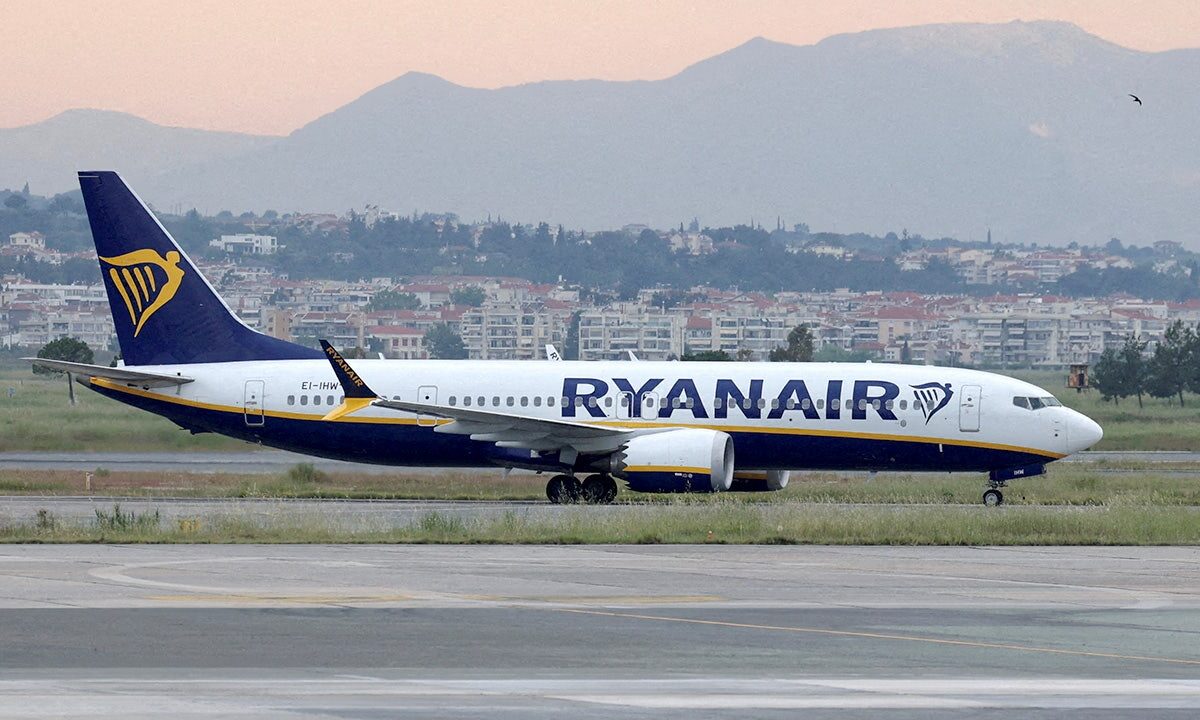
Ryanair said early findings point to foreign object damage after a piece of a Boeing 737 engine separated and struck a cabin window shortly after takeoff from Thessaloniki on July 10. The airline emphasized the assessment is preliminary while investigators from the U.S. National Transportation Safety Board and the Federal Aviation Administration examine parts, flight data and maintenance records.
The plane lost cabin pressure and made an emergency return to Thessaloniki. Flight-tracking data and statements from authorities show the crew descended and circled to burn fuel before landing safely about an hour after departure. Officials and the airline have repeatedly cautioned that conclusions are provisional.
What happened on the Thessaloniki flight — foreign object damage
Video shared publicly, aviation footage and regulatory statements indicate a fragment of the Boeing 737’s engine separated shortly after takeoff and struck a cabin window, causing a rapid loss of pressure. Flightradar24 tracking data shows the flight climbed past 15,000 feet within minutes of departure, then descended to roughly 6,000 feet while the crew followed emergency procedures and burned fuel prior to returning to the airport.
Passengers and crew helped manage the inflight emergency. Eyewitness video and FAA comments say debris from the engine struck the cabin window, creating a breach that led to cabin depressurization. The crew declared an emergency, descended to a safer altitude for breathing without oxygen masks and returned to Thessaloniki for an expedited landing.
Ryanair CEO statement and early findings — foreign object damage
Ryanair CEO Michael O’Leary told analysts the airline’s initial view is that the event “looks like a foreign object damage to the engine on takeoff at Thessaloniki,” but he stressed that the observation is an early assessment and not a definitive determination. Ryanair reiterated investigators must complete technical analysis before a final cause is assigned.
O’Leary noted the aircraft was delivered to Ryanair in 2008 and is 18 years old, and said the engine had undergone servicing and overhaul work within the past two years. The airline framed those technical remarks as part of preliminary information provided while evidence is being reviewed by investigative authorities.
Passenger injuries and inflight response
The sudden depressurization led to a passenger being partially expelled through the breached window before other travelers and his wife were able to pull him back into the cabin. The 61-year-old man was taken to hospital with neck and shoulder injuries and friction burns. Ryanair said cabin crew followed emergency procedures and coordinated with fellow passengers to help restrain and care for the injured person until emergency services met the aircraft on the ground.
Crew actions included an emergency descent and a controlled return to Thessaloniki. Passengers reported alarm and chaos in the immediate aftermath, followed by systematic assistance from flight attendants trained for such incidents. The quick actions of crew and other passengers were credited with preventing a worse outcome.
Investigations under way and draft report timing
The National Transportation Safety Board has taken a technical lead role in examining engine components, the separated fragment, and the damaged cabin structure, with the Federal Aviation Administration and Greek authorities participating. Investigators will analyze metallurgical samples, maintenance logs and flight data recorder output to determine whether an external object, mechanical failure or other factor led to the separation.
Ryanair said it expects a draft report in under a month, and officials from involved agencies have said formal findings take time as laboratory testing and component examinations proceed. All parties involved have reiterated that preliminary observations should not be treated as final conclusions until the investigative authorities publish their results.
What comes next for regulators and carriers
Investigators will scrutinize Boeing technical records, the engine’s servicing history and any available surveillance or runway inspection footage that might indicate debris or foreign objects in the takeoff area. If foreign object damage is confirmed, investigators will examine whether it stemmed from runway debris, a ground-service issue, bird strike, maintenance oversight, or some other cause.
Potential implications include recommendations for operators on inspection intervals, runway foreign object debris programs, and possible scrutiny of parts and maintenance practices. Boeing, Ryanair and regulators typically await the NTSB’s technical analysis before changes are recommended; the NTSB’s formal findings and safety recommendations will shape any regulatory or industry response.
Key takeaways
Early airline statements point to foreign object damage as a likely cause, but that view is provisional and subject to confirmation by technical investigators. The aircraft returned safely to Thessaloniki and one passenger was hospitalized after being partly ejected and rescued by fellow travelers. The NTSB and FAA are involved in laboratory analysis and a draft report is expected within weeks, though final findings may take longer.
Findings in this article are based on initial airline statements, publicly available flight-tracking data and reporting from news organizations; investigators emphasize that results are preliminary pending completion of the formal probe.
Source: Reporting and statements compiled from Reuters and Fox Business reporting; investigation led by the National Transportation Safety Board with technical participation from the Federal Aviation Administration and Greek authorities.