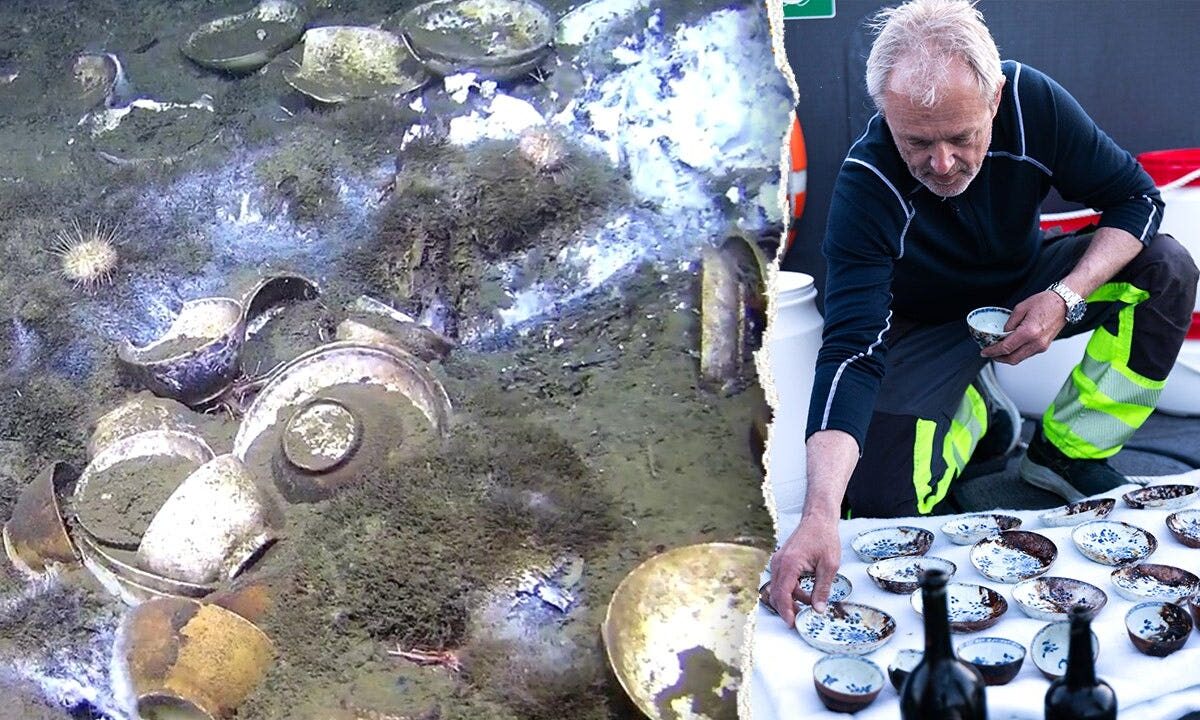
Archaeologists have identified an 18th-century shipwreck about 1,970 feet below the surface of the Skagerrak Strait, revealing unusually well-preserved cargo that includes large amounts of Chinese porcelain.
Recovered cargo items include intact Chinese porcelain and other luxury goods visible in seabed footage. The discovery is being treated as a protected underwater cultural heritage site while specialists assess what remains sealed in crates on the wreck.
18th-century shipwreck: cargo and condition
Remote imagery of the site shows stacks of dishes and plates that appear to be Chinese porcelain laid out on the seabed.
Observers also reported chandeliers, goblets and bottles amid the debris field. Photographs and video indicate much of the material sits in recognizable groupings rather than scattered wreckage.
“The cargo is very well-preserved, considering how old it is,” said Hanna Geiran, director of the Norwegian Directorate for Cultural Heritage. “It is unlike anything previously documented in shipwrecks in Northern Europe.”
Geiran cautioned that the exact condition of artifacts that remain inside crates is unknown until conservators can examine them in controlled conditions.
What else was on board
Investigators documented barrels that appear to contain grain, along with bottles and varied tableware in the visible sections of the wreck.
Rows of stacked crates are visible in the survey footage but have not been opened. Researchers say some crates show signs that their contents could include textiles or organic material.
Geiran said researchers suspect some crates may hold tea, dried herbs or medicines, but she emphasized those identifications are tentative. “We need conservation and sampling to confirm what is inside,” she said.
Because organic material can survive in cold, low-oxygen seabed environments, the unexamined crates may contain fragile but informative items. Specialists will prioritize non-destructive sampling where possible.
Clues to origin and age
One tangible clue from the site is a brick stamped “Luebecker Ratsziegelei,” a mark connected with production in Lübeck.
The Luebecker Ratsziegelei stamp helps bracket the likely period of the cargo: the brickworks was active historically up to around 1772, which is consistent with an 18th-century date for the assemblage.
Geiran and other investigators say the porcelain itself appears to be Chinese by style, but where the ship came from or where it was headed remains unclear.
“Besides the Chinese porcelain, we think that some of the luxury goods might have come via England or Germany,” Geiran said, adding this is a working hypothesis rather than a confirmed trade route.
Surveyor Espen Saastad, who provided the initial footage that led to the Directorate’s investigation, described the find cautiously. “We found concentrations of stacked ceramics and crates where we did not expect them,” Saastad said. “But the exact origin and full contents will only become clear after careful analysis.”
Site condition and threats
Despite the largely intact appearance of many objects, the site shows evidence of damage from modern trawlers.
Investigators observed torn nets and disturbed sediment near parts of the wreck. Those signs suggest continuing fishing activity could threaten exposed material.
Rows of crates remain unexamined; leaving them sealed can help preserve organic contents but also delays knowledge about what they contain. Officials say they will weigh the risks of in situ preservation against the benefits of recovery for research and conservation.
What comes next and public display
Conservation teams from national heritage agencies and specialist conservators will assess recovery options. The work is expected to be slow, careful and staged to avoid damage.
Items that are fragile or that contain organic material will likely undergo stabilization at secure conservation facilities before any public display.
Officials say conserved objects will be prepared for exhibition at the Norwegian Maritime Museum in Oslo when it is appropriate. “We are very pleased that this amazing find will be available for everyone to see when it is eventually exhibited at the Norwegian Maritime Museum in Oslo,” Geiran said.
The Norwegian Maritime Museum is coordinating conservation planning and will work with maritime archaeologists to determine exhibition timing. For museum information and updates, see the Norwegian Maritime Museum website.
Expert reaction
Specialists in maritime archaeology describe the discovery as a rare opportunity to study 18th-century trade and material culture in a largely intact context.
Saastad noted the value of imagery and careful surveying before any physical intervention. “High-resolution survey data helps us plan recovery without causing unnecessary disturbance,” he said.
Geiran emphasized cultural protection. “Today, the wreck’s greatest value lies in its status as a protected cultural monument rather than its monetary worth,” she said, underlining the priority of preservation and research.
FAQ
How old is the shipwreck and how deep was it found?
Evidence such as the stamped brick points to an 18th-century date range, with the brickworks’ activity ceasing around 1772. The wreck has been located at approximately 1,970 feet (about 600 meters) depth in the Skagerrak Strait.
What did archaeologists find inside the crates?
At this stage, investigators have visually identified large quantities of Chinese porcelain, chandeliers, goblets, bottles and barrels of grain on the seabed. Some crates appear to contain textiles or organic material that could include tea, herbs or medicines, but these are tentative assessments pending conservation and sampling.
When and where will the finds be displayed for the public?
Conserved items are planned to be exhibited at the Norwegian Maritime Museum in Oslo, but exact timing will depend on the pace of conservation, research and legal protection measures.
Source and credits
Reporting and initial seabed footage from Espen Saastad prompted the investigation. Key institutions involved: Norwegian Directorate for Cultural Heritage and the Norwegian Maritime Museum. Additional survey and reporting sources include published coverage of the discovery.
Primary credited parties: Norwegian Directorate for Cultural Heritage; Norwegian Maritime Museum; Espen Saastad.