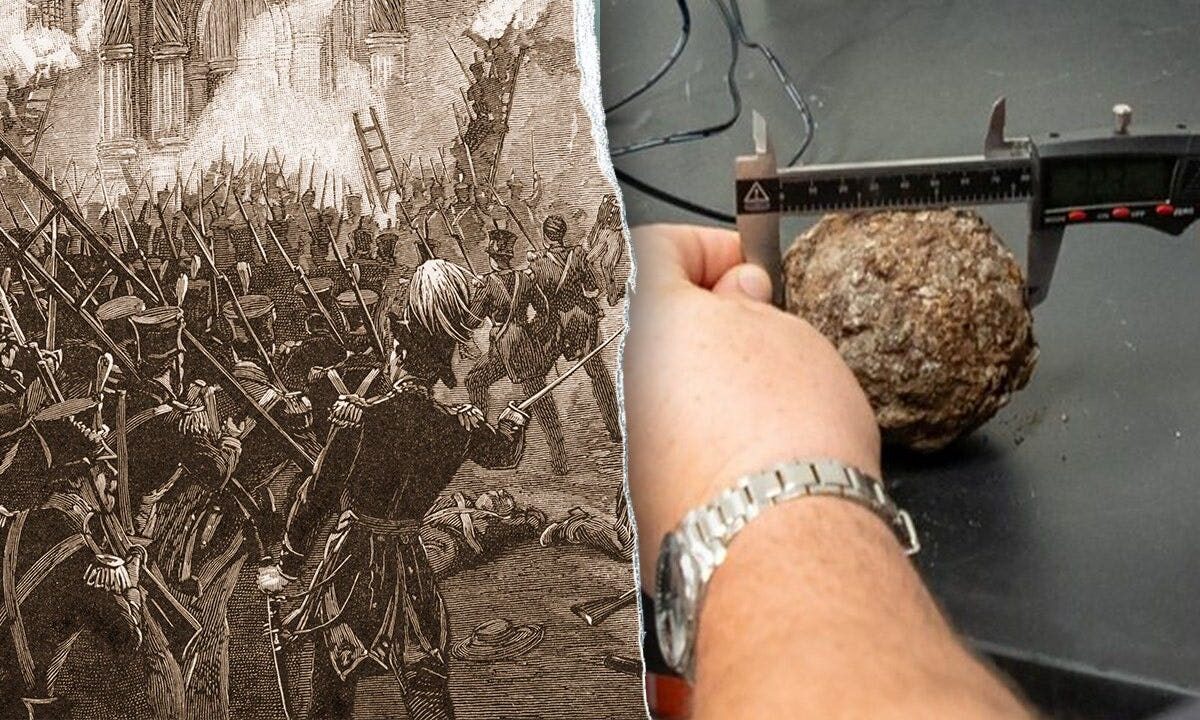
An Alamo cannonball was uncovered June 2 just outside the northeast corner of the Alamo Church, the Alamo Trust said in a June 16 announcement. The solid iron shot appears orange-brown from heavy rust in site photos and was recovered from a unit adjacent to a bronze cannonball found in March. Because both were at roughly the same depth, archaeologists say the pair may have lain undisturbed since around the time of the 1836 siege.
What archaeologists found: Alamo cannonball condition and context
The newly revealed object is a solid iron cannonball. Photographs released by site staff show a heavily corroded surface with orange-brown oxidation typical of iron left in soil for long periods. Site archaeologists reported the iron ball was recovered from an excavation unit immediately next to the March recovery of a solid bronze cannonball, which retained clearer surface detail by contrast.
Archaeology staff emphasized the difference in preservation between the two shots, noting metal type drives long-term survival. “The bronze example had clearer surface detail, while the iron ball isn’t as well-preserved as the first due to the type of metal,” Tiffany Lindley, director of archaeology at the Alamo, said in the announcement. The adjacency and similar depth of the two finds is what led staff to propose the objects may have been undisturbed since the early 19th century.
Where it was found at the Alamo
Field notes and the Alamo Trust statement place the iron cannonball outside the northeast corner of the Alamo Church, recovered from a discrete excavation unit next to the March bronze find. Excavation records indicate both objects were encountered within the same stratigraphic level, which archaeologists interpret as a promising sign the local soils have not been heavily mixed by later construction or large-scale disturbance in that immediate area.
That alignment in depth is an important contextual clue but not proof of a battlefield origin. Archaeologists caution that intact context can indicate long-term burial but does not by itself identify exactly when or how an object arrived where it was found.
Why the find may matter for Battle of the Alamo research
The presence of two intact cannonballs in adjacent units could provide new insight into the 13-day siege that ran Feb. 23 to Mar. 6, 1836. If laboratory analysis and close contextual study support a mid-1830s deposition, the shots could help researchers refine maps of firing positions, identify probable cannon types used at the Alamo, and contribute to a more detailed picture of combat and occupation on the mission grounds.
Beyond battlefield questions, the finds feed research into the daily lives and material landscape of people at the Alamo. Excavations routinely recover nails, brick fragments, personal items and building materials; when combined with rarer military objects, these materials help archaeologists reconstruct patterns of living space, supply, and maintenance that shaped how the mission functioned before, during and after 1836.
Independent archaeologists generally advise caution: context matters more than a single object. Without laboratory confirmation, multiple specialists say it would be premature to make firm claims about exactly when the cannonballs were deposited or whether they were fired during the battle itself.
Conservation and next steps
Alamo Trust officials said both the iron and bronze cannonballs will be sent to professional conservators after the excavation season ends. Lindley said the plan is to stabilize and preserve the objects before performing detailed analyses. “We are hoping to send both artifacts off for conservation,” she said, adding that interpretation will follow careful laboratory work and context study.
Conservators typically remove loose corrosion, desalinate iron artifacts, and apply stabilizing treatments that allow scientists to carry out non‑destructive tests. Researchers expect to use a combination of visual microscopy, elemental analysis such as X-ray fluorescence (XRF) where appropriate, and metallurgical study to learn about alloy composition and manufacturing marks. Those analyses can reveal where a shot was cast, whether it was repaired or modified, and how soil chemistry affected its preservation.
Only after conservation and lab work can teams make stronger statements about age, origin and battlefield use. The Alamo Trust has been explicit that claims about dating and battlefield attribution are provisional until those studies are completed.
Background: Battle of the Alamo in brief
The Battle of the Alamo, fought from Feb. 23 to Mar. 6, 1836, ended when Mexican forces overran Texian defenders after a 13-day siege. Notable defenders included Davy Crockett and William B. Travis. The event is central to accounts of the Texas Revolution and remains a focal point for historical and archaeological inquiry at the former mission site in downtown San Antonio.
The Alamo site has a long occupation history and has seen later development, including use by the U.S. military and commercial activities, which disturbed some deposits across the grounds. The excavation team stressed that while much of the site has experienced disturbance, the immediate area around the northeast corner appears to have retained intact deposits that can yield meaningful data once the artifacts are conserved and analyzed.
For now, researchers are treating dating and battlefield attribution as preliminary. The assessment that the iron shot “likely remained undisturbed for nearly 190 years” is based on archaeological context rather than independent laboratory dating, and officials have not asserted a definitive firing date.
Source attribution: Reporting and the site statement by the Alamo Trust form the basis of this article. Quotations and specifics about the excavation come from the Alamo Trust announcement and Tiffany Lindley, director of archaeology at the Alamo. Additional context about standard conservation and analysis methods is descriptive of common professional practice and not meant to assert completed laboratory results. Original reporting: https://www.foxnews.com/travel/rare-cannonball-emerges-from-ground-alamo-likely-untouched-nearly-190-years