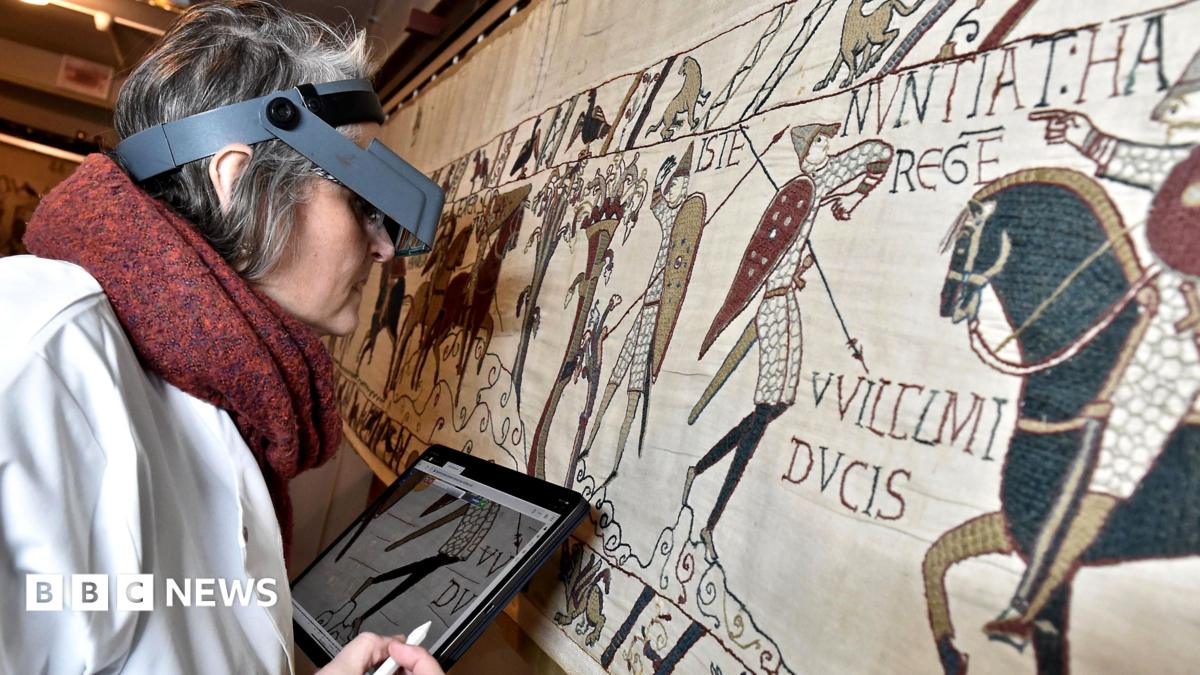
The Bayeux Tapestry is an 11th-century embroidered narrative that many readers use to visualise the lead-up to the Norman conquest of England. In short panels it stitches together a sequence of events often read as showing William the Conqueror’s contested claim to the English throne and the campaign that ended at Hastings.
This explainer highlights five key scenes from the tapestry, describes what each panel shows, and sets out how historians treat the cloth as a partial, framed account rather than an undisputed chronicle.
Quick overview: what the Bayeux Tapestry shows
The Bayeux Tapestry is a long embroidered cloth, made in the medieval period, that runs through a linear series of images and short Latin captions. It presents episodes in Normandy, the crossing of the English Channel and the fighting in England that culminates at Hastings.
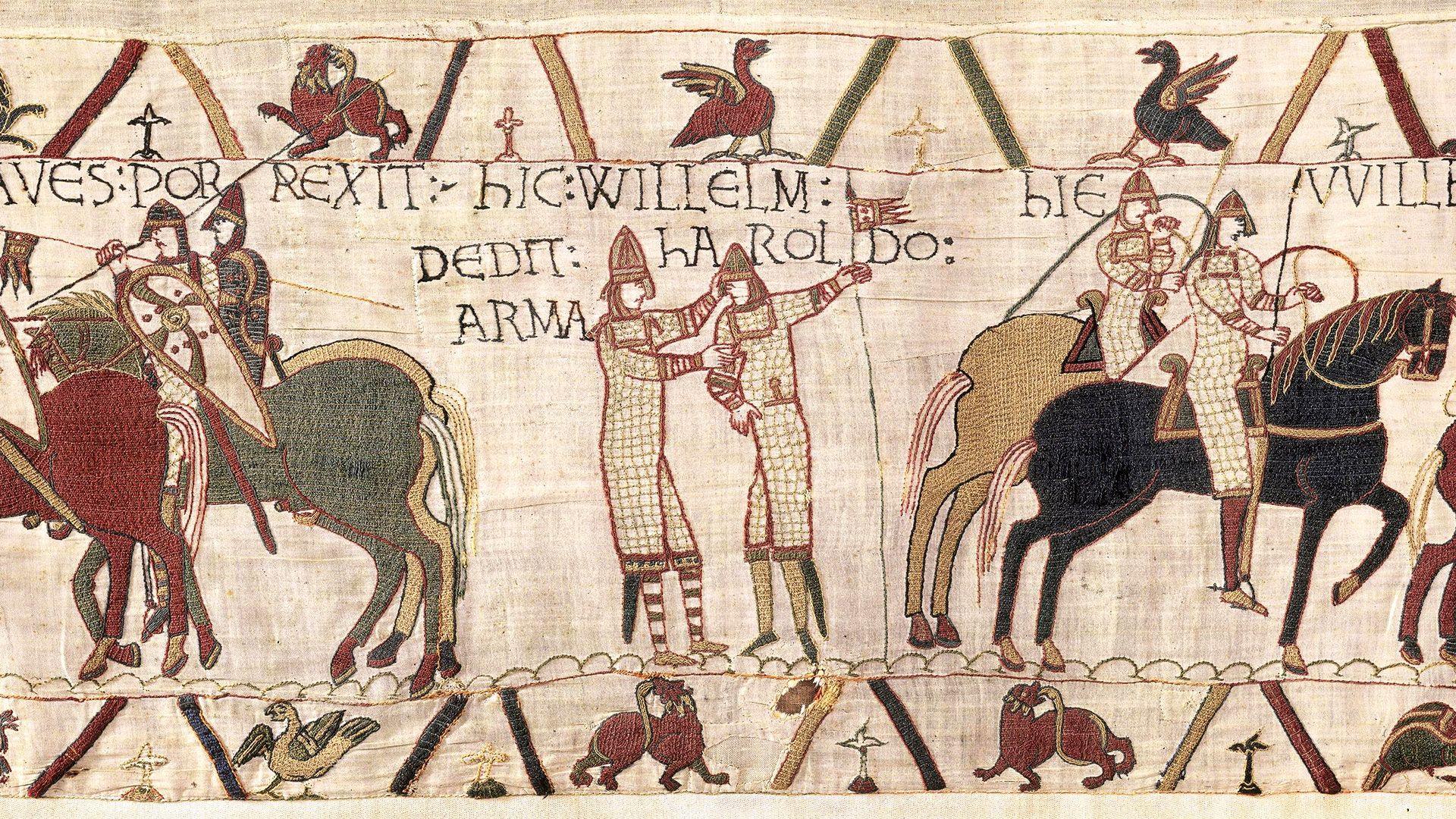
Scholars generally date the work to soon after 1066. It combines material detail — clothing, ships and weapons — with selective emphasis on particular people and moments. As such, it functions as both visual record and a crafted narrative reflecting the priorities of its makers and likely patrons.
Scene 1: The claim to the throne
The opening key panel sets out the central political dispute. The tapestry introduces figures connected to William the Conqueror and to Harold, using gestures, labels and composition to present a contested transfer of authority.
In this scene, captions and posture imply that William had a claim to the English throne and that Harold’s position was disputed. The tapestry foregrounds that claim as the reason for the campaign that follows, framing the rest of the work around a succession crisis.
Scenes 2-4: key moments on the road to Hastings
The middle of the tapestry compresses travel, diplomacy and mobilisation into vivid, sequential panels. These tapestry scenes concentrate on the practical steps that made the invasion possible: shipbuilding and loading, moving troops, and local encounters along the route.
One panel shows Norman ships prepared for crossing the Channel; another depicts men gathering and organising; a third records skirmishes and captures that reveal how control of men and money mattered. The tapestry’s pictorial economy means whole episodes are suggested in a few details, so each board of images functions as a shorthand for larger logistical efforts.
Scene 5: The battle and its depiction
The tapestry’s final large sequence is dominated by the battle scene commonly interpreted as Hastings. It shows dense groups of armed men, standards and the fallen; name labels and gestures help viewers identify prominent participants.
The cloth draws attention to King Harold in the fighting and to the chaos of battle. Different readings of the scene have produced debate: some elements are consistent with Harold falling in combat, while other features may be symbolic or conventional ways of showing defeat. Describing this sequence as a medieval “game of thrones” is a modern metaphor used to convey dynastic rivalry; it is not a contemporaneous label and should be understood as editorial framing.
How historians read the Bayeux Tapestry
Historians treat the Bayeux Tapestry as an important but partial source. It makes an asserted claim about the causes and course of events: the narrative privileges William’s perspective and may have been intended to justify or celebrate his position.
Researchers cross-check the tapestry against written chronicles, material finds and later narrative traditions. Where the tapestry gives concrete detail — dress, ship forms or weaponry — it can illuminate material culture. Where it makes claims about motives, decisions or precise sequences, scholars remain cautious and seek corroboration from independent evidence.
Calling the tapestry a form of propaganda captures how narrative choices shape meaning. Using contemporary scholarship alongside the images helps separate what the cloth shows from what it asserts.
Why it matters today
The Bayeux Tapestry endures because it combines striking imagery with a political story that still captivates audiences. It offers a rare visual window into how near-contemporary makers represented power, legitimacy and warfare in the 11th century.
Its public impact is wide: the tapestry is central to museum displays, educational narratives and popular accounts of 1066. Debates about interpretation also show how historians, curators and the public negotiate evidence and meaning in the study of medieval history.
FAQ
What is the Bayeux Tapestry?
The Bayeux Tapestry is an 11th-century embroidered cloth that tells a sequence of events associated with the Norman conquest of England via images and captions.
Does the tapestry prove William killed Harold?
No. The tapestry depicts scenes interpreted as showing Harold’s death, but historians treat it as one piece of evidence among many. Its narrative framing and biases mean it does not function as conclusive proof on its own.
Where can I see the Bayeux Tapestry today?
The tapestry is conserved and exhibited in or near Bayeux in France. Check museum listings and schedules before planning a visit.
Source: BBC News — Five key scenes from the Bayeux Tapestry, and the story they tell.