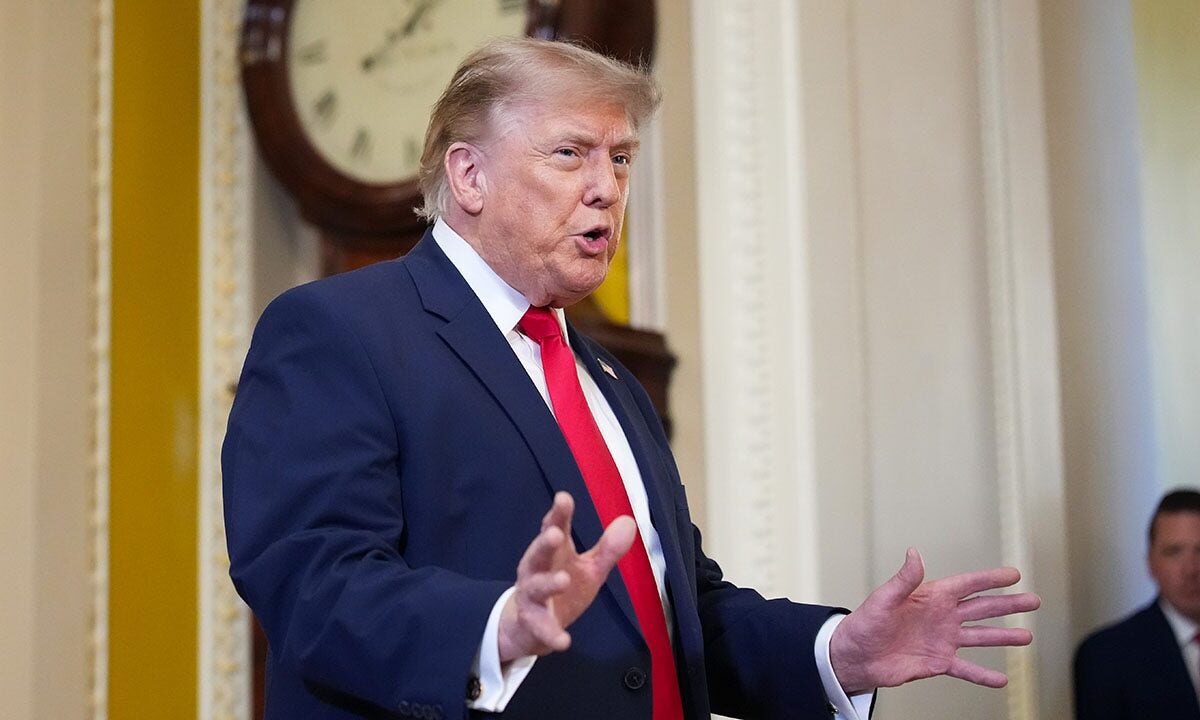
Donald Trump Iran: President Donald Trump opened a radio interview by accusing “fake news” of rooting for the United States to lose a conflict with Iran, and he warned American forces would “hit them very hard” in the days ahead — specifically naming Pickaxe Mountain as a possible target. Speaking with Hugh Hewitt, Trump framed his remarks as both a rebuke of The New York Times and as justification for continued U.S. military pressure in the region.
Donald Trump Iran: what he said
In the interview, Mr. Trump accused what he called the “fake press” of wanting the U.S. to fail against Iran, singled out The New York Times by name and reiterated a contested inflation claim — that Iranian inflation had risen to “301% from 5%” — which he attributed to press reporting without citing a specific article. He warned: “We’re going to hit them very hard tonight, and we’re going to hit them hard tomorrow,” and said U.S. surveillance was monitoring activity near Pickaxe Mountain.
Those quotes were presented as the president’s assessment and political framing rather than as independently verified facts. The interview, broadcast by radio host Hugh Hewitt, was used by Trump to press his narrative about media coverage and to justify stepped-up operations in the region.
Threats and potential targets including Pickaxe Mountain
Trump named Pickaxe Mountain — described in prior reporting as a heavily fortified, deeply buried complex near the damaged Natanz enrichment site — as a potential target for a “nice big fat shot right near the front door.” Prior Reuters reporting notes the site includes multiple tunnel entrances and deep-buried facilities; analysts cited by Reuters say some such tunnels may be difficult to penetrate even with advanced bunker-busting munitions.
The president also reiterated a view, framed as his assessment, that if Iran ever obtained a nuclear weapon it would be used quickly — a claim presented as his opinion and not as an intelligence community consensus in the public record. Reporting to date does not confirm resumed nuclear operations inside Pickaxe Mountain; access for outside inspectors remains limited.
U.S. military moves and the resumed blockade
U.S. Central Command announced a resumption of a maritime blockade of vessels heading to and from Iranian ports while saying humanitarian shipments would be allowed. Central Command framed the move as a security measure tied to recent attacks and maritime risks in the region and warned that noncompliant ships could face forceful interdiction.
The Central Command statement cited in news coverage emphasized rules of engagement and the allowance for humanitarian traffic but did not spell out all operational details. The announcement and its enforcement will be important to monitor for how strictly vessels are inspected and how the blockade is managed with allied partners and commercial shippers.
Claims vs verification
Several of the president’s assertions remain unverified in open-source reporting and should be read cautiously. Trump did not cite a specific New York Times article to support his inflation or military-strength claims; the 301% inflation figure was presented as his citation rather than as an independently corroborated statistic. Reuters and other outlets have not confirmed that exact inflation number as a current, verified figure.
On Pickaxe Mountain, Reuters analysis has reported vehicle activity near tunnel entrances at times but has not confirmed nuclear development inside the complex. The International Atomic Energy Agency has reportedly not been granted access to the site, which limits external verification. Those caveats mean claims about nuclear operations or their absence rest largely on classified assessments and U.S. surveillance statements rather than open-source confirmation.
Expert context and risk of escalation
Experts who have commented in reporting warn that deeply buried facilities pose serious targeting challenges and that even advanced bunker-busting weapons have limits against certain hardened complexes. Those technical constraints, noted in Reuters coverage, complicate claims that such sites can be cleanly neutralized by a single strike.
Analysts also caution that public threats increase the risk of miscalculation or escalation in an already tense theater. Announcing potential targets publicly can compress decision timelines, influence adversary behavior and heighten pressures on commanders who must weigh collateral effects, allied reactions and the possibility of retaliatory strikes.
What comes next and what readers should watch
Near term, readers should monitor official Central Command updates for clarification of the blockade’s scope, enforcement rules and whether the U.S. will publicize additional evidence of hostile activity. Satellite imagery releases, additional Reuters analyses of site activity and any IAEA statements on access to Natanz or nearby complexes will be key to verifying claims about underground activity.
Watch also for any named Times reporting that Trump referenced; he did not point to a specific article in the interview. Independent confirmation of economic figures and of any resumed nuclear work would materially affect assessments of threat and policy justification.
Finally, expect scrutiny from allied partners and international organizations: how they respond to both the blockade and public targeting threats will influence diplomatic and operational options in the weeks ahead.
Sources: Fox News reporting on the Hugh Hewitt interview and related developments (Fox News); Reuters analysis of site imagery and technical assessments; public statements from U.S. Central Command as cited in news coverage.