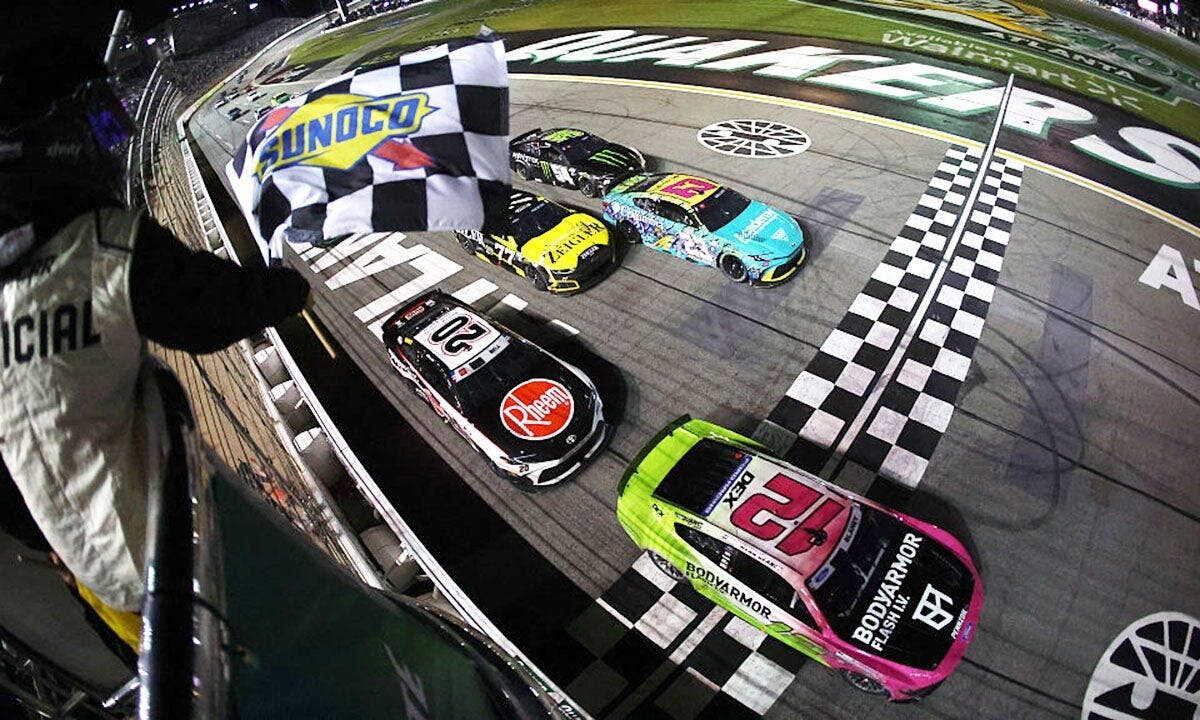
Ryan Blaney won the rain-delayed NASCAR Atlanta race with a last-lap pass that completed a finish near 3 a.m., and the late restart plus a disputed yellow-line incident dominated reaction. The NASCAR Atlanta race finish — decided down to the stripe after a midnight restart — produced hard racing and heated complaints about the timing and an on-track penalty.
What happened at the NASCAR Atlanta race
The event at Atlanta Motor Speedway was halted by rain about 100 laps in, resumed after a long delay and concluded in dramatic fashion when Blaney edged Bubba Wallace on the final lap. Christopher Bell, Carson Hocevar and several others were in the mix; Blaney’s last-gasp move at the line earned the victory after a postrace review of on-track contact and track-limit issues.
Officials reviewed the finish and a separate incident involving track limits that left Wallace penalized at the line. That penalty, and Wallace’s account of contact while running below the double yellow line, became the focal point of the dispute that followed the checkered flag.
The midnight restart and timeline
The race was paused for roughly three hours because of rain. Track crews prepared the surface and, when conditions permitted, NASCAR sent the field back to green at 12:01 a.m., an intentional restart time that pushed the decisive laps into the early-morning hours and moved the finish to roughly 3 a.m. local time.
NASCAR and track officials said safety protocols and drying operations governed the timing; critics argued the midnight restart reduced live viewership and created an avoidable scheduling problem. Many viewers and some drivers said the timing meant fewer fans saw the finish live, shifting attention to highlights and social recaps instead of full broadcast coverage.
NASCAR Atlanta race: The yellow-line dispute involving Bubba Wallace and Ty Gibbs
At the center of the controversy was an incident with Bubba Wallace running close to the double painted lines. NASCAR’s on-track rule states, in part, that “vehicles must compete above the double painted lines at all times. Passing below the double painted lines to advance position will result in a black flag.” Video shown after the finish appears to show Wallace going below the line and momentarily ahead.
Wallace told reporters he was forced below the line after contact, and his team has said telemetry and video will show the shove from behind. Those descriptions are presented here as Wallace’s claims and team statements; they have not been independently verified by this outlet. NASCAR applied a penalty consistent with the rule language, and officials said enforcement followed the letter of the regulation.
Ty Gibbs was mentioned in postrace coverage because of his proximity in the closing laps; drivers and teams differ on whether contact was intentional, unavoidable, or a byproduct of close pack racing. The split between driver accounts (who emphasize context and contact) and officials (who point to the rule text and the observed movement below the line) explains why debate persisted after the race.
Driver reactions and on-track confrontations
Tensions were visible in the paddock and on the radio. Bubba Wallace publicly described being shoved downward and expressed frustration in postrace comments; team representatives indicated data would back up his account. Those are presented as driver and team claims pending independent confirmation.
William Byron and crew chief Rudy Fugle exchanged heated radio words before the rain delay while working through a handling problem; audio released after the race captured blunt language as they tried to diagnose a loose car that ultimately finished outside the top 10. Several other drivers also voiced frustration about the late restart and how timing magnified every incident on track.
On-track confrontations and terse interviews underscored how close competition can turn into dispute when a high-profile rule — the double-yellow-line restriction — is implicated in a win-or-lose moment.
Why the finish matters for fans and NASCAR
Atlanta Motor Speedway’s recent repave and rebanking make it one of the season’s most action-packed tracks, and Sunday’s race had the elements of a classic: long green-flag runs, intense drafting and a dramatic final lap. But the late finish highlighted a tension between producing competitive nights of racing and preserving audience access.
For broadcasters and NASCAR, a 3 a.m. finish is a ratings and scheduling risk. For fans, the midnight restart meant many relied on highlights rather than watching live. For teams and drivers, the timing intensified scrutiny of officiating decisions because fewer viewers and less immediate context can magnify controversy in postrace coverage.
How NASCAR addresses weather-related scheduling — whether through revised contingency rules, different start windows, or clearer communication about late restarts — will shape whether similar finishes are embraced or criticized in future events.
Source attribution
This account is based on original reporting by Fox News / Outkick and official NASCAR postrace statements cited in that coverage. Contested claims about contact and intent are presented as driver or team claims unless independently confirmed by official telemetry or a formal NASCAR review.
Sources: Fox News / Outkick reporting on the event (race coverage and postrace quotes). Contested assertions about contact are attributed to drivers or teams in the body text pending independent verification.
Note: The yellow-line rule language quoted in this article reflects the rule text described in race coverage and postrace summaries; specific rulebook citations were summarized from NASCAR’s public explanations in the wake of the event.