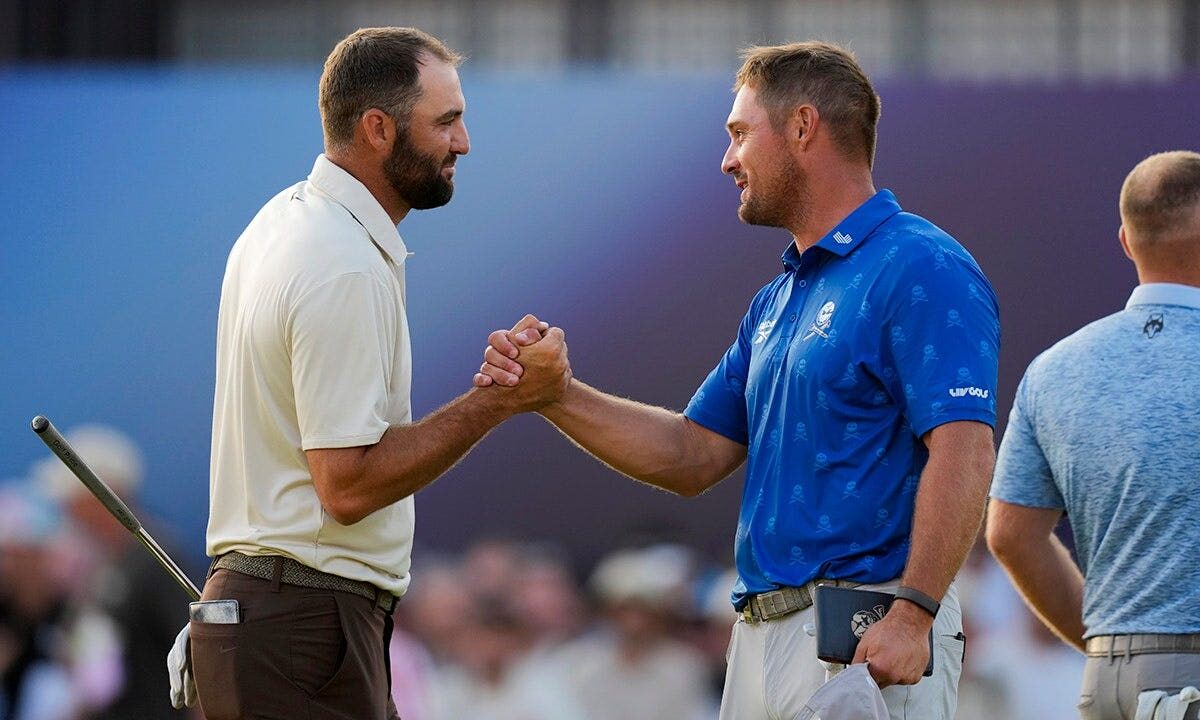
Scottie Scheffler on Bryson DeChambeau penalty was blunt early: “he’s definitely not a cheater.” The world No. 1 addressed reporters after DeChambeau was assessed a two-shot penalty during the second round of The Open Championship, defending the player’s integrity while calling for clearer policing and noting how broadcast coverage can affect perception.
Scottie Scheffler on Bryson DeChambeau penalty
Scheffler told media he had known DeChambeau for years and had “never seen him cheat once” in casual or competitive play. He emphasized the difference between careless actions and deliberate rule-breaking, saying, “Maybe he was a touch careless around his ball, but I don’t think he did anything intentionally.”
That distinction — between intent and carelessness — formed the core of Scheffler’s defense. He declined to speculate beyond what was in front of the tournament committee, but stressed that personal knowledge of a competitor can inform how one judges their character.
What happened: the penalty at The Open
The two-shot penalty was applied after round two following review of DeChambeau’s actions around his ball during play. Tournament officials determined the conduct in question met the criteria for a two-shot penalty under the rules as they interpreted them using available footage.
The ruling altered the scoring for that round and drew immediate attention because of the high-profile nature of the player and the extensive television coverage. The addition of penalty strokes in a major championship often shifts momentum and triggers debate among players, fans and pundits alike.
Why Scheffler defended DeChambeau
Scheffler said his view was shaped by long familiarity with DeChambeau on and off the course. He differentiated between someone who would intentionally try to gain an edge and a player who might make an inadvertent mistake under pressure. “He’s a lot of things, but he’s definitely not a cheater,” Scheffler told reporters.
To illustrate how judgments can be complicated, Scheffler referred to past incidents where intent was difficult to establish in real time. He cited high-profile moments in the sport — such as the Jon Rahm episode at the Memorial — to underline how split-second events and after-the-fact review can lead to contentious outcomes.
Rules, TV scrutiny and policing
Scheffler also raised concerns about how television coverage can shape what gets reviewed by officials. “When you have camera angles that are far away, things can look different than they do when you’re right there,” he said, noting that players who draw more broadcast attention may be subjected to more post-shot scrutiny simply because more footage exists.
He argued for clearer standards and consistent policing so that enforcement does not feel selective. “I think we need to kind of get back to the traditions of the game, and maybe we do need to police things a little bit more stricter in the game,” Scheffler said, framing the issue as one of fairness and consistency across players and events.
That conversation — over whether technology and broadcast review should change how rules are enforced — is ongoing in golf. Some observers say television has made it possible to catch infractions that would previously have been missed; others worry that it can punish players unevenly based on how closely they are televised.
Reactions and what comes next
Reactions from peers and media have been mixed. Some players sided with Scheffler’s assessment of DeChambeau’s character, while others emphasized that rules must be applied uniformly regardless of a player’s history or profile. The debate centers less on the identity of the player and more on how modern coverage affects enforcement.
Tournament officials applied the two-shot penalty for the round in question. Any formal dispute or appeal would follow the procedures set by the tournament and governing authorities; those processes typically involve the committee that issued the ruling and, when applicable, the sport’s rule authorities. Observers expect the incident to prompt further discussions among players, broadcasters and officials about the role of televised evidence and whether enforcement practices should be updated.
At the time of Scheffler’s comments, he did not suggest an appeal was imminent. The episode is likely to remain a talking point during the rest of the championship as stakeholders consider whether policy changes are needed to ensure consistent, transparent outcomes.
FAQ
Did Scheffler call DeChambeau a cheater? No. Scheffler explicitly said DeChambeau is “definitely not a cheater” and based that view on his personal experience with the player.
What triggered the two-shot penalty? The penalty followed tournament officials’ review of DeChambeau’s actions around his ball during the second round. Officials concluded those actions met the criteria for a two-shot penalty under the rules as applied for that situation.
Could the penalty be appealed or changed? Any appeal or change would follow tournament procedures and involve the committee or governing bodies responsible for the championship. Scheffler did not indicate whether an appeal would be pursued.
Source attribution
This report is based on Fox News coverage. Original reporting: Fox News — Scottie Scheffler comments on Bryson DeChambeau’s two-shot Open Championship penalty: ‘not a cheater’.