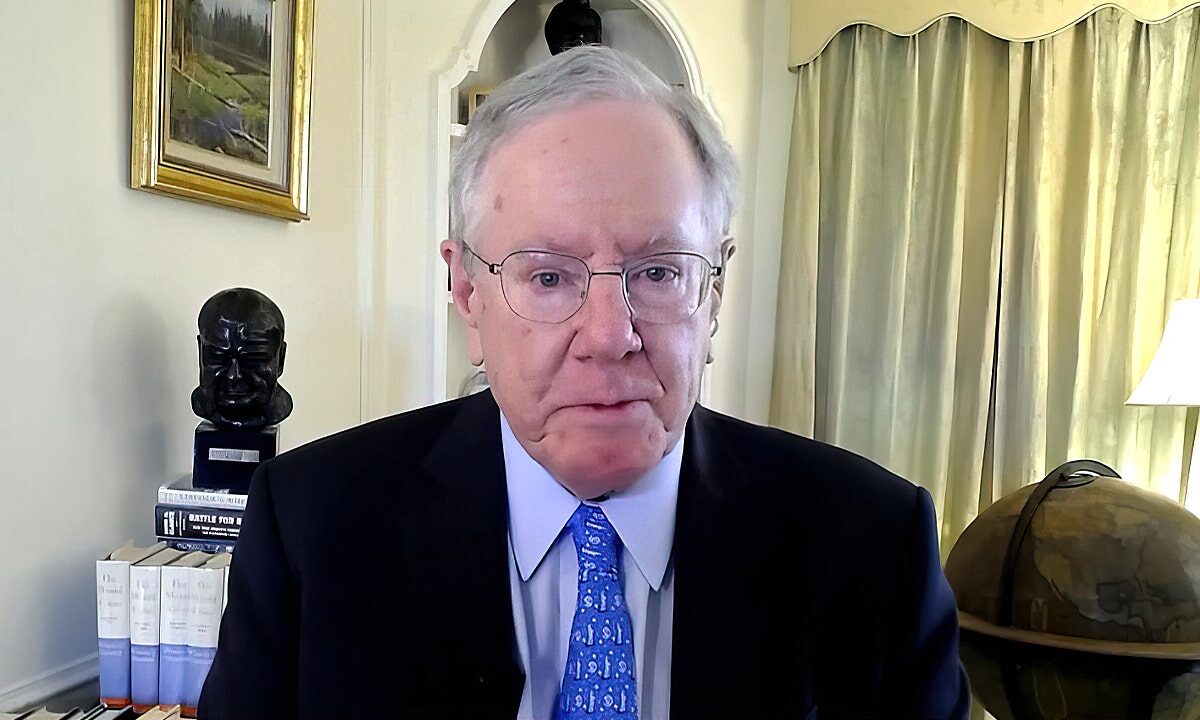
Steve Forbes told Fox News Digital at Freedom Fest in Las Vegas that he agrees with former President Trump’s Mount Rushmore warning about an internal communist threat and used the platform to press conservative economic prescriptions.
In the interview, the longtime publisher and two-time presidential candidate framed current left-leaning movements as an organized ideological challenge and outlined policy steps — tax cuts, deregulation and changes to how the Federal Reserve approaches inflation — that he said should be central to conservative strategy going forward.
What Steve Forbes said at Freedom Fest
Forbes sat down with Fox News Digital at the libertarian-leaning conference to assess the economy, the politics of New York City and the broader cultural arguments conservatives must make. His remarks mixed historical reference, economic theory and campaign-stage messaging aimed at both policy and persuasion.
“We’ve got to get the message out. And one thing that the left has learned is that you try to occupy the high moral ground.”
He pressed the view that conservatives need to pair policy proposals with moral arguments about freedom and opportunity, not only technical economic claims. In his telling, that combination helps blunt what he described as an organized effort by the left to win cultural and institutional influence.
“We have to tell the story of how free enterprise creates opportunity for ordinary people.”
That framing is strategic: presenting market outcomes as moral goods as well as material benefits. Forbes tied that message to specific proposals he believes resonate politically, as well as to critiques of institutions he sees as misaligned with conservative priorities.
Forbes on Mount Rushmore, communism and New York City
Forbes explicitly endorsed the framing used by Trump in his Mount Rushmore address, arguing the greater threat is internal rather than foreign and should be treated as such. He cited Abraham Lincoln and referenced New York City’s history of electing radical candidates to illustrate how domestic political shifts can have long-term effects.
“Whatever you call it, communism, socialism, extreme leftism, anti-Semitism, it’s all the same disease.”
Those comments are clearly opinionated and presented as a political argument rather than a dispassionate history lesson. The interview referenced an “allegedly only communist member of Congress back in the late 1940s” as an illustrative point; this article does not independently verify that detail, which readers should treat as part of Forbes’ rhetorical framing.
“This isn’t about foreign armies at our gates — it’s about ideas inside our institutions.”
Forbes’ compilation of ideological threats into a single category is an explicit argument for a cultural and institutional response. Because such broad characterizations can conflate distinct movements and motivations, the piece flags those parts of the interview as advocacy rather than established fact.
Economic prescriptions: tax cuts, deregulation and the Fed
Forbes laid out a conventional conservative economic playbook: enact tax cuts, pare back regulation, and shift how the Federal Reserve thinks about inflation and prosperity. He argued these steps would both boost growth and offer a clearer, voter-facing alternative to the left’s agenda.
“On the domestic front, go for a new round of tax cuts. Reduce tax rates for individuals and for businesses.”
He criticized the Federal Reserve’s frequent warnings about “overheating” when the economy improves and framed such cautions as misplaced. Forbes called the notion that prosperity causes inflation “absolute nonsense” and suggested the Fed should prioritize preserving the dollar’s purchasing power over actively managing business cycles.
“Start with the Federal Reserve, the idea that prosperity causes inflation. Experience shows time and time again, it’s absolute nonsense.”
Those positions place Forbes within a particular strand of conservative economic thought that favors supply-side measures and narrower central-bank objectives. Supporters argue tax relief and deregulation spur investment and productivity; critics point to trade-offs with deficits, distributional effects and the complex causes of inflation.
Markets, technology and rent control examples
To illustrate the benefits of markets, Forbes pointed to rapid technological progress and used housing policy as a counterexample to intervention. He emphasized how market-driven innovation has driven down the cost of computing and expanded access to powerful tools.
“Take your handheld. If you’d said 30 years ago [that your] grandma could operate a supercomputer, you’d have gotten a rather strange look.”
He contrasted that innovation story with what he called the perverse incentives of rent control, arguing such interventions reduce supply and degrade quality over time. Forbes used the housing example to argue that well-intentioned regulations can produce unintended, adverse outcomes for the people they aim to help.
“You can’t control prices without distorting supply — that’s what rent control teaches you.”
Those analogies are meant to be illustrative rather than conclusive. They condense complex technological and regulatory histories into shorthand points to bolster a broader defense of free enterprise. Observers should weigh these examples alongside empirical research and local policy differences.
Why it matters and what comes next
Forbes’ remarks matter because he is a visible voice in conservative economic circles; his alignment with Trump’s cultural framing helps tie fiscal arguments to broader national narratives. That pairing — moral messaging plus technical policy proposals — is designed to appeal to both donors and voters who respond to principled and practical arguments.
Politically, Forbes offered a two-part playbook for conservatives: (1) sharpen the moral case for markets and freedom, and (2) translate that message into tangible proposals voters can understand, namely tax cuts and deregulation. For activists and strategists, the measure of success will be whether those proposals can be packaged to win in swing constituencies and withstand critiques about distribution and deficit impacts.
At the same time, several of Forbes’ statements are contestable or clearly opinion-driven. He grouped broad ideological and social phenomena together and made historical references that the interview did not independently confirm. Those elements should be read as advocacy rather than settled fact.
Risk notes: Forbes’ references to an “allegedly only communist member of Congress” and his sweeping equating of communism, socialism and other ideologies are presented here as his commentary. They are opinion statements and not independently verified historical findings in this piece.
Source: Fox News