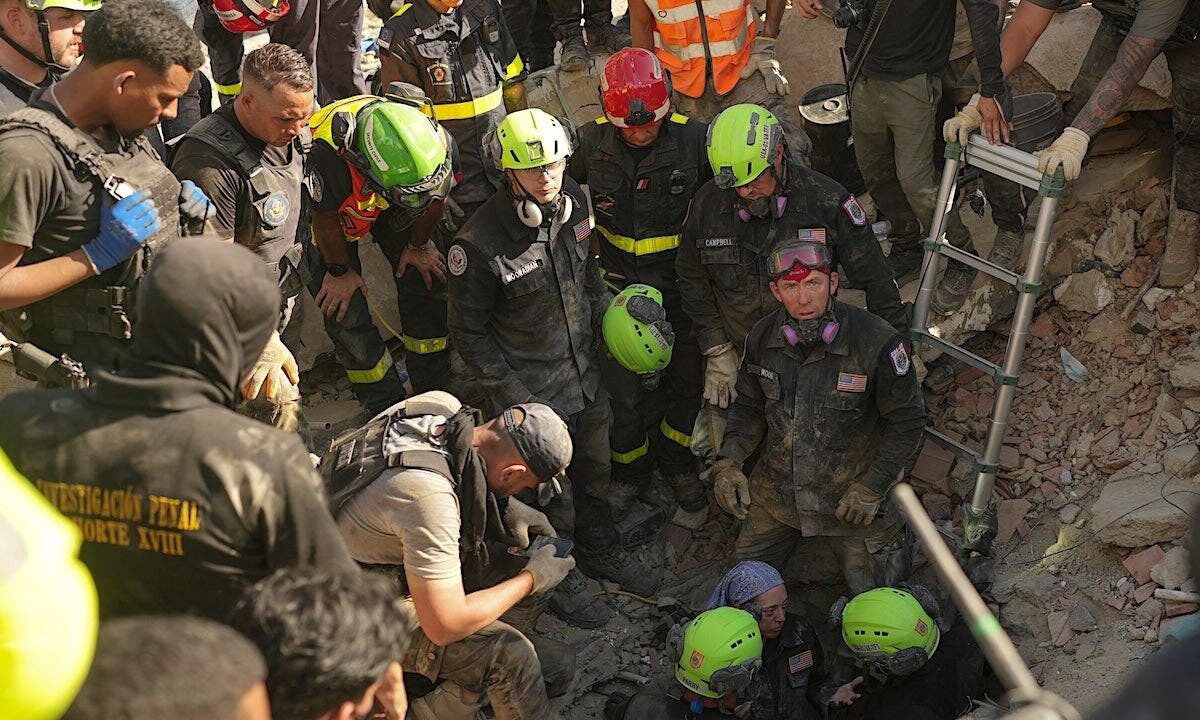
Search-and-rescue crews pulled 33 people alive from collapsed buildings over the weekend after twin Venezuela earthquakes devastated the country’s northern coast, but officials warned time was running out for tens of thousands still unaccounted for. The main rescue effort has focused on La Guaira state, where magnitude 7.2 and 7.5 tremors flattened apartment blocks and hotels and sent hundreds of aftershocks through damaged neighborhoods.
Venezuela earthquakes: Top lines now
Authorities and news agencies reported 33 people pulled alive from rubble over the weekend as crews worked around the clock (Fox News; AP). The death toll stood at about 1,430 late Saturday, according to The Associated Press (AP). Venezuelan officials said more than 3,000 people were injured and roughly the same number were staying in temporary shelters (Venezuelan officials, reported by Reuters).
Estimates of missing people varied widely: Venezuelan authorities said hundreds were missing or trapped, some local tallies approached 50,000, and one compiled family list reported nearly 69,000 names marked as unaccounted for — figures underscoring chaotic accounting as communications and registries failed (AP).
Casualties, injured and shelter counts
All official figures remain provisional and subject to change as search teams reach cut-off areas and communications are restored. The AP’s 1,430 death toll was the most widely cited figure by late Saturday, but local authorities and family-compiled lists show much broader disruption (AP).
Venezuelan authorities reported more than 3,000 injured and said roughly the same number were sheltering after losing homes; those counts come from government statements relayed by Reuters and AP (Venezuelan officials via Reuters/AP). Hundreds of aftershocks and damaged bridges, roads and power lines have slowed movement of the injured and the cataloguing of missing persons.
Reporting agencies and officials emphasized discrepancies in missing counts, citing collapsed records, crowded shelters and broken communications that have left families unable to check in with relatives (AP; Reuters).
Survival timeline: the 72-hour window
International rescue leaders stressed how quickly odds fall for people trapped under rubble. Swiss rescue-team leader Sebastian Eugster told Reuters: “There exists a window of roughly three days, 72 hours, where the probability afterwards decreases that you can save people alive” (Reuters).
That rough 72-hour mark passed late Saturday, and teams said the window for finding survivors was narrowing (Reuters; AP). Rescue leaders stressed that the guideline is probabilistic, not absolute: while chances decline after roughly three days, individual rescues remain possible and teams continued operations where it was safe to do so.
Field commanders said the 72-hour standard helps prioritize scarce search-and-rescue assets such as sniffer dogs, acoustic sensors and heavy lifting equipment, particularly in areas where aftershocks and collapse risk make large-scale dig operations dangerous (Reuters).
Rescue stories on the ground
The 33 people pulled from rubble included dramatic survivals that highlighted international cooperation. U.S. rescuers removed an infant alive from a collapsed apartment block, a recovery that galvanized local and foreign crews (AP). A Colombian team using ground-penetrating radar located and extracted an 11-year-old boy from about 10 feet down, and Mexican rescuers freed another child in Caraballeda (AP; Reuters).
Teams from the United States, Colombia, Mexico and Swiss-led specialists worked alongside Venezuelan authorities, bringing dogs, listening devices and cutting gear. Rescuers said sweltering heat, repeated aftershocks and narrow access routes complicated dig-and-care operations and slowed medical evacuations (AP).
One U.S. search coordinator described a tense night shift in La Guaira where crews rotated every few hours because of heat and the psychological toll of prolonged rescue work; local volunteers and firefighters were credited with many early-life recoveries before international teams arrived (reported by AP).
Communications and aid: Starlink and connectivity
Broken communications have made it harder to account for missing people and coordinate relief. Private satellite systems and carrier fixes have been crucial where terrestrial networks failed.
“Starlink Mobile is providing free connectivity to @MovistarVe customers in the La Guaira region, and we are working to provide free service for @DigitelAyuda and @movilnet_ve customers as quickly as possible,” Starlink wrote on X (as reported by Fox News).
Starlink said families and businesses with compatible LTE phones could send SMS messages through Starlink Mobile even when local towers were down, though service is best with a clear view of the sky (Starlink post on X; reported by Fox News). Relief coordinators told reporters that restored messaging ability was already helping families locate loved ones, prioritize medevac cases and direct scarce resources to the hardest-hit neighborhoods (AP).
What comes next for survivors and responders
Search-and-rescue efforts will continue while authorities manage sheltering, medical care and the slow process of identifying the dead. Officials warned that hundreds of aftershocks and damaged roads will keep some zones difficult to reach for days, and heavy machinery will be used only when rubble is stable enough to avoid further collapses (AP; Reuters).
Immediate priorities include expanding temporary shelter capacity, restoring reliable communications across affected states, triaging urgent medical needs among the injured, and setting up coordinated registries to reconcile widely varying missing-person lists (Venezuelan officials; AP). International aid agencies and partner countries said they were preparing field hospitals, water and sanitation support, and logistics hubs to push supplies into La Guaira and nearby coastal areas (Reuters; AP).
Longer-term tasks will include structural assessments of buildings, mental health support for survivors and families, and rebuilding critical services. Rescue leaders said operations would be reassessed continually as new areas become safe enough for heavy equipment and ground teams.
Frequently asked questions
How many people have been rescued after the Venezuela earthquakes?
Authorities and reporting agencies said rescue crews pulled 33 people from rubble over the weekend, including infants and children, with international teams assisting local responders (Fox News; AP).
What is the 72-hour survival window and why does it matter?
Search-and-rescue experts say the probability of finding people alive under rubble drops sharply after roughly 72 hours. That guideline helps teams prioritize efforts, though it is not an absolute cutoff and rescues after that period sometimes occur (Reuters).
How is Starlink helping relief efforts in La Guaira?
Starlink posted on X that it had provided free connectivity to some MovistarVe customers in La Guaira and was working to expand free service to other carriers; reports say SMS over Starlink Mobile has helped families and responders coordinate when towers were down (Starlink on X; Fox News; AP).
This report draws on coverage from Fox News, The Associated Press and Reuters. Sources: Fox News; The Associated Press; Reuters.