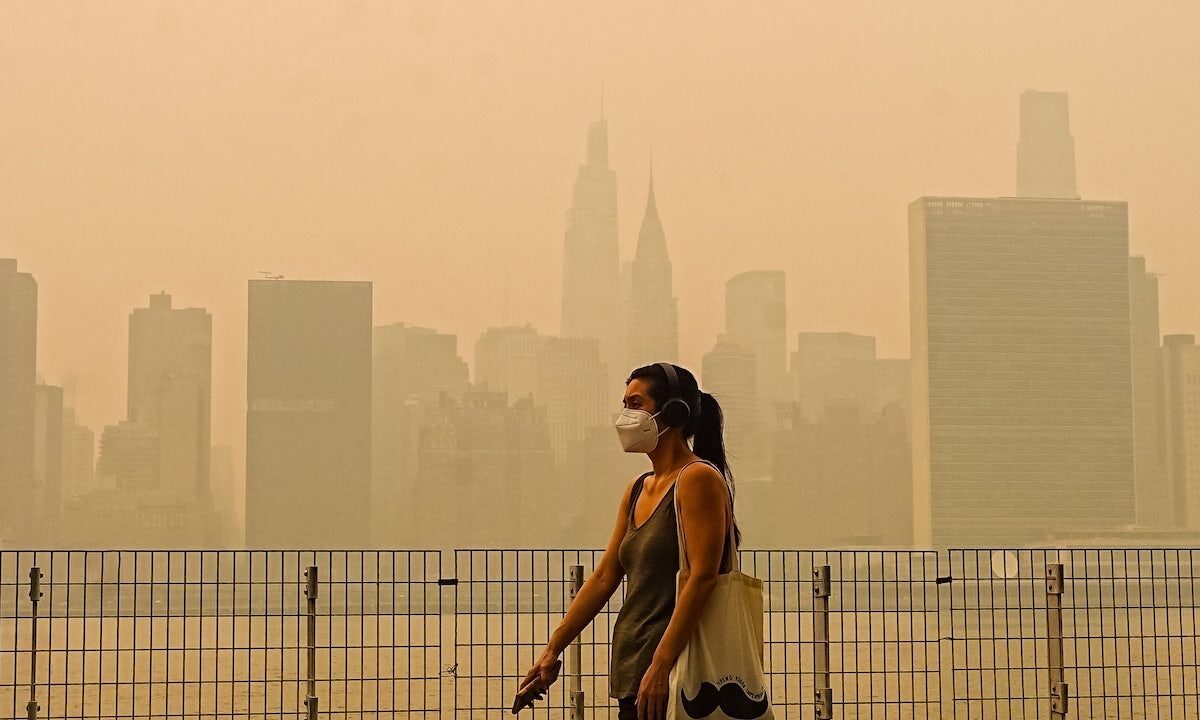
Wildfire smoke from Canadian and Ontario fires is drifting across large swaths of the United States, prompting air-quality alerts from the Upper Midwest to the East Coast. NASA data and news reports say more than 180 wildfires are burning in Ontario, with nearly 850 active across Canada, and smoke has been detected in more than 20 states.
What is happening now
Smoke from widespread Canadian wildfires is moving southward into the U.S., reducing visibility in some areas and raising fine-particle (PM2.5) concentrations. Authorities and satellite-based observations reported dozens of large fires in Ontario and the broader Canadian system of active wildfires; drifting smoke is affecting communities across more than 20 states, depending on wind patterns.
Key takeaways
- Wildfire smoke (PM2.5) can harm lungs and the cardiovascular system.
- Check local Air Quality Index (AQI) at AirNow.gov before outdoor plans.
- When AQI is high, stay indoors, use HEPA filtration or recirculate HVAC, and use a well-fitting N95 if you must be outside.
Where the wildfire smoke is and current AQI
Air quality varies by location and can change quickly with shifting winds. Use AirNow.gov for real‑time AQI and PM2.5 readings for your address or ZIP code before going outside.
Remember AQI thresholds: values above 100 are unhealthy for sensitive groups; values above 150 are unhealthy for everyone. PM2.5 — fine particles suspended in the air — is the main pollutant of concern during wildfire smoke events.
The CDC notes that fine particles can irritate the lungs and worsen existing heart or lung conditions; public-health guidance uses AQI and PM2.5 readings to recommend when to limit outdoor activity.
Who is most at risk
Certain groups face higher risk from wildfire smoke because of physiology or existing health conditions. High-risk groups include:
- Children, whose lungs are still developing and who breathe more air per body weight.
- Older adults, who often have underlying heart or lung disease.
- Pregnant people, because some studies link smoke exposure to pregnancy complications.
- People with asthma, COPD or other chronic lung conditions.
- People with cardiovascular disease or other heart conditions.
- Outdoor workers and first responders who spend extended time outside.
Health effects of PM2.5
The main health concern from wildfire smoke is fine particulate matter (PM2.5). These particles are tiny — roughly 30 times smaller than a human hair — and can penetrate deep into the lungs; the smallest may enter the bloodstream.
Short-term symptoms commonly include burning or watery eyes, scratchy throat, runny nose and coughing. More severe responses may include chest tightness, wheezing, shortness of breath, headaches, fatigue and a faster heart rate.
Research and public-health agencies link PM2.5 exposure to increased emergency-room visits for heart problems and breathing illnesses. The EPA and cardiovascular groups note that intense short-term exposures can worsen heart failure and, in some cases, contribute to life‑threatening events.
Repeated or long-term high exposure has been associated in studies with increased risks of chronic heart and lung disease, lung cancer, cognitive effects and adverse pregnancy outcomes, though individual risk depends on duration and intensity of exposure.
How to protect yourself
Federal guidance from the CDC and EPA recommends steps to reduce smoke exposure and protect indoor air. Key actions include:
- Monitor local air quality: Check AirNow.gov before going outside. Limit activity when AQI exceeds 100 for sensitive groups and 150 for everyone.
- Stay indoors when levels are high: Keep doors and windows closed. Set air conditioners or central HVAC to recirculate to limit intake of smoky outdoor air.
- Clean indoor air: Run a portable air cleaner with a true HEPA filter or use the highest-efficiency filter your HVAC supports. Avoid indoor activities that add pollutants, such as smoking, frying oil, burning candles or vacuuming.
- Wear a certified respirator outdoors if needed: A well-fitting N95 or equivalent respirator can filter most fine particles when you must be outside during heavy smoke.
- Reduce strenuous activity: Postpone heavy outdoor exercise until air quality improves because exertion increases intake of fine particles.
- Follow medical plans: People with asthma or COPD should follow their action plans and keep rescue medications accessible. Seek care if symptoms—such as severe shortness of breath, chest pain, confusion or fainting—develop.
For detailed official guidance, see CDC wildfire smoke resources at cdc.gov/disasters/wildfires and the EPA’s wildfire smoke pages at epa.gov/wildfire-smoke.
What to do if you have symptoms
Mild irritation—such as watery eyes or a sore throat—often improves after moving to cleaner air and resting. Seek prompt medical care if symptoms worsen or do not improve.
- Get emergency help for persistent or severe shortness of breath, chest pain, fainting or confusion.
- Don’t delay emergency care if rescue inhalers or regular medicines aren’t controlling symptoms.
- Contact your health provider for tailored advice if you have heart disease, severe asthma, COPD or are pregnant.
Source attribution: This report is based on reporting by Fox News Digital and public data from NASA. Official guidance and data referenced above come from AirNow.gov, the CDC and the EPA.