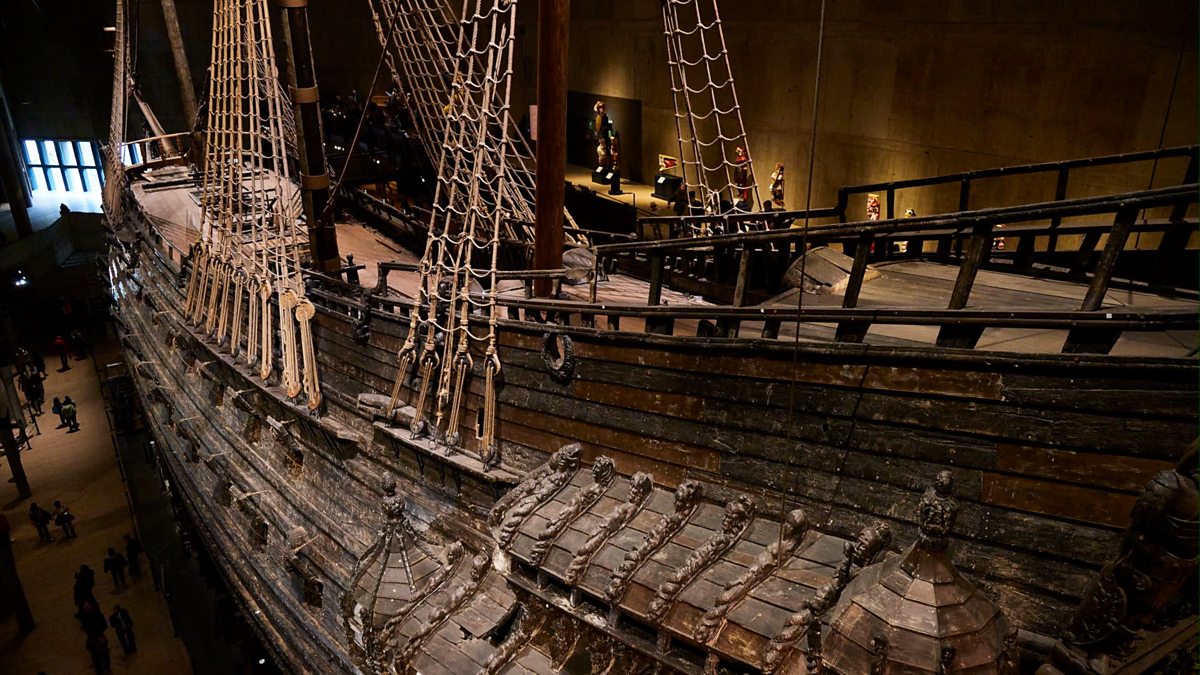
Adrienne Murray travels to Sweden in a BBC News – Technology segment to meet the team working on historic warship preservation. The BBC report shows how digital tools and onsite monitoring are being used to record the vessel’s condition, guide conservation choices and reduce long-term risks to timbers and metalwork. Watch the segment on BBC iPlayer: https://www.bbc.co.uk/iplayer/episode/m002ysd5?at_medium=RSS&at_campaign=rss
Filmed on the Swedish coast, the piece follows conservators, maritime archaeologists and technicians as they balance hands-on craft with data-driven methods. The BBC footage emphasises cautious, staged interventions and the use of technology to document fragile material without repeated handling.
Historic warship preservation: the technology
In the BBC segment, historic warship preservation is shown as a hybrid process: traditional conservation techniques combined with modern technology to document, monitor and manage deterioration. Tools highlighted include high-resolution 3D scanning and photogrammetry to create digital models, and a network of environmental sensors to track humidity, temperature and salinity fluctuations that affect preservation.
Digital recording—such as 3D scans and overlapping photographic surveys—produces accurate models of the ship that conservators can study remotely. The BBC report explains how these models help plan delicate interventions, letting teams visualise problem areas and simulate different treatment options before touching the original material.
Environmental sensors, another focus of the piece, are placed around the wreck and inside shelters. The BBC footage shows teams checking logs of humidity and temperature so they can select drying protocols, storage conditions and chemical treatments tailored to the object’s response. The approach is described in the report as iterative: test on a small area, monitor results, then scale up if data support the method.
“The report shows a careful balance between hands-on conservation and data-driven methods,” the BBC segment conveys, as Adrienne Murray guides viewers through the site.
The team on site in Sweden
Adrienne Murray’s report puts faces and roles to the work. The BBC footage follows conservators stabilising planks, maritime archaeologists recording context, and technicians managing digital capture and monitoring systems. On camera, the team demonstrates routines that mix manual craft and technical checks: a plank may be consolidated in the morning, then scanned and compared with sensor logs in the afternoon.
The BBC coverage emphasises collaboration. Conservators, museum scientists and engineers are shown discussing trial treatments, checking data together and agreeing staged plans so that each intervention can be evaluated before wider application. The film highlights that decisions are documented and archived, making later review by peers and future researchers possible.
How the tools help conservation work
The BBC segment makes three practical benefits clear: technology improves monitoring, supports detailed planning, and reduces risk. Continuous environmental monitoring creates objective records that let teams spot changes quickly; when a sensor reading shifts, conservators can intervene before irreversible damage occurs, as the footage demonstrates.
Digital models and datasets make planning more precise. Virtual reconstructions let the BBC’s team visualise treatment scenarios and estimate impacts without repeated physical testing on fragile material. That reduces unnecessary handling and preserves more of the original fabric of the ship.
Measured, iterative testing is another theme. The report shows small-scale trials of treatments where results are checked against sensor records and re-scans. The BBC highlights that scaling up only when the data support an approach prevents unintended consequences and preserves long-term options for future research.
Why this work matters now
Preserving maritime heritage has clear cultural, scientific and educational value. Ships are physical records of past technologies, repairs and trade; conserving them safeguards those stories for researchers and the public. The BBC segment links those cultural values to the need for transparent, data-led conservation that can be reviewed and understood by specialists and non-specialists alike.
The programme also points out the public benefit: making the project visible on BBC iPlayer invites wider interest and scrutiny, helping people understand why careful, evidence-based preservation is needed to keep cultural heritage accessible for future generations.
Key takeaways
- Combining conservation craft with digital tools improves documentation and reduces risk, as shown in the BBC segment.
- Monitoring and modelling allow staged interventions that can be evaluated before full application.
- Public access to projects via platforms such as BBC iPlayer helps explain the value of preserving cultural heritage.
FAQ
What is historic warship preservation?
Historic warship preservation involves stabilising, documenting and conserving ships of historical importance so they can be studied and displayed. As the BBC segment explains, it combines physical treatments, environmental control and digital recording to protect the vessel and its contextual information.
How can technology help preserve ships?
According to the BBC report, technology helps by providing accurate digital records (3D scans, photogrammetry), continuous environmental monitoring (temperature, humidity, salinity), and tools for planning and risk assessment. These technologies reduce unnecessary handling and support evidence-based conservation choices.
Where can I watch the BBC segment?
The BBC News – Technology segment presented by Adrienne Murray is available on BBC iPlayer: https://www.bbc.co.uk/iplayer/episode/m002ysd5?at_medium=RSS&at_campaign=rss
Source attribution
This article is based on the BBC News – Technology segment presented by Adrienne Murray. Original segment and full report available on BBC iPlayer: https://www.bbc.co.uk/iplayer/episode/m002ysd5?at_medium=RSS&at_campaign=rss. Credit: BBC News – Technology; reporter Adrienne Murray.