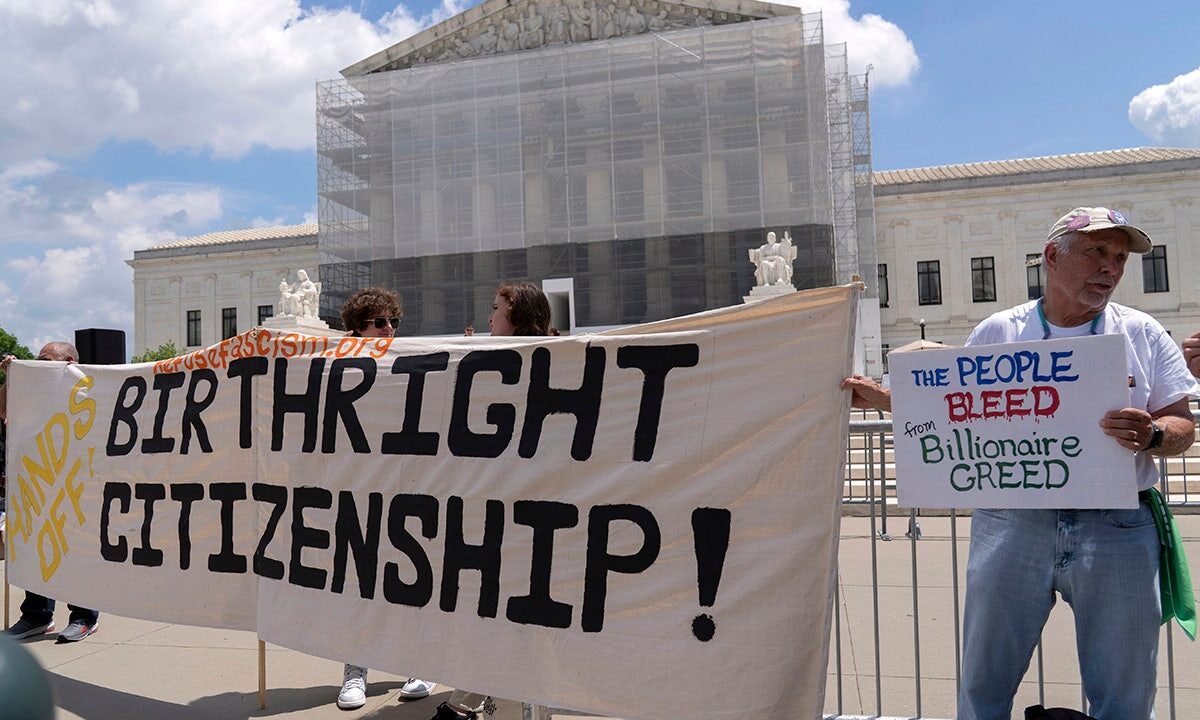
The Supreme Court on Thursday issued a 6-3 decision in Trump v. Barbara upholding birthright citizenship under the Fourteenth Amendment. The majority — including Justices Brett Kavanaugh and Amy Coney Barrett joining Chief Justice John G. Roberts Jr. and the court’s three liberal justices — rejected an executive order that sought to strip automatic citizenship from children born on U.S. soil.
The ruling prompted sharp reactions. White House adviser Stephen Miller called the decision “one of the most destructive and outrageous decisions in the long history of the Supreme Court,” while Sen. Eric Schmitt said he would press for a constitutional amendment to reverse the outcome. Democratic senators and House members praised the decision as protecting settled law and families.
What the Court decided on birthright citizenship
The majority held that the Fourteenth Amendment’s Citizenship Clause remains controlling: the Constitution’s text and longstanding precedent protect most children born in the United States. The justices concluded the executive order at issue could not override explicit constitutional language or preexisting judicial interpretation of that text.
To help general readers, the Citizenship Clause of the Fourteenth Amendment provides: “All persons born or naturalized in the United States, and subject to the jurisdiction thereof, are citizens of the United States and of the State wherein they reside.” The Supreme Court long ago in United States v. Wong Kim Ark (1898) interpreted that clause to confer citizenship on most children born in the country, with narrow exceptions such as children of foreign diplomats. The Court in Thursday’s opinion relied on that textual framework and historical precedents in reaching its conclusion.
Justice Brett Kavanaugh wrote a separate concurrence emphasizing an additional statutory point. While he agreed the Constitution protects birthright citizenship, he wrote that the particular executive action at the center of the case also conflicted with federal statute and that the administration’s method for attempting to strip citizenship was legally improper.
Majority and dissent
The three dissenting justices — Justices Clarence Thomas, Samuel Alito and Neil Gorsuch — argued the Court should have reached a different reading of the Fourteenth Amendment and related laws. The dissenters expressed concerns about the majority’s interpretive approach and warned that disagreement over textualist and originalist methods remains unresolved on the Court.
The split underscores continuing debate among the justices over how historical understanding, statutory text and modern consequences should be balanced in constitutional interpretation.
Key reactions from Washington
Conservative critics were immediate and forceful. White House adviser Stephen Miller called the decision “one of the most destructive and outrageous decisions in the long history of the Supreme Court.” Daniel Turner, head of Power the Future, said the ruling would “dilute” citizenship and raised hypothetical concerns frequently voiced by opponents of broad birthright rules.
Sen. Eric Schmitt called the ruling “wrong, dangerous, and disastrous for American sovereignty and the American people,” and vowed to press for a constitutional amendment if Congress could not address the issue through ordinary legislation.
“If we can’t fix it with ordinary legislation, then we must do what the Constitution commands in moments of national crisis: We must amend the Constitution and restore American citizenship,” Schmitt said.
Rep. Clay Fuller announced he would introduce HR 172, described by supporters as a House measure to begin the constitutional amendment conversation. Fuller and other Republican lawmakers urged swift congressional action; legal experts note that the constitutional amendment route requires approval by two-thirds of both chambers of Congress and ratification by three-fourths of the states or a convention called by two-thirds of the states.
Democratic lawmakers praised the ruling. Sen. Alex Padilla said the Constitution “could not be clearer” that those born in the U.S. are citizens, and Rep. Jasmine Crockett called the decision a protection of long-settled law and the rights of families.
What this means for policy and next steps
Republican leaders signaled they will pursue both legislative and constitutional routes. Sen. Schmitt and allied lawmakers described amendment proposals that, if pursued, would begin a lengthy and politically difficult ratification process. The amendment path requires broad national consensus or an unprecedented, state-driven constitutional convention; either route is expected to be slow and contentious.
Congress could also consider ordinary statutes addressing related immigration topics, but lawmakers and legal scholars emphasize that ordinary legislation cannot override explicit constitutional text as interpreted by the Supreme Court.
Practical impact and scope
For now, the Court’s decision preserves the existing legal framework: most children born on U.S. soil continue to acquire citizenship at birth under the Fourteenth Amendment as interpreted by precedent. That means immediate legal status for those born here remains unchanged.
Critics raised concerns about “birth tourism” and incentives for noncitizens to travel to the U.S. to give birth. The Court’s decision does not itself create new immigration enforcement rules, and claims about future migration patterns remain contested and largely speculative; those points are presented here as critics’ warnings rather than established outcomes.
Enforcement of immigration laws and border policy remains under the prerogative of Congress and the executive branch; the ruling does not directly alter those separate authorities.
Background and context
The lawsuit, filed under the pseudonym Barbara to protect the plaintiff’s identity, challenged an executive order from the Trump administration that sought to limit birthright citizenship. Central to the dispute was whether an executive action could change the settled interpretation of the Fourteenth Amendment’s Citizenship Clause.
The Court’s decision reaffirms a long line of precedent while leaving open political responses from Congress and state actors. Lawmakers on both sides signaled next steps within hours of the ruling.
Source: Fox News – Latest Headlines