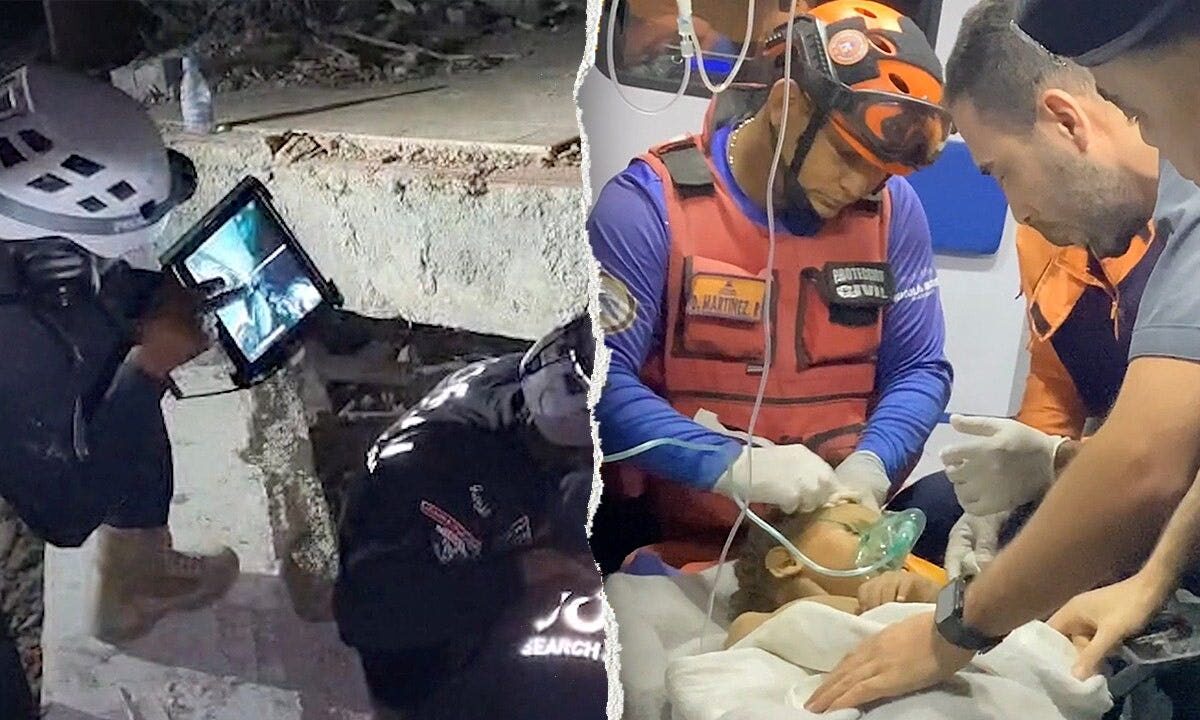
Rescuers pulled a 2-year-old boy alive from rubble six days after Venezuela’s twin quakes, a rare and emotional development in an otherwise grim recovery effort. The Venezuela earthquake rescue in La Guaira brought the child, identified by authorities as Klieber Moran, to a Caracas health center for evaluation and treatment, officials said (Venezuelan government statements reported by Reuters and Fox News).
Acting President Delcy Rodríguez credited Jordanian emergency workers with extracting the child from a collapsed building in La Guaira, the coastal city among the hardest hit by last week’s tremors, during a televised update (statement attributed to Delcy Rodríguez, cited by Reuters and Fox News).
Venezuela earthquake rescue: What happened in La Guaira
Rescuers reached Moran after six days of painstaking clearing at a private residence and neighboring structures. Authorities said the operation was complex because of unstable debris and damaged infrastructure; Jordanian teams who joined local crews worked with specialized lifting gear in the extraction, officials told reporters (Venezuelan authorities and foreign team briefings, as reported by Reuters).
The boy was alive when pulled free and was transported by ambulance to a health facility in Caracas where doctors provided immediate care, National Assembly President Jorge Rodríguez said in a televised address (quote below). Local officials described a scene of exhausted rescue workers and neighbors who gathered and prayed as the extraction took place.
“Early this morning, a 2-year-old boy was rescued and is currently receiving care at a health center in Caracas,” National Assembly President Jorge Rodríguez said, according to the government statement reported by Reuters and Fox News.
Venezuelan officials said earlier rescues included an infant and her mother pulled alive by U.S. search teams; authorities and international partners have repeatedly highlighted those recoveries as signs that targeted search operations can still find survivors in some pockets of collapsed buildings (reported by Reuters and Fox News).
Scale of the disaster
The twin earthquakes that struck Venezuela’s northern coast were recorded with magnitudes of about 7.2 and 7.5, according to seismic data cited by Venezuelan officials and international reporting (seismic and official briefings reported by Reuters). The tremors toppled buildings, damaged roads and utilities and triggered landslides in mountainous coastal zones.
Venezuelan authorities have reported a death toll of 1,943 and more than 10,500 injured; those figures were released by national agencies and relayed in international coverage (figures from Venezuelan officials, Reuters reporting). Officials cautioned the numbers are provisional and subject to change as recovery teams reach more areas and complete victim identification.
Search teams have repeatedly noted obstacles: unstable structures that risk secondary collapses, disrupted communications, and limited access to some communities because bridges and roads were damaged. That has slowed recovery and made some search sectors extremely hazardous for rescuers.
International and US response
International partners have mobilized to assist. The United Nations system, including the United Nations Children’s Fund (UNICEF), reported shipments of humanitarian supplies to support medical care, maternal-newborn services and other urgent needs (UNICEF reported delivery of emergency supplies in UN/UNICEF briefings cited by Reuters and agency statements).
The U.S. State Department confirmed deployment of three Urban Search and Rescue (USAR) teams from Virginia, California and Florida. The department said those teams comprise roughly 312 personnel, 18 canine units and more than 200,000 pounds of specialized rescue and technical equipment to support operations on the ground (U.S. State Department statement cited by Reuters and U.S. agency releases).
Other nations and international relief organizations have provided naval logistics, medical teams and airlift capacity to move relief cargo into affected coastal zones. Venezuelan officials have said they welcome coordinated international assistance while maintaining operational control of domestic response efforts.
Official statements and hope for survivors
Venezuelan leaders framed the six-day rescue as a powerful morale boost amid a devastating toll. “We must hold onto the hope of continuing to find people alive beneath the rubble,” National Assembly President Jorge Rodríguez said, urging continued support for search teams and medical personnel (Rodríguez’s remarks reported by Reuters and domestic state media).
Acting President Delcy Rodríguez specifically thanked foreign emergency crews — including Jordanian specialists — for their role in the extraction, and emphasized ongoing coordination with international partners on logistics and medical response. Hospital officials in Caracas said the rescued child was under observation and receiving care for dehydration and minor injuries, according to the government briefings cited in reporting.
What comes next for survivors and recovery
Authorities and aid agencies said search operations will continue while simultaneously scaling up relief distribution, sheltering, debris clearance and the restoration of basic services. Officials warned that casualty figures may rise as teams access remote or severely damaged areas and as identification of victims proceeds.
Humanitarian shipments already reported — including the UNICEF supplies — are intended to address urgent health needs, support safe childbirth and newborn care, and reduce disease risks among displaced populations (UNICEF and UN situational briefs cited by international reporting).
Recovery planners said sustained funding, more heavy equipment for debris removal, and expanded medical and psychosocial support for survivors and rescuers will be critical in the coming weeks. Coordination among Venezuela’s national agencies, UN partners and international search-and-rescue teams will shape how quickly communities can begin rebuilding.
Key takeaways
- A 2-year-old, Klieber Moran, was rescued alive after six days under rubble in La Guaira (Venezuelan government statements reported by Reuters and Fox News).
- Venezuelan authorities report 1,943 dead and more than 10,500 injured; tallies remain provisional (official counts cited by Reuters).
- International assistance includes UNICEF humanitarian shipments and U.S. State Department-dispatched USAR teams with roughly 312 personnel and 18 canine teams (UNICEF and U.S. State Department statements reported by international outlets).
This article is based on official Venezuelan government statements, reporting by Reuters and a Fox News story, and public statements from the United Nations/UNICEF and the U.S. State Department. Some details are drawn from those sources and have not been independently verified by this outlet.
Source attribution
Reporting and official statements used in this story:
- Fox News: Boy, 2, pulled alive from rubble six days after Venezuela’s devastating twin earthquakes
- Reuters coverage and official briefings: Reuters
- U.S. State Department public statements: state.gov
- UNICEF/United Nations humanitarian updates: unicef.org and un.org
Verification note: this outlet compiled official government statements and international agency briefings reported by Reuters and Fox News. Where possible, primary agency statements (UNICEF, U.S. State Department) are cited; numbers and operational details are subject to revision as agencies and local authorities update their reports.