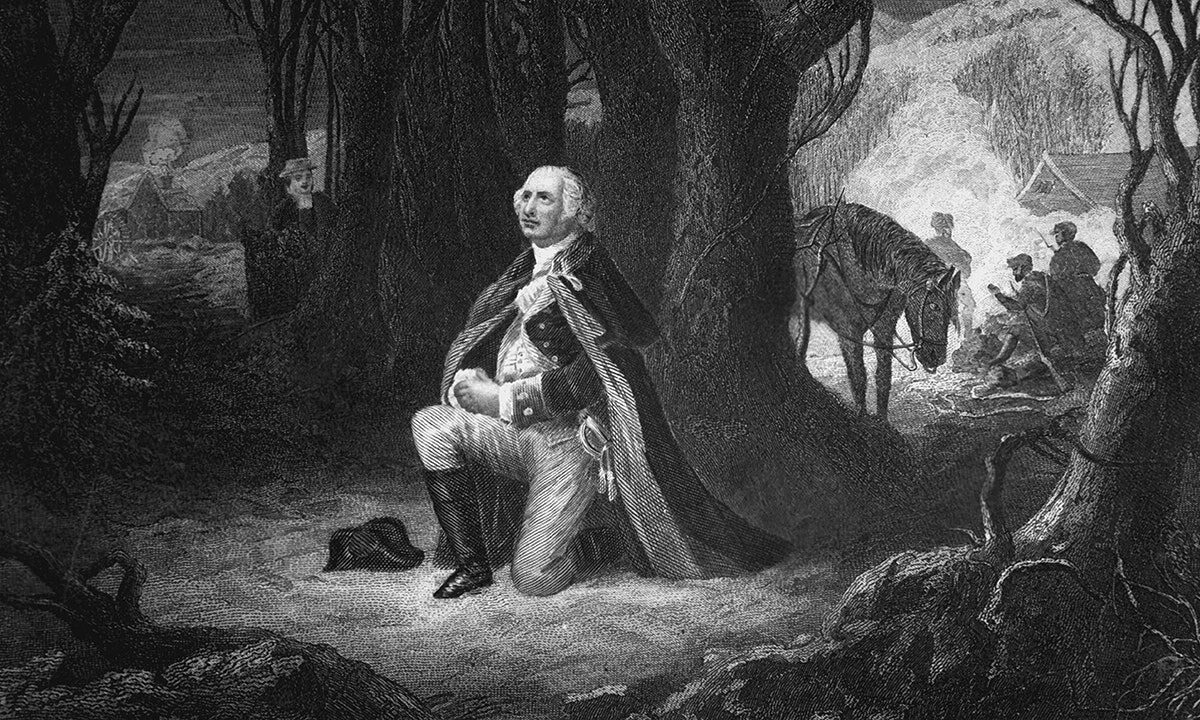
The Museum of the Bible in Washington, D.C., has placed Arnold Friberg’s Prayer at Valley Forge at the center of a new display marking America’s 250th anniversary. The painting, produced around the U.S. bicentennial era, depicts Gen. George Washington in a moment of apparent private devotion during the harsh winter of 1777–1778 and serves as the exhibit’s visual anchor.
The museum pairs the painting with interpretive text, artifacts and theatrical programming to explore themes of faith, scripture and leadership in the founding era. The presentation intentionally connects art and religious language with the story of national perseverance during a severe winter encampment at Valley Forge.
What is Prayer at Valley Forge
Prayer at Valley Forge is a large-scale, commemorative painting by Arnold Friberg that imagines General George Washington in a posture of private prayer amid the privations of the Continental Army’s winter at Valley Forge. Painted for a later commemorative purpose, the work is less a documentary record than a symbolic image that reflects how the artist and later audiences visualize Washington’s inner life.
The Museum of the Bible lists the painting as a centerpiece of its America 250 exhibit. Museum materials use the image to prompt discussion about scripture’s role in leaders’ moral imagination and to open a faith-centered conversation about the challenges the revolutionaries faced in 1777–1778.
The scene shown and its historical basis
The canvas places Washington alone, kneeling in the snow, a moment that conveys humility and dependence on Providence. The winter of 1777–1778 at Valley Forge was marked by extreme cold, supply shortages and disease; it tested the Continental Army’s endurance and leadership.
Historians caution that while Washington expressed religious language in letters and public orders and maintained private religious practices, the precise details of any single prayer at Valley Forge are not recorded in contemporaneous sources in the way a painting implies. The image is best read as an interpretation: a later generation’s visualization of Washington’s spiritual stance during crisis rather than a verbatim historical account.
How the museum frames faith and founding history
Carlos Campo, Ph.D., CEO of the Museum of the Bible, is quoted in the exhibit materials and related coverage asserting that Washington was “most powerful on his knees,” linking scripture and moral training to the impulses behind early American leadership. The museum frames the painting and supporting objects as evidence that scripture and religious conviction informed civic responsibility among some founders.
The exhibit is explicitly positioned within the Museum of the Bible’s interpretive lens: it privileges spiritual readings of founding-era actions and speeches and ties those narratives to the institution’s America 250 programming. That choice is presented as the museum’s perspective and not as the only valid historical interpretation.
Voices and anecdotes in the exhibit
The display includes dramatic and testimonial elements. A one-man show features actor James Denton portraying Washington in moments described as vulnerable and prayerful. Commentators such as Dr. Ben Carson appear in exhibit materials and coverage offering reflections on Washington’s faith and leadership.
The exhibit also cites a longer arc of presidential testimony about prayer, including a quote attributed to Abraham Lincoln about being “driven many times upon my knees” in crisis, used to suggest a recurring theme of private devotion in public leadership.
Unverified anecdote: An illustrative story recounted in related coverage—repeated in the exhibit’s narrative arc by commentators—describes an early battle (the 1755 Monongahela engagement) and includes an account in which an Indigenous marksman allegedly claimed to have shot Washington 17 times. This anecdote is presented as oral or anecdotal history in the exhibit and in press coverage; it is not corroborated by contemporaneous primary sources and should be treated as an unverified story rather than established fact.
Background
Arnold Friberg’s image joins a long tradition of commemorative artwork that shaped public perceptions of founders long after events occurred. Paintings like this are as much about memory and civic meaning as they are about historical reconstruction. Museums often use such works to prompt reflection rather than to assert documentary claims.
What to know before you visit
Expect a reflective, faith-centered exhibit that foregrounds scripture and devotional language when interpreting founding figures. The Museum of the Bible’s approach emphasizes spiritual explanations for leadership decisions and national resilience and supplements galleries with theatrical programming aimed at personal engagement.
Readers and visitors should keep in mind that the presentation blends documented history with commemorative interpretation and oral or anecdotal claims. Where historical precision is required, consult primary documents (for example, Washington’s correspondence and orders) or academic histories of Valley Forge and Washington’s religious practices to separate contemporaneous record from later commemoration.
Expert reaction and context
Scholars of early American religion generally note that founders’ personal piety varied and that public references to Providence served multiple political and rhetorical ends. While Washington used religious language, historians emphasize the limits of the surviving record for reconstructing private devotional episodes with certainty. Museum displays that emphasize prayer as a causal driver of political decisions are representing an interpretive stance rather than settled historical consensus.
Key takeaways
- Prayer at Valley Forge is a commemorative painting by Arnold Friberg and now functions as a central visual for the Museum of the Bible’s America 250 programming.
- The museum frames the painting to highlight scripture and faith as influences on leadership; this is an institutional interpretive choice, not an uncontested historical fact.
- The exhibit combines documented history, theatrical interpretation and anecdotal stories; some tales included in the presentation, such as the marksman anecdote, are unverified in primary records and should be read cautiously.
For visitors: read exhibit labels and quoted voices as part of the museum’s interpretive viewpoint and consult primary sources or scholarly works for further context on Washington’s letters, religious practice and the conditions at Valley Forge in 1777–1778.
Source attribution: This article is based on reporting in Fox News — “George Washington’s remarkable prayer for America still resonates 250 years later” (https://www.foxnews.com/travel/george-washingtons-prayer-america-still-resonates-250-years-later). The Fox News piece served as the primary source for exhibit details and quotations used here. Where coverage relays oral or anecdotal stories, those items are noted above as unverified and interpreted cautiously.