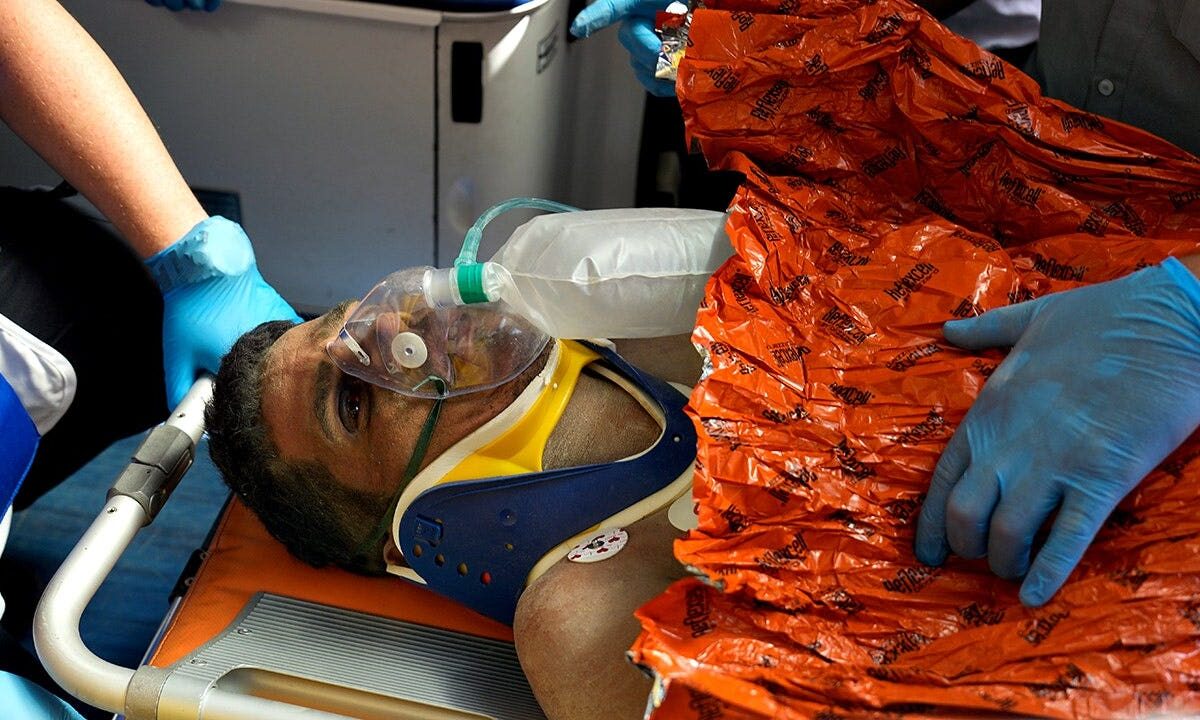
In a dramatic Venezuela earthquake rescue in La Guaira, rescuers pulled 43-year-old Hernán Alberto Gil Flores from the basement rubble of the Galerías Playa Grande shopping center Thursday, ending an eight-day ordeal after powerful twin quakes hit the region.
Video from the scene showed teammates carrying Gil Flores on a stretcher through cheering crowds before he was loaded into a Red Cross ambulance. The extraction offered a rare moment of hope amid a catastrophe that has left thousands dead and widespread damage.
Venezuela earthquake rescue at Galerias Playa Grande
Gil Flores was working an overnight shift when the first of two strong quakes struck on June 24, according to news reports. Much of the shopping center collapsed; rescuers say a small security booth in the basement remained intact enough to shelter him while debris shifted around it.
Teams at the scene said initial contact was made over the weekend and then maintained as crews planned a careful, methodical extraction. Onlookers and family members gathered nearby as rescuers dealt with continuing aftershocks and heavy rain during the operation.
How rescuers reached him
Crews used a telescopic camera to locate Gil Flores inside the rubble and to guide their approach. Through a narrow shaft, they lowered water and liquid nutrient solutions to sustain him while excavation continued, and they used small, precision tools and hand excavation to limit further collapse.
Rescuers described widening the shaft inch by inch until they could reach him safely. The final moments of the extraction were tense, then jubilant, as workers lifted Gil Flores onto a stretcher and carried him past cheering neighbors and relief personnel to awaiting medical help.
Teams on the ground and international aid
The operation at Galerías Playa Grande was led by Chilean firefighters, with search-and-rescue personnel from Costa Rica, the United States, Portugal, Mexico and other nations assisting in different areas, news organizations reported. Members of the Costa Rican Red Cross were among those who made contact and provided immediate medical attention at the site.
U.S. officials have mobilized humanitarian assistance to support the response. News reports state the U.S. government has made roughly $150 million in humanitarian aid available to help Venezuela address the disaster, and American teams have been involved in rescue and relief work in affected regions, according to coverage by major outlets.
Tight timeline of the rescue
- June 24: Twin earthquakes, reported by some outlets as magnitudes 7.2 and 7.5, strike northern Venezuela and topple buildings across coastal areas.
- Weekend after quakes: Rescuers detect signs of life beneath Galerías Playa Grande and establish limited communication with the trapped guard.
- Days 6–7: Teams lower liquids and nutrients through a narrow shaft while carefully clearing debris around the security booth and shoring unstable sections.
- Day 8: After widening the access shaft, rescuers extract Hernán Alberto Gil Flores and carry him through the crowd to awaiting medical assistance.
Scale of the disaster and ongoing needs
News organizations report the quakes have caused widespread devastation, with more than 2,200 people reported killed and over 11,000 injured; tens of thousands of buildings were damaged or destroyed. Authorities and aid groups caution these figures may change as search-and-rescue teams continue to work through rubble and assess hard-hit areas.
Immediate humanitarian priorities include continuing searches for trapped survivors, emergency medical care for the injured, shelter and protection for displaced families, and the rapid delivery of water, sanitation and food to isolated communities. Logistics remain a central challenge as roads and infrastructure sustain heavy damage.
Voices from the rescue
Rescuers and relatives described a tense operation that ended in relief. Costa Rican Red Cross rescuer Minyar Collado told reporters, “When we found him, he asked us not to tell his wife that he was alive, just in case he wouldn’t make it.”
Gil Flores’ wife, Gusbimar González, told the Associated Press the news of his survival brought a burst of hope: “When I learned he was alive, I saw a ray of light in the darkness.” Their comments were reported by news organizations covering the rescue.
What comes next for survivors and responders
Search-and-rescue teams will keep working in areas with reported entrapments while emergency agencies scale up aid distribution. Priorities for the coming days include clearing debris to improve access, establishing temporary shelters and medical stations, and restoring critical services such as water and electricity where possible.
Longer-term recovery will involve damage assessments, rebuilding damaged infrastructure, evaluating housing needs and coordinating sustained humanitarian assistance. Officials and international partners say coordinated logistics and consistent funding will be essential to reach remote or cut-off communities and to support survivors through reconstruction.
FAQ
How did the security guard survive for eight days?
Reports say Gil Flores sheltered inside a small security booth that remained relatively intact as much of the surrounding structure collapsed. Rescuers established contact and sustained him with water and liquid nutrients through a narrow shaft until extraction.
Which countries led the search-and-rescue effort?
The operation at Galerías Playa Grande was led by Chilean firefighters and included teams from Costa Rica, the United States, Portugal, Mexico and other nations assisting across the broader response, according to news coverage.
How much U.S. humanitarian aid has been mobilized?
News reports state the U.S. government has mobilized about $150 million in humanitarian aid to support Venezuela’s response to the earthquakes.
Sources: Fox News, The Associated Press and Fox News Digital. Original reporting: https://www.foxnews.com/world/security-guard-survives-eight-days-beneath-collapsed-shopping-center-venezuela-earthquakes
Next steps: Authorities say coordinated searches will continue and humanitarian partners are scaling up supplies and shelter. Readers should expect continued updates as teams complete searches and officials publish consolidated casualty and damage assessments.