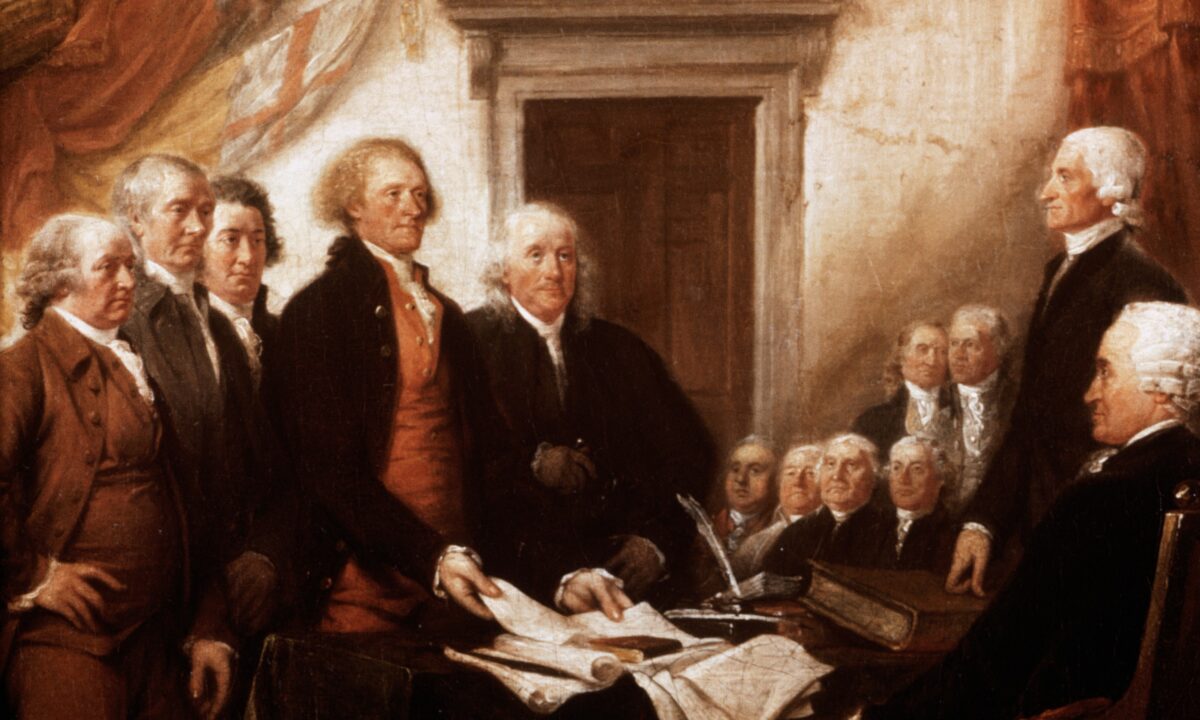
The Declaration of Independence remains a touchstone for debates about rights, sovereignty and the duties of government. The Declaration of Independence declared a radical principle for its time: that legitimate political authority rests on the consent of the governed and that certain rights are inalienable.
This piece follows a single thread: the text, how it was produced, the human cost for those who signed it, and the contested claims about its global legacy. Short sections keep the analysis tight and practical.
Declaration of Independence: What it said
The Declaration famously asserts, “We hold these truths to be self-evident, that all men are created equal, that they are endowed by their Creator with certain unalienable Rights, that among these are Life, Liberty and the pursuit of Happiness.” That sentence distilled Enlightenment premises into a political claim: governments exist to secure rights, not to grant them. (Text source: National Archives.) https://www.archives.gov/founding-docs/declaration-transcript
It pairs philosophical language with a list of grievances against King George III, turning moral assertion into a case for separation. The rhetorical force of that mix — principle plus concrete complaint — helped the Declaration travel beyond its immediate crisis and into later constitutional debates.
How the document was written and adopted
Thomas Jefferson was largely tasked with drafting the document. Contemporary accounts and Jefferson’s own papers place his drafting work in mid-June 1776; he completed a draft that was reviewed and edited by a congressional committee and the full Continental Congress. (See Monticello and other primary-document collections for drafting context.) https://www.monticello.org
Fifty-six delegates met in the Pennsylvania State House in Philadelphia to debate and ultimately adopt the Declaration. The adoption was not merely ceremonial: it marked a public, collective commitment to break with Britain and accept the risks that came with that choice.
The human cost for the signers
Putting one’s name on the Declaration carried concrete danger. The Fox News opinion this piece builds on states that “five of the signers were captured, tortured and killed” and that “nine signers died from wounds or hardships fighting in the war.” Those assertions reflect the author’s assessment of the personal toll on some signers; however, the exact counts and the nature of mistreatment vary among sources.
Contemporary and later records confirm that many signers endured imprisonment, property confiscation, exile and deaths related to the war. Biographical collections and archival records list individual cases and make clear that the costs ranged from economic ruin to loss of life; researchers should consult signer biographies for granular detail. (See collections at Monticello and other archival projects for signer-by-signer notes.) https://www.monticello.org/site/research-and-collections/signers-declaration
Global legacy and the modern argument
The Fox News author argues that the principles in the Declaration helped spark a long-term shift toward representative government and broader prosperity. The argument links the Declaration’s language to later constitutional experiments and to political change in the centuries that followed.
Those broad claims require careful sourcing. For the share of countries that are democracies, long-running datasets such as those produced by the V-Dem Institute and related research show that roughly half of the world’s states now hold competitive elections or fall into categories described as electoral or liberal democracies — though classifications and thresholds differ by dataset. For an overview of democracy measurement, see V-Dem. https://www.v-dem.net/en/
On wealth and prosperity, long-run economic data compiled by historians and presented in accessible form by Our World in Data show that global GDP per capita has risen dramatically since the 18th and 19th centuries, but the exact multiplier depends on the base year, price adjustments and which countries are included. Contemporary research supports the broad claim of a large increase in average global material prosperity since 1776, but most mainstream datasets do not support an unqualified “more than 100 times richer” figure without substantial qualifiers. For long-run economic trends, see Our World in Data. https://ourworldindata.org/global-economic-growth
Editorial note: The specific statistics cited in the original opinion piece — for example that “nearly half of countries are democracies” or that the world is “more than 100 times richer” than in 1776 — are presented there without detailed source citations. We have linked to widely used datasets above and flag these numbers for editor review. Where possible, provide dataset and methodology citations before printing headline multipliers.
Continuing debates and contradictions
The Declaration’s universal language coexisted with profound exclusions: slavery, limited suffrage and legal inequalities. Those contradictions were not incidental; they shaped the politics of the early republic and continue to shape how Americans and international audiences interpret the Founders.
Historians and commentators still debate how to weigh the Declaration’s rhetorical reach against the moral failings of the era. That argument shows up in competing narratives: some see the Declaration as a launching point for expanding liberty over time; others stress that its promises required later social and political struggle to approach universality.
Conclusion — a cautious legacy
The Declaration of Independence compressed an influential set of political claims into a short, public document. Its language helped frame later constitutional design and inspired movements for representative government in other nations, but the scale and direction of that influence are complex and mediated by local histories, institutions and subsequent choices.
Measured claims about how many countries are democratic today or how many times wealth has multiplied since 1776 should be backed by specific datasets and methodology. When those links are explicit, the Declaration’s place in global history becomes easier to trace: a powerful rhetorical template that, combined with other forces, helped reshape political possibilities over two centuries.
Source attribution and further reading
Source: Opinion by John Coleman, Fox News. Original article: https://www.foxnews.com/opinion/unwinnable-war-americas-founding-fathers-fought-won-changed-human-history-forever
Primary and reference sources cited in this piece: the Declaration text (National Archives), signer biographies and draft context (Monticello), democracy measurement (V-Dem Institute), and long-run economic trends (Our World in Data). Editors: please verify the numeric claims with the cited datasets before publication.