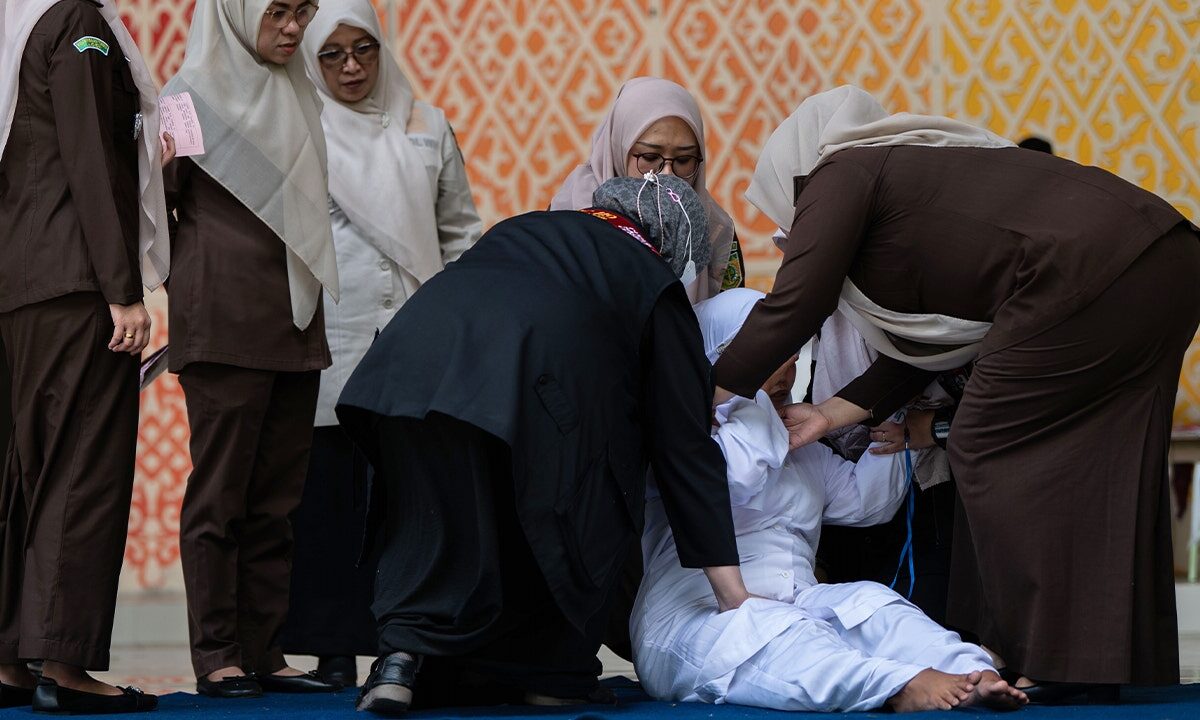
Authorities in Banda Aceh carried out a public caning Thursday after a viral TikTok livestream, a punishment that has reignited debate over local Sharia enforcement. The public caning Aceh case involved a 22-year-old man and a 25-year-old woman who were each given 21 lashes following a conviction in a Sharia court.
What happened in Banda Aceh
Local officials say the couple were detained in March and spent about four months in custody before the corporal punishment was carried out. The sentence was reduced from an initial 25 lashes to 21, authorities said.
Sharia police and local prosecutors told reporters the pair filmed a TikTok video inside a car that circulated online and prompted residents to file complaints. Police said the livestream showed what they described as an “immoral act,” and that residents who were upset by the clip reported it to authorities, which led to the arrest and trial.
Investigators confiscated a cellphone and a USB flash drive believed to contain the video. Officials said they planned to destroy those devices, according to reporting from The Associated Press. The handling and possible destruction of digital evidence has drawn scrutiny from legal observers and rights groups.
Public caning Aceh: law and sentence
Aceh province enforces its own Islamic Criminal Code under authority granted by a 2005 peace agreement with Indonesia’s central government. The local code criminalizes a range of what officials call moral offenses and allows caning as a penalty for certain violations.
Under the provincial rules, penalties for some offenses can reach up to 100 lashes. In this case, a Sharia court found the pair guilty and, after adjusting the sentence downward, ordered 21 lashes each. Provincial authorities say the punishment is part of the legal framework they apply for breaches of local morality codes.
The role of social media: the TikTok livestream
Authorities say the TikTok clip — which local media reported showed an alleged kiss inside a parked car — went viral locally and prompted residents to complain. Fox News reported the video was portrayed in local coverage as an alleged kiss that sparked outrage.
Sharia police described the video as “uncovered thanks to reports from residents who were disturbed by their immoral livestream content,” according to local reporting. That community reporting, combined with the online circulation of the clip, was cited as a key factor in launching the investigation.
Local reactions and human-rights concerns
Reaction in Banda Aceh was mixed. Some residents welcomed the punishment. One local resident quoted by reporters, 22-year-old Aini Nadhirah, said she believed the punishment was “entirely justified” because it would deter others from posting similar content and educate people about local norms.
Human-rights organizations criticized the practice. Amnesty International Indonesia called the punishment “cruel and degrading,” saying public caning violates international human-rights standards. International rights groups and some legal advocates raised concerns about due process, corporal punishment and the use of public shaming.
Supporters of Aceh’s system argue the province is exercising rights granted by law to uphold local moral codes. Critics counter that such penalties conflict with broader human-rights norms and can target vulnerable people in highly visible ways.
Evidence handling and the device-destruction claim
The confiscation of a phone and USB drive and the reported plan to destroy them is one of the more controversial details. Authorities told reporters they would destroy the devices after extracting what they called necessary evidence. The Associated Press reported the officials’ intention to destroy the devices; legal analysts warn that such steps can complicate transparency and appeal processes.
Observers say proper chain-of-custody for digital evidence is important for any case that could be appealed or reviewed. Rights groups have argued for clearer standards so that digital files can be preserved for independent review while still addressing privacy or community concerns.
What comes next
The case raises questions about social media use in Aceh and how platforms might respond when local laws differ sharply from national norms. Residents may change how they create and share content, while platform moderation and takedown policies could be tested in a province where local reporting can trigger legal action.
Legal and policy implications include whether provincial authorities will refine rules for handling digital evidence and whether there will be any domestic or international review of how such punishments are applied. For many observers, the incident highlights tensions between local autonomy under Aceh’s special status and broader human-rights expectations.
Reporting on this incident drew on coverage by The Associated Press and Fox News. For further reading, see the Fox News story below for the original reporting and local detail.
Source: Fox News; additional reporting by The Associated Press.