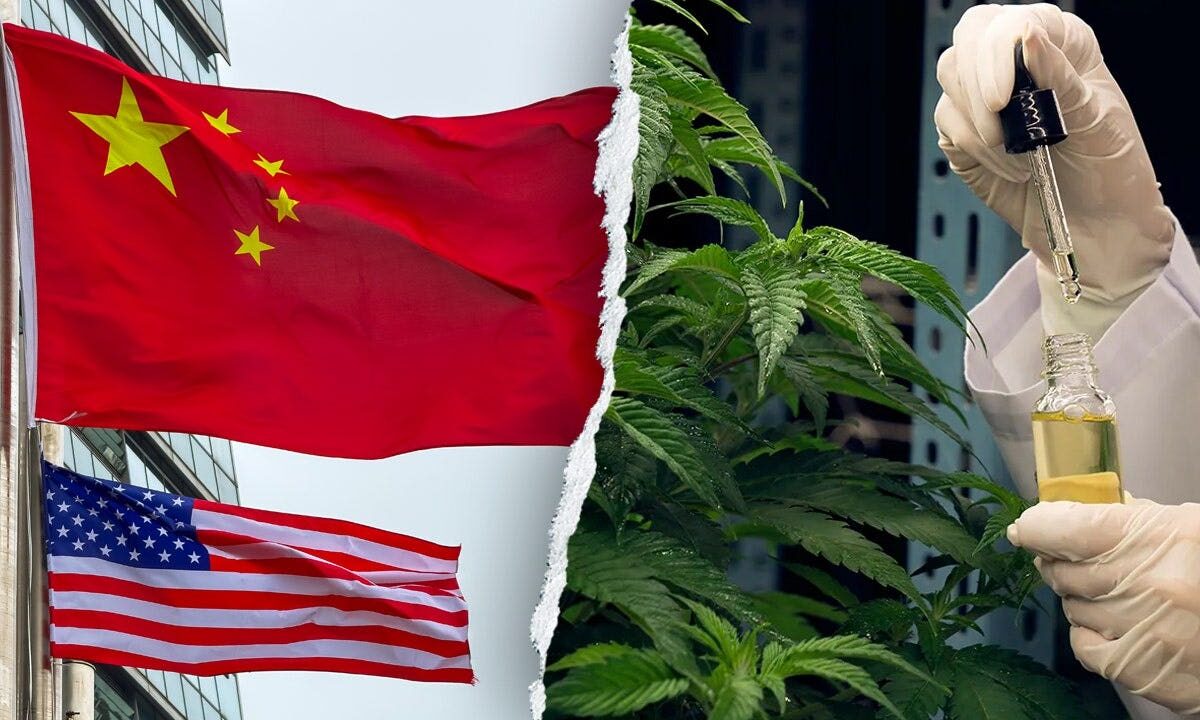
Former acting Homeland Security Secretary Chad Wolf this week urged Congress to probe what he called the growing role of Chinese-linked actors hemp industry in the U.S. intoxicating hemp market. In a letter to Rep. John Moolenaar and Rep. Ro Khanna, Wolf said the shift from industrial hemp to high-potency, intoxicating hemp-derived THC products appears to be driven in part by transnational groups and raised both public health and national security concerns.
Wolf explicitly cited the White House’s 2026 National Drug Control Strategy in urging action, and asked the House Select Committee on the Chinese Communist Party to open an inquiry into how these actors may be involved across the supply chain. Wolf framed many of the claims as concerns drawn from the strategy and law-enforcement reporting rather than proven facts, and asked lawmakers to investigate further.
What Wolf told lawmakers
In his letter to Rep. John Moolenaar (chair) and Rep. Ro Khanna (ranking member), Wolf described a market that has moved beyond narrowly regulated industrial hemp and CBD into widespread production of intoxicating hemp-derived THC products. He flagged the forms those products take — gummies, candies, beverages and vapes — and warned they often lack consistent controls on potency, labeling and age verification.
Wolf quoted passages from the White House strategy and urged the committee to examine how supply chains, financing and chemical processing intersect with alleged transnational criminal activity. He warned that recent federal fixes could be weakened or delayed and urged Congress to ensure reforms are fully implemented.
Chinese-linked actors hemp industry
The White House National Drug Control Strategy, which Wolf referenced in his letter, characterizes parts of the marijuana and intoxicating hemp trade as having been industrialized by transnational criminal organizations, including actors with ties to China. The strategy itself cites a law enforcement estimate that Chinese criminal groups operate more than 80% of Oklahoma’s thousands of marijuana and hemp farms; Wolf repeated that estimate while noting it is an attribution from the strategy and law-enforcement reporting.
According to the documents Wolf cited, processed hemp-derived THC can enter the market in edible forms, disposable and refillable vapes, and novelty consumables. The strategy and Wolf’s letter describe routes from cultivation and extraction through distribution to retail and online sales, and they flag gaps in labeling, testing and age checks that could let high-potency products reach underage users.
Public health and national security risks
Officials behind the White House strategy and Wolf’s letter warned of public health implications primarily for youth and other vulnerable populations. Those warnings include concerns about high-potency THC exposure, inconsistent dosing, potential chemical contaminants and the absence of standardized safety testing in some parts of the market. Wolf and the strategy present these points as reported concerns that merit verification and enforcement, not as settled findings in every instance.
The documents also raise law-enforcement and national-security issues. They describe allegations — reported by state and federal investigators and summarized in the strategy — that some cultivation and processing sites may be linked to human trafficking, sophisticated money-laundering schemes and the use of unregistered pesticides. The White House strategy additionally connects transnational networks involved in these operations to broader illicit drug flows, suggesting the intoxicating hemp market could be exploited as another channel for criminal activity.
What Congress and regulators could do next
Wolf urged the committee to investigate concrete parts of the supply chain: financing sources for large-scale cultivation, chemical manufacturing and imports used to extract or concentrate THC, the extent of illegal cultivation operations, and suspected money-laundering conduits. He recommended document requests, witness interviews and coordination with federal and state law enforcement to trace commercial links and financial flows.
Policy and enforcement steps discussed in Wolf’s letter and the White House strategy include better interagency data sharing, targeted criminal probes, stepped-up controls on chemicals and pesticides, and stricter product labeling and age-verification standards at retail. Wolf also underscored the need to implement last year’s bipartisan law closing regulatory loopholes around intoxicating hemp products and to resist regulatory rollbacks that could weaken protections.
What comes next
Lawmakers could respond by opening hearings, issuing subpoenas or requesting federal agency records. Regulators at the FDA, USDA and EPA, alongside DOJ and DHS components, could coordinate enforcement and guidance. State and local authorities also play a role in licensing, testing and inspections. Wolf’s letter asks the committee to prioritize tracing financial ties and chemical-supply chains as immediate next steps.
Background
The House Select Committee on the Chinese Communist Party, with Rep. Moolenaar leading this letter’s primary recipients and Rep. Khanna as ranking member for the subject, has acknowledged receiving Wolf’s correspondence. Federal and state authorities have a history of investigating unlicensed cultivation and cross-border networks tied to illicit drug distribution; Wolf’s submission frames the current issue as an extension of those enforcement priorities into the hemp-derived THC market.
Source attribution
This reporting and the details in Wolf’s letter draw on Fox News reporting and the White House’s 2026 National Drug Control Strategy, which Wolf cited in his correspondence. Readers should note that specific claims such as the Oklahoma estimate and allegations of trafficking or money laundering are attributed to the White House strategy and law-enforcement sources referenced therein; they are presented in Wolf’s letter as reported concerns that merit further investigation.
Source: Former acting DHS secretary warns Chinese criminal organizations are infiltrating America’s hemp industry (Fox News); White House 2026 National Drug Control Strategy.
FAQ
What happened with Chinese-linked actors hemp industry?
Former acting DHS Secretary Chad Wolf sent a letter to House leaders urging an investigation into alleged roles played by Chinese-linked actors in the U.S. hemp-derived THC market and related illegal cultivation, citing the White House’s 2026 National Drug Control Strategy and law-enforcement reporting.
Why does Chinese-linked actors hemp industry matter?
Officials say the issue matters because of potential public-health harms — particularly youth exposure to high-potency, poorly regulated THC products — and because alleged ties to transnational criminal networks could create law-enforcement and national-security challenges. The claims in Wolf’s letter are attributed to the White House strategy and should be examined through oversight and investigation.
What happens next?
Wolf asked the House Select Committee to investigate financing, chemical manufacturing, illegal cultivation, money laundering and criminal ties. Lawmakers could open hearings, request documents and press regulators to enforce last year’s bipartisan reforms more aggressively.