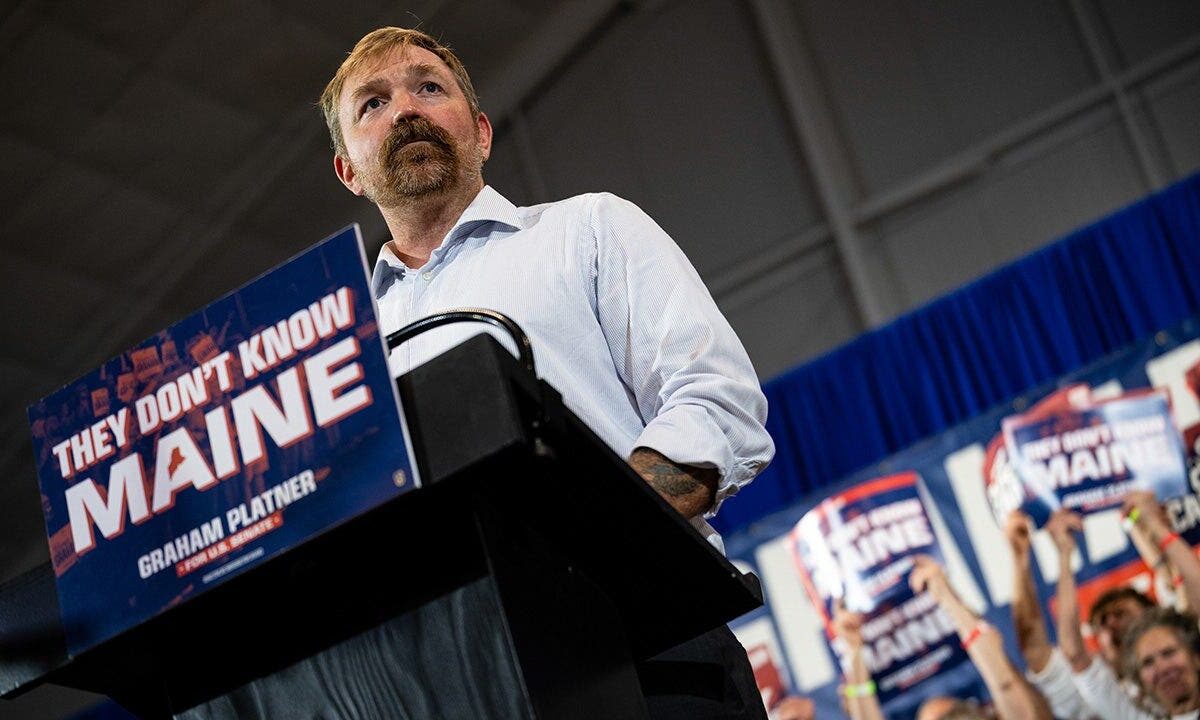
Graham Platner remains the Maine Democratic nominee for U.S. Senate, the state party said, and no formal replacement process can begin unless he formally withdraws by the secretary of state’s July 13 deadline. The party set July 27 as the cutoff to submit a new nominee, giving party leaders and potential candidates a narrow window to act if Platner steps aside.
Graham Platner campaign status
Platner has not withdrawn and continues to be listed as the official Democratic nominee challenging incumbent Republican Sen. Susan Collins. The candidate has denied a sexual-assault allegation reported by Politico and said he is considering “the best path forward.”
Platner’s campaign pushed back on media accounts and on claims from some party officials about how outreach between the campaign and party leaders occurred. In a statement, the campaign said it had sought clarity on procedural questions, adding, “At no point has the campaign tried to ‘put its finger on the scale.’” The campaign also noted the role of the volunteers and voters who backed Platner during the nominating process and said those supporters should be considered in any discussion about next steps.
Party rules on a replacement
The Maine Democratic Party issued a statement and circulated a video from Executive Director Devon Murphy-Anderson outlining how the party would handle any potential replacement. Murphy-Anderson emphasized that the party would run “an open, inclusive, transparent, and fair” process and warned that an individual campaign cannot unilaterally select a nominee.
“The Maine Democratic Party has been working around the clock to develop a process to replace our U.S. Senate nominee that is open, inclusive, transparent, and fair,” Murphy-Anderson said. “The integrity of this process is just as important as the outcome.”
The party’s guidance repeatedly states that a replacement cannot be nominated unless the current nominee formally suspends or withdraws the candidacy. Under the timeline the party described, July 13 is the secretary of state’s deadline for a nominee to withdraw; July 27 is the latest date the party could submit a replacement and have that name appear on the general-election ballot.
Allegation and media reporting
The allegation that sparked these discussions was first reported by Politico and has been described in media accounts as an accusation from a woman who previously dated Platner. Platner has denied the allegation; reporting to date has treated the matter as an allegation rather than a proven fact.
The Maine Democratic Party said in its public comments that “multiple women have made serious, credible allegations” and that the party stands with survivors. That claim reflects the party’s public position and has not been independently verified for this article. Fox News Digital reported attempts to reach both Platner’s campaign and party officials for additional comment, and the campaign and party have provided differing accounts of outreach and intent.
Party officials framed the dispute as concerning process as much as personnel: they argued the party must retain authority over any replacement to ensure fairness, while the campaign said its contacts were meant to clarify mechanics, not to influence the outcome.
Names floated and next steps
Media reports have identified several figures who could be discussed as possible replacements if Platner withdraws. Those names have included former Maine Senate President Troy Jackson, Secretary of State Shenna Bellows, and Nirav Shah, the former director of the Maine Center for Disease Control and Prevention. Reporting has described those names as being floated in the media; none has been named by the party as a nominee and none has, as of publication, publicly announced an intention to run as a replacement.
If Platner does not withdraw by the July 13 deadline, the party says it would have no mechanism to remove him from the ballot under its stated timeline. If he withdraws by July 13, the party would then have until July 27 to complete an internal selection process and submit a new nominee to the secretary of state so the new name appears on voters’ ballots.
The compressed schedule would present logistical hurdles for any replacement campaign. Potential nominees would need to organize fundraising, staffing and messaging quickly, while party leaders would have to balance calls for a deliberative process with the practical need to meet the secretary of state’s deadlines.
Short timeline
- July 13 — secretary of state’s deadline for a nominee to withdraw.
- July 27 — deadline for the party to submit a new nominee if a withdrawal has occurred.
What comes next
The immediate question is whether Platner will withdraw by the July 13 deadline. If he does, the Maine Democratic Party has signaled it will begin a structured replacement process; if he does not, the party’s public guidance indicates the nominee will remain on the ballot. Party leaders say they plan to operate with transparency and inclusiveness if a selection is required, while the campaign has emphasized protecting supporters’ voices.
Observers say the window for any change is narrow and that decisions in the coming days will determine whether the party heads into the fall with Platner on the ticket or with a new nominee in place. The situation is likely to remain fluid through the key July dates.
Source: Fox News. Politico first reported the allegation that prompted the debate; the Maine Democratic Party issued the statement and video outlining replacement rules referenced above.