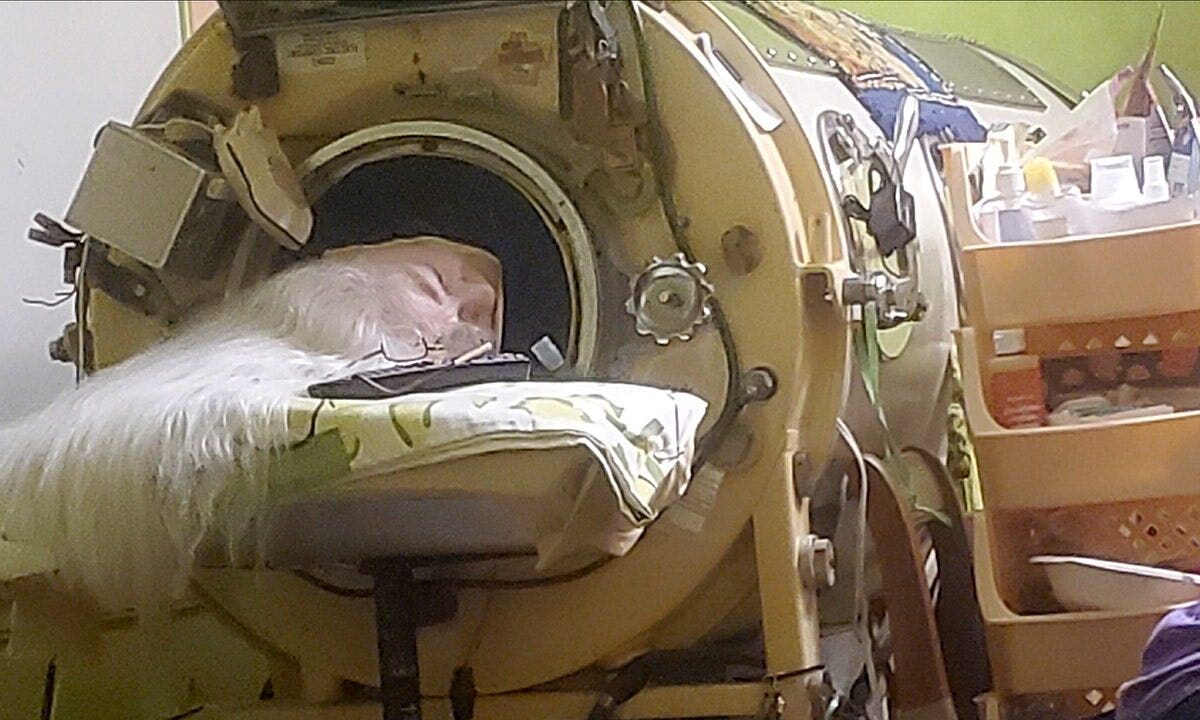
Martha Lillard, an Oklahoma woman described in news reports as the last American to rely on an iron lung, has died at 78. Her death certificate lists chronic pulmonary failure and post-polio syndrome as causes, and family members told reporters that COVID-19 infections in recent years left her increasingly dependent on the device.
The iron lung shaped much of Lillard’s life: she contracted polio at age five and used a negative-pressure ventilator for decades to assist breathing. Reporting about her death and family accounts was published by Fox News and The Associated Press; this article attributes key factual claims to those reports and to the death certificate where noted.
What we know
Lillard died at 78, according to reporting by Fox News and The Associated Press. Her death certificate cited chronic pulmonary failure and post-polio syndrome as causes.
The Associated Press, citing family members, reported that Lillard contracted COVID-19 twice during the pandemic and that those infections corresponded with a major decline in her respiratory health. Her sister told AP that Lillard spent nearly all of her time in the iron lung after the infections, and relatives linked the decline to long-haul COVID. These connections are presented here as family-reported and supported by the death certificate; they are not the output of peer-reviewed, case-specific clinical study in public records.
Fox News published a feature that brought wider attention to Lillard’s situation; that reporting described her as the last American to rely on an iron lung. The claim is notable and widely reported in recent coverage, but independent verification beyond those news reports is not available in the public record cited here.
Life with polio and the iron lung
Lillard contracted polio at age five, initially leaving her paralyzed from the neck down. As a child she used an iron lung at night to breathe; the device supports respiration by creating negative pressure around the torso, allowing the lungs to expand.
Despite early disability, Lillard maintained a high degree of independence. She attended school for two hours a day while tutors worked with her the rest of the time, and she communicated with classmates and teachers using an intercom-style phone system from home.
Her family adapted travel arrangements so she could take road trips: a custom trailer was fitted to carry the iron lung, and hotels were selected for doorways wide enough to accommodate the machine. Over time she regained use of her left arm and legs through therapy and was able to drive for a period.
In recent years she married after corresponding for two decades with a man from Egypt who later obtained a visa; her sister described the couple as “soul mates.” Lillard also wrote poetry and volunteered with the Humane Society, according to family accounts cited in news reporting.
COVID-19 and changing dependence
Family members told reporters that Lillard contracted COVID-19 twice and that the infections coincided with a sharp change in her breathing. Before those infections, the reporting said she had about 25% lung capacity; afterward, relatives said she spent nearly around-the-clock time in the iron lung.
Relatives and the death certificate link her final decline to chronic pulmonary failure and post-polio syndrome; family members described the progression as accelerated after COVID infections. This article reports those family statements and the death-certificate findings while noting that direct medical causation in an individual case like this is not established here beyond the documentation and interviews cited by news organizations.
Medical context: post-polio syndrome and the iron lung
Post-polio syndrome affects some survivors years after initial recovery from poliomyelitis and can include new muscle weakness, fatigue and breathing problems. Chronic pulmonary failure denotes long-term respiratory insufficiency that can be life-threatening and may require ongoing ventilatory support.
The iron lung is a negative-pressure ventilator that was commonly used in the mid-20th century when poliovirus often paralyzed chest muscles. The device encloses the body (leaving the head exposed) and cyclically lowers pressure around the chest to draw air into the lungs. Modern ventilators typically use positive pressure via tubes or masks instead.
Vaccination dramatically reduced polio in the United States: the first widely used polio vaccine was introduced in 1955, and by 1979 polio was considered eliminated in the U.S., greatly decreasing demand for iron lungs and other acute polio-era supports.
Why her story matters
Lillard’s life is a personal window onto a disease that once caused widespread disability and fear, and on how survivors live with long-term consequences decades later. Her experience underscores the human dimension behind public-health achievements such as the polio vaccine and provides a poignant example in discussions about prolonged respiratory illness after viral infection.
Her story also intersects with broader conversations about long-haul COVID, caregiving needs for people with complex chronic conditions, and how families and communities adapt technology and travel to preserve quality of life.
What comes next
For clinicians and researchers, individual cases like Lillard’s may raise questions about mechanisms linking viral infections and respiratory decline in polio survivors; for families and policymakers, they prompt consideration of support systems for people with rare, long-term medical needs. Reporting on Lillard’s life may encourage clinicians to document and study similar cases more closely, while reminding the public of both vaccination impact and the lingering effects of historic infectious diseases.
Frequently asked questions
What is an iron lung?
An iron lung is a negative-pressure ventilator that encases the body and periodically reduces pressure around the chest to draw air into the lungs, supporting breathing when chest muscles are paralyzed or severely weakened.
Was Lillard the last American to use an iron lung?
Recent reporting in Fox News described Lillard as the last American to rely on an iron lung. That description comes from the news coverage; independent verification beyond those reports is not presented in the public reporting cited here.
Did COVID-19 cause her increased reliance on the iron lung?
Family members linked Lillard’s respiratory decline and greater dependence on the iron lung to two COVID-19 infections and to long-haul COVID. The death certificate lists chronic pulmonary failure and post-polio syndrome. These connections are reported here based on family statements and the death certificate; this summary does not establish medical causation beyond those sources.
Source: Reporting by Fox News and The Associated Press. Original Fox News story: https://www.foxnews.com/health/last-american-use-iron-lung-dies-78-years-old-childhood-polio-diagnosis