FIFA investigation into post-match brawl: FIFA said it has appointed a Disciplinary and Ethics Prosecutor to examine reported incidents that followed Spain’s 1-0 extra-time win over Argentina in the World Cup final. The move begins a formal fact-finding process under the FIFA Disciplinary Code after several alleged confrontations on the pitch at New York/New Jersey Stadium.
FIFA statement and probe
In an official statement, FIFA said it had “appointed a Disciplinary and Ethics Prosecutor to investigate potential breaches of the FDC with regard to the post-match incidents,” citing article 36 of the FIFA Disciplinary Code. That language indicates the matter will be handled through FIFA’s disciplinary procedures, which include evidence gathering by the prosecutor, possible charges and consideration by the relevant disciplinary bodies.
The statement did not list individuals under formal charge. Instead, FIFA said the appointment of a prosecutor was the procedural step needed to assess whether disciplinary proceedings should be opened based on available match reports, referee accounts and video evidence.
What happened at the final
Spain beat Argentina 1-0 in extra time after Ferran Torres scored past goalkeeper Emiliano Martínez. The match, held at New York/New Jersey Stadium, was tightly contested and decided late in extra time, prompting intense reactions on both benches.
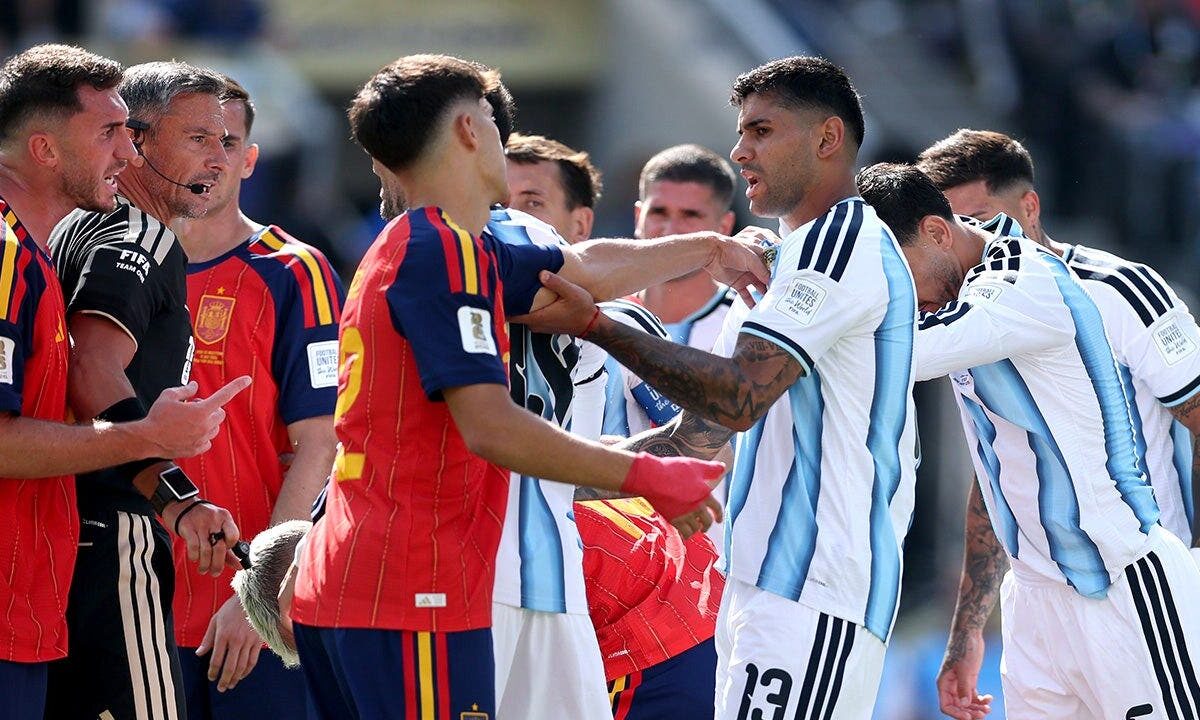
Shortly after the final whistle, video footage and media reports show multiple, brief on-pitch confrontations involving players and staff from both teams. Stewards and teammates moved in to separate those involved while referees completed post-match procedures.
Alleged incidents on the pitch
Reporting and available footage describe several distinct incidents that are now under review. These accounts should be read as reported or alleged until FIFA’s disciplinary process reaches conclusions.
-
Video and reports show Argentina midfielder Leandro Paredes reportedly appearing to grab Spain defender Eric García by the throat during a heated exchange. Media outlets described the action as a throat grab based on slow-motion replays; FIFA will assess whether the conduct constitutes a breach of the Disciplinary Code.
-
Leandro Paredes received a red card shown after the final whistle. He had earlier received a yellow card after coming on as a substitute.
-
Reports from multiple outlets indicate Argentina assistant coach Roberto Ayala was seen approaching Spain’s Dani Olmo and, according to those reports, striking or making contact with him in the face/chin area before others intervened. That action is described in news coverage as an alleged punch and will be reviewed as part of the investigation.
-
Additional confrontations were captured involving players and staff exchanging words and shoves; several participants were held back by teammates and stadium stewards as the situation was contained.
Timeline of the incidents
The sequence, as reported by media and seen in broadcast footage, unfolded rapidly:
-
The final whistle and immediate celebrations by the Spanish team.
-
Around the same time, Argentina players and staff reacted to the defeat, leading to moments of tension during player interactions on the pitch.
-
Footage shows the reported throat grab involving Leandro Paredes and Eric García during a separate exchange.
-
Shortly after, a red card was issued to Paredes following the end of play; earlier he had been booked.
-
Reports indicate Roberto Ayala approached and allegedly struck Dani Olmo during the fall-out, after which teammates and officials separated the parties involved.
All timestamps and fine details of these exchanges will be verified by FIFA’s review of official reports and video evidence; the timeline above reflects initial reporting and available footage and is subject to refinement as the investigation proceeds.
Who may be investigated and next steps
Media outlets including The Associated Press and Fox News reported that Nahuel Molina and Roberto Ayala are among those expected to be reviewed as part of the inquiry. FIFA itself did not name individuals in its initial statement; the federation’s appointment of a prosecutor starts a formal phase in which the prosecutor will gather evidence and determine whether to bring formal charges.
Under FIFA’s disciplinary framework, the prosecutor may refer cases to the FIFA Disciplinary Committee, which can impose measures ranging from warnings and fines to match suspensions or bans, depending on the conduct established and the articles applied. Any sanctions would follow FIFA procedures and provide the parties involved with an opportunity to respond.
What comes next
Next steps will include an examination of match reports from the referees, video review from multiple angles, witness statements and any relevant communications recorded by match officials. The prosecutor’s findings will determine whether formal proceedings are opened and which specific provisions of the Disciplinary Code, including article 36 as cited by FIFA, are invoked.
FIFA has not provided a public timetable for the completion of the prosecutor’s review. Historically, the duration of such investigations varies with the complexity of the incidents and the volume of evidence to be assessed.
Why this matters to teams and fans
A disciplinary probe at the World Cup final level has implications for accountability and reputational risk. Findings could affect player availability for future matches, staff roles within national associations and how national teams are perceived by fans and sponsors.
For both Argentina and Spain — countries with global football profiles — the outcome may influence public narratives about sportsmanship and the conduct of coaching staff and players in high-stakes fixtures.
Reactions and context
Argentina coach Lionel Scaloni said after the match that the team had given everything and accepted the result; his comments emphasized respect for the outcome while acknowledging the emotional fallout of a narrow defeat. Media commentators offered mixed reactions, with some praising gestures of sportsmanship by individual players and others condemning the post-match confrontations.
News organizations caution that several actions captured on video remain described as “appearing to” or “reported” and that final determinations will come from FIFA’s disciplinary process. The Associated Press and other outlets provided early reporting that FIFA and tournament match reports will now help clarify the facts.
Sources: FIFA’s official statement (linked below) is the primary source for the procedural action taken; reporting from Fox News and The Associated Press contributed to the identification of reported incidents and named individuals.
FIFA official statement: FIFA — Official statement on post-match incidents
Additional reporting: Fox News — FIFA launches investigation into brawl after Spain defeated Argentina in World Cup Final. The Associated Press contributed to background reporting and match assessments.