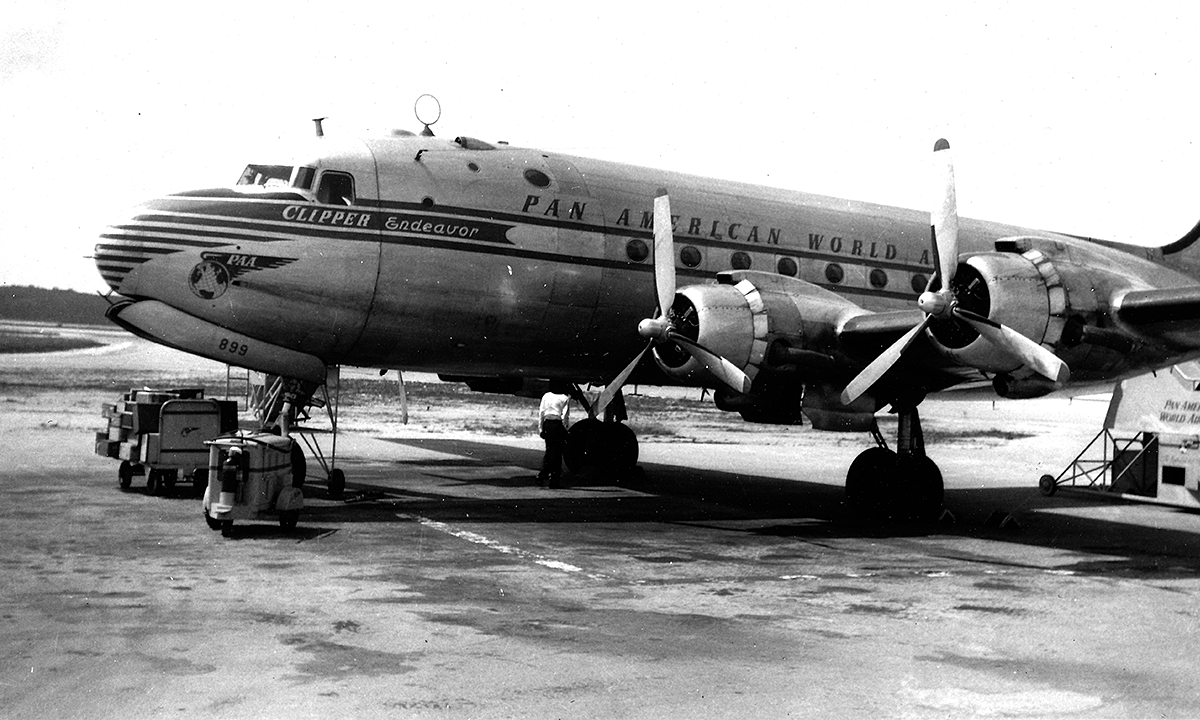
Searchers have located the long-lost Pan Am crash wreckage from the 1952 DC-4 that ditched off Puerto Rico, a discovery that revives a tragedy that killed 52 people and illuminated the safety changes that followed. The fuselage and a separated tail were identified in nearly 2,000 feet of water more than seven decades after the aircraft — known in records as a Pan American World Airways DC-4 — went down shortly after leaving San Juan for New York.
The find is the result of matching archival maps and witness testimony with modern undersea technology, giving historians and investigators a physical site to compare with the Civil Aeronautics Board report and survivor accounts.
What was found and why the Pan Am crash wreckage matters
High-resolution sonar data returned from the search zone shows the DC-4 fuselage lying intact in places and a detached empennage some distance away. Contemporary records of the 1952 ditching document that 52 people were killed and 17 survived; linking those records to the wreck location helps clarify the sequence of events during and after the water landing.
Having the wreck in view provides a material anchor for questions long limited to testimony and paper records: where the plane settled, how quickly key sections flooded, and which components match descriptions in the CAB files. For safety historians, that matters because many postwar regulations trace back to the failures exposed by this accident.
How searchers located the wreckage
Researchers led by the Air/Sea Heritage Foundation used archival sleuthing to define a tight search grid, drawing on a Puerto Rico hearing record and an Air Force map sketched by aviators who witnessed the ditching. That narrowed the area where undersea assets needed to sweep.
Deep Sea Vision provided an autonomous underwater vehicle equipped with high-resolution sonar. Operating from the company’s survey ship, the AUV ran a targeted 10-square-nautical-mile grid. On its first pass over the prioritized zone the vehicle returned imagery that matched the expected outline of a DC-4 fuselage and a separate tail assembly.
As Deep Sea Vision CEO Tony Romeo summarized, “There we were, and everything kind of came together at the moment: good weather, the right team, and the right equipment and ship.” The search underscores how precise archival work plus modern sensors can resolve questions that once seemed out of reach.
What the Civil Aeronautics Board concluded
The Civil Aeronautics Board’s original investigation remains the authoritative historical account. The CAB concluded that inadequate maintenance contributed to an engine failure shortly after departure and that decisions by the captain after the loss of power were a factor leading to the ditching.
Those findings have not been superseded by the new discovery; rather, locating the wreckage gives researchers an opportunity to test the CAB’s documented sequence against physical evidence on the seafloor and to better understand structural damage consistent with the board’s conclusions.
Survivor testimony and evacuation problems
Seventeen survivors and contemporaneous testimony described a water landing that left many passengers alive at first but a chaotic evacuation afterward. Investigators noted confusion over life vests, difficulty deploying life rafts and the rapid sinking of the airframe.
Officials and witnesses recorded that the DC-4 sank within minutes of ditching, limiting time for an orderly evacuation. Those operational failures—difficulty locating flotation equipment and launching rafts under pressure—were central to the reforms that followed.
Why this discovery matters now
Beyond answering long-standing questions about where the wreck settled, the site highlights how technical and procedural gaps observed in the 1952 accident shaped later rules. The panic and problems locating flotation devices documented after the ditching helped drive reforms such as mandatory preflight passenger briefings and improvements to flotation equipment and crew procedures.
The wreck also offers researchers a chance to study midcentury aircraft construction and corrosion in deep water, and to see how material evidence lines up with archival descriptions. That comparison deepens understanding of why particular safety changes were adopted.
What comes next for the site and research
With the initial sonar confirmation complete, likely next steps include additional non-intrusive undersea imaging — more AUV passes, higher-resolution photogrammetry and possibly side-scan or magnetometer surveys — to build a detailed site model. Any decision to recover artifacts or disturb the wreck would require permits and coordination with relevant authorities and stakeholders.
Researchers and preservationists, including the Air/Sea Heritage Foundation and Deep Sea Vision, plan to align the new imagery with CAB files, Coast Guard testimony and witness maps to refine the timeline of the ditching and evacuation. Conservation specialists and archival partners would then assess whether selected artifacts could be documented or conserved for study without compromising the site’s integrity as a location where people died.
Those concrete steps — further imaging, careful archival comparison, and tightly controlled documentation or recovery only under formal permissions — would expand knowledge while treating the site with necessary legal and ethical care.
FAQ
How was the Pan Am crash wreckage discovered?
Investigators combined archival records, witness maps and a targeted search grid. Deep Sea Vision’s autonomous underwater vehicle, fitted with high-resolution sonar, located the fuselage and separated tail on its first pass over the 10-square-nautical-mile search area.
What did the original investigation find caused the ditching?
The Civil Aeronautics Board concluded that inadequate maintenance contributed to an engine failure and that the captain’s handling after the loss of power was a factor. Those conclusions remain the official historical account.
Did this accident change airline safety rules?
Yes. The evacuation difficulties and equipment failures documented after the 1952 ditching helped spur aviation-safety reforms such as mandatory preflight passenger briefings and improvements to flotation equipment and crew procedures.
Source notes and attribution
This article draws on reporting and archival research from the Air/Sea Heritage Foundation and reporting that included contributions from The Associated Press. Air/Sea Heritage Foundation President Russ Matthews led archival research that guided the search, and Deep Sea Vision supplied the autonomous underwater vehicle and sonar data used to identify the wreck.
For the original reporting and details on the discovery, see the Fox News story: Long-lost Pan Am crash wreckage found decades after deadly disaster that reshaped airline safety.