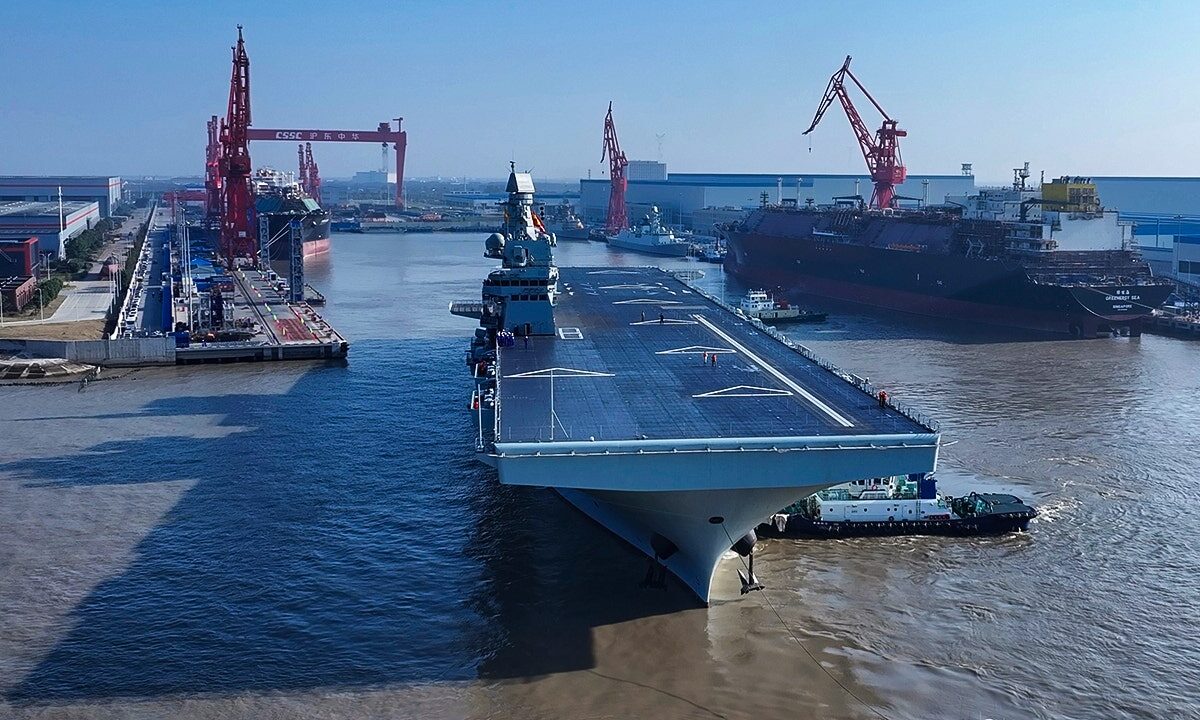
The Chinese naval replenishment ship under construction near Guangzhou, reported by Fox News, is roughly 885 feet long and appears designed to refuel, rearm and resupply carrier groups at extended range. That characterization is interpretive and based on open-source imagery and analysis rather than an official People’s Liberation Army operational statement.
This article traces how a large replenishment hull fits into a broader logistics and industrial picture: expanded shipbuilding capacity, strategic energy buffers, critical industrial inputs and space-based assets that together can increase the endurance of deployed forces. At each step the account notes the source and flags provisional or interpretive claims where appropriate.
Chinese naval replenishment ship
The vessel visible in satellite and port-area imagery near Guangzhou is described in reporting as about 885 feet long and configured in ways consistent with at-sea refueling and rearming. The phrase “appears designed” is appropriate: open-source imagery supports this assessment, but there is no formal PLA declaration in the public record confirming the ship’s specific role or operational status.
What the Guangzhou vessel appears to be
Open-source reporting frames the hull as a large replenishment ship intended to carry fuel, munitions and logistics stores. If fitted for underway replenishment, such a hull would increase the volume of supplies that could move with carrier groups and task forces, reducing the frequency of port calls.
That capability is interpretive from imagery: mast and deck arrangements visible in public photos are consistent with resupply functions, but analysts caution this does not confirm the vessel’s operational readiness or precise outfitting.
How logistics and shipbuilding scale sustain operations
Logistics are the limiting factor in sustained naval presence. A single large replenishment ship raises the aggregate fuel and stores available to a task force, enabling longer patrols and quicker reconstitution after strikes. In practice, this reduces dependence on nearby friendly ports and gives commanders more flexibility in routing and timing.
China’s industrial base matters for this equation. A U.S. Trade Representative assessment found Chinese shipbuilders accounted for more than 50% of global shipbuilding tonnage by 2023, a scale that keeps yards, steel supply and supplier networks active. That capacity makes it easier to build and replace logistic hulls quickly and to sustain a larger blue-water auxiliary fleet.
Still, logistics by themselves do not guarantee operational success. Underway replenishment requires escorts, secure communications, and robust damage-control practices. Attrition risk, contested sea control, and diplomatic limits on port access can all blunt the practical impact of added tonnage.
Cross-domain enablers: energy, chips, minerals and satellites
Maritime logistics are embedded in a broader cross-domain support system. Energy reserves, semiconductor access, refined strategic minerals and space assets together shape how long and how effectively a navy can operate away from home bases.
For example, publicly available energy estimates put Chinese onshore crude stocks near 1.2 billion barrels as of late February — a strategic buffer that could help sustain industry and military fuels through supply disruptions (this is an estimate and subject to revision). Similarly, Chinese firms hold substantial shares of global capacity for foundational logic chips and certain refined minerals; these inputs keep propulsion systems, sensors and weapons production running.
Space-based reconnaissance and communications are another enabler. Open-source satellite tallies indicate China continued to expand its space assets through 2025, increasing the number of spacecraft capable of intelligence, surveillance and reconnaissance. Such assets improve situational awareness for fleet movements and logistics coordination, though the degree to which specific satellites are taskable for naval operations is an open, technical question.
Operational impact for carrier groups and regional chokepoints
If the hull is fitted and integrated into fleet logistics, it could increase the operational radius of carrier task forces, allowing longer on-station times and fewer port visits. That would complicate adversary planning by extending the timeframe over which naval presence can be maintained without resupply from shore.
In scenarios involving Taiwan or contested sea lanes, greater at-sea sustainment can matter at chokepoints such as the Malacca Strait or approaches to Taiwan. Sustained presence can create episodic pressure on commercial shipping and allied surveillance resources, particularly when combined with shore-based logistics nodes or access agreements with third-party ports.
However, analysts caution that a single replenishment hull is only one piece of a larger puzzle. Command-and-control resilience, anti-access/area-denial (A2/AD) threats, escort and air defense coverage, and attrition risk all affect whether additional logistics tonnage translates into strategic leverage.
What the United States and partners can do next
Policy responses should be cross-domain and allied. Pentagon and Indo-Pacific Command tracking of production and movement is ongoing; analysts recommend aligning U.S. shipbuilding, munitions stockpiles and supply-chain resilience to reduce vulnerability to a logistics surge by an adversary.
Law enforcement and counterintelligence actions — including work by the Justice Department and FBI to disrupt espionage and illicit procurement — are part of the broader response to protect critical technologies and personnel. These measures do not directly counter a single ship, but they aim to limit the broader industrial and technology flows that enable expanded sustainment.
Concrete steps include investing in allied repair yards and replenishment capacity, expanding maritime domain awareness with partners, and coordinating strategic stockpiles of fuels and critical components. Such investments are defensive and resilience-focused rather than escalatory.
By the numbers
Baseline sources: Fox News reporting and open-source defense assessments. Numbers below are best-available public estimates and should be treated as provisional where noted.
- 885 feet — reported approximate length of the Guangzhou vessel (reported by Fox News; interpretive based on imagery).
- 1.2 billion barrels — estimated onshore crude China held by late February (estimate; subject to revision).
- ~500 — open-source estimate of J-20 deliveries by mid-2026 (approximate, subject to update).
- Cross-Border Interbank Payment System — 210 direct and 1,619 indirect participants; a financial tool that can help sustain trade if conventional channels are disrupted.
Source attribution and caveats
This analysis draws primarily on Fox News reporting identifying the Guangzhou vessel (primary reporting: Fox News) and a range of open-source defense and industry assessments. Where language such as “appears designed” is used, it reflects an interpretive judgment based on imagery and public data rather than an official PLA confirmation.
Open-source figures for shipbuilding share, energy stocks, satellite counts and aircraft deliveries use varying methodologies and are best treated as provisional indicators rather than fixed counts. Readers should view operational implications as informed analysis, not definitive assessments of intent or readiness.
FAQ
What is a naval replenishment ship used for?
A replenishment ship carries fuel, munitions, food and spare parts so combat ships can remain at sea longer. It enables underway replenishment, reducing the need for frequent port calls.
Could this ship allow longer Chinese carrier deployments near Taiwan?
A large replenishment hull would be an enabler of extended deployments but is not decisive on its own. Command-and-control, access to ports, escort protection and attrition risk all influence deployment duration.
Is the vessel confirmed operational by the PLA?
No. Reporting indicates the ship is under construction and “appears designed” for replenishment roles. That characterization is an assessment based on imagery and open-source indicators, not an official PLA confirmation.
Primary reporting and open-source assessments inform this article; interpretive claims are labeled accordingly.