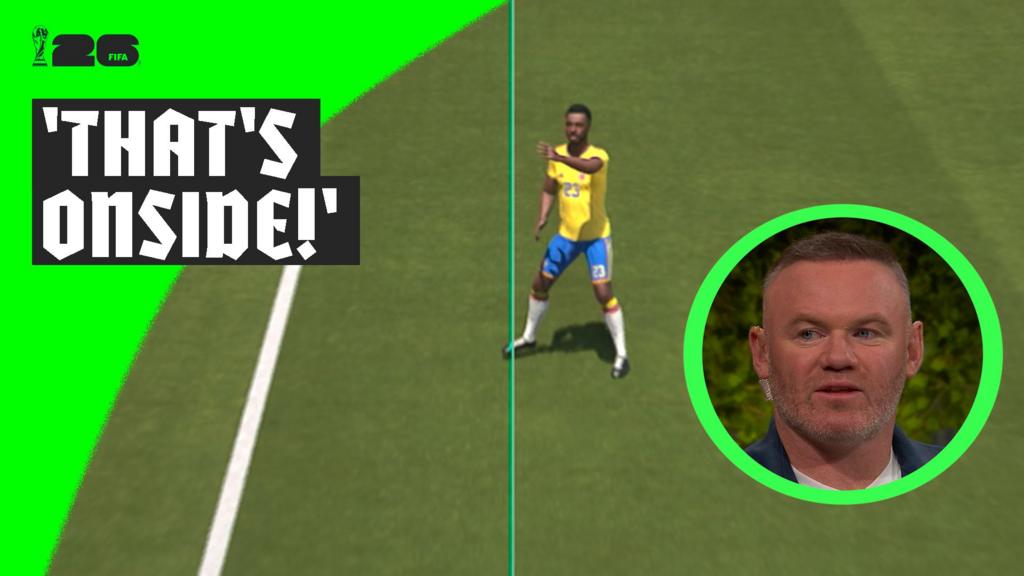
VAR intervened in a crucial moment of Colombia v Portugal when Davinson Sanchez’s goal was ruled out for offside by a toe — a decision that prompted former England striker Wayne Rooney to urge: “Get rid of VAR!”
The ruling, reported by BBC Sport, has reignited debate about the technology’s role in the World Cup and the fine margins that can decide high-stakes matches. This article explains what officials adjudicated, why tiny offside margins matter in VAR reviews, and why pundit commentary such as Rooney’s is opinion rather than a revision of the match facts.
VAR review: what happened to the Sanchez goal
According to BBC Sport, Davinson Sanchez believed he had scored for Colombia against Portugal, but the goal was disallowed after a VAR review. Match officials concluded that an attacker was offside “by a toe” and overturned the on-field decision to award the goal. That description — offside by a toe — is the officials’ adjudication reported by BBC Sport.
The sequence followed standard VAR protocol. Play was paused while video officials checked the build-up, virtual lines were applied to judge relative positions and the referee recorded the on-field decision after the VAR intervention. As BBC Sport frames it, the outcome reported is the match officials’ ruling rather than an independently verifiable change to the laws of the game.
Rooney and pundit reaction
Wayne Rooney, speaking as a BBC Sport World Cup pundit, reacted strongly. He said: “Get rid of VAR!” That quotation is reported commentary and should be read as Rooney’s opinion on the system, not a statement of objective fact about the play. Pundit reactions often express frustration at marginal calls and are part of the public debate on how the game is officiated.
Other commentators have voiced similar concerns about marginal offsides and the way VAR interrupts match flow. These reactions amplify scrutiny of particular decisions but do not alter the adjudication made by the officials using the available replays and calibrated lines.
How toe offside decisions work in VAR reviews
VAR offside checks rely on multiple camera angles, freeze frames and virtual reference lines to determine player positions at the exact moment the ball is played. Broadcasters and VAR teams use calibrated images to draw horizontal lines across the pitch at the relevant body parts of attacker and defender to measure any overlap.
When the margin is described as a toe, it indicates an extremely small separation between onside and offside. Such tiny differences push the limits of broadcast resolution and the calibration process used by VAR operators. Factors such as parallax, the chosen video frame and the precise placement of virtual lines can influence the measurement.
Governing bodies provide protocols for how these reviews are conducted, but the procedure still involves human operators interpreting images produced by cameras and software. As the BBC report emphasises, the determination in this case is a reported adjudication reached under those protocols.
Implications for the World Cup and match outcome
A disallowed goal in a World Cup match can change tactics, momentum and potentially the tournament paths for the teams involved. For Colombia and Portugal, the removal of Sanchez’s strike altered the immediate scoreline and could affect substitutions, game management and player morale during the remainder of the match.
On a broader level, high-profile marginal reversals continue to fuel debate over whether VAR improves fairness or undermines the game’s spontaneity. Advocates argue VAR corrects clear errors and preserves sporting integrity; critics point to marginal calls, stoppages and contentious frame-by-frame decisions as reasons to refine or even curtail aspects of the system.
Pundit anger, including Rooney’s outburst, does not change how the system works but it can influence public perception and increase pressure on tournament organisers and governing bodies to review protocols, transparency and communication following contentious decisions.
Background: VAR’s evolving role
Since its adoption, VAR has been tweaked to clarify what constitutes a “clear and obvious” error and to try to limit ultra-marginal interventions. Competitions have trialled different thresholds for frame-by-frame review and experimented with how to display decisions to viewers to improve understanding.
Those adjustments reflect an ongoing effort to balance technological precision with consistent, comprehensible officiating. Yet controversies persist when a single frame or the smallest positioning difference decides a call — precisely the issue raised by the toe offside described in the BBC coverage.
Source and attribution
This analysis is based on BBC Sport – Top Stories coverage. See the original BBC Sport item for video and commentary: ‘Get rid of VAR!’ Rooney unhappy Sanchez goal ruled out (BBC Sport – Top Stories, published 2026-06-28).
BBC Sport reported that Davinson Sanchez’s Colombia goal against Portugal was ruled out after officials determined a player was offside by a toe. The description of the offside margin and Rooney’s quoted reaction are presented here as, respectively, the match adjudication and pundit opinion.