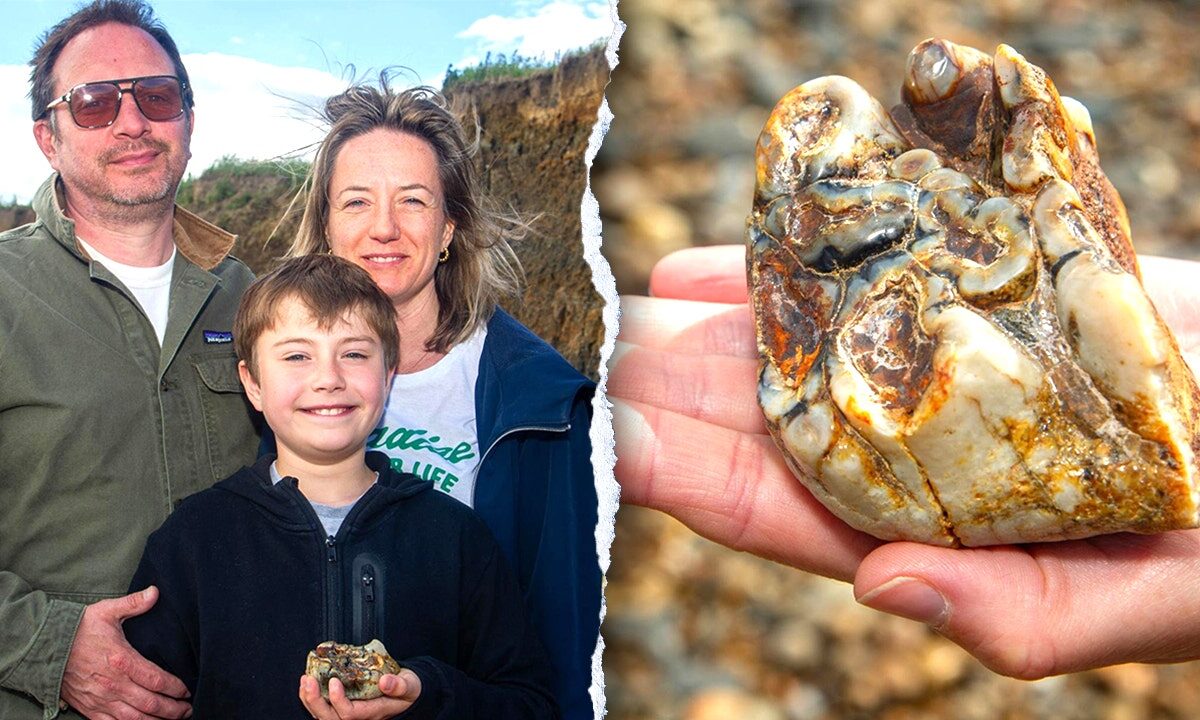
An 11-year-old boy on a beach in Suffolk discovered an elephant tooth fossil identified as an Anancus arvernensis molar, the family and news reports say. The specimen, reported to measure about 4 inches across, was found at the shoreline of East Lane beach in Bawdsey in May and is reported to date to about 1.8 million years.
The find was striking enough that the family recognized it at once. Photographs shared with news outlets show mineralized enamel and the broad cusp pattern typical of a Pleistocene-era elephant relative.
What was found: the elephant tooth fossil
The object was later identified as an upper left molar belonging to Anancus arvernensis, an extinct relative of modern elephants. Reports say the tooth measures roughly 4 inches wide and shows mineralized enamel rather than fresh bone.
The preserved enamel and overall shape led to the identification reported by SWNS and carried by news outlets. The specimen’s size and tooth structure are consistent with published descriptions of Anancus molars, which differ from contemporary elephant teeth in crown shape and wear patterns.
How it was discovered
Charlie Orchard-Lisle, 11, found the tooth while walking with family along East Lane beach near Ipswich. His mother, Eleanor Orchard-Lisle, told reporters the family spotted the unusual object by the lapping waves and picked it up.
“It is quite incredible, and I can’t believe you can find something so old that existed 1.8 million years ago and then just rocks up on the beach,” Eleanor said, according to the SWNS account published by Fox News.
Photographs and the family’s account indicate the discovery occurred during a casual outing rather than a planned fossil hunt. That kind of chance find is not uncommon along Britain’s fossil-rich coasts, where erosion can reveal long-buried objects.
Where the fossil may have come from
The family suggested the tooth may have been eroded from a nearby Red Crag cliff and then washed onto the beach. Red Crag deposits along parts of England’s eastern coast are known to contain marine and some terrestrial fossils laid down millions of years ago.
Experts were not cited directly in the family’s report, so the Red Crag origin remains a plausible explanation rather than a confirmed source. Coastal erosion can dislodge sediment and fossils from cliffs and flush them onto beaches, but until the tooth is examined by specialists its exact provenance cannot be verified.
Labeling the Red Crag explanation as a hypothesis reflects the limits of the initial reporting. If local geologists or museum staff examine the specimen, they can better determine whether the tooth came from Red Crag deposits or another nearby horizon.
Why the find matters
If the identification and age hold up under expert review, the tooth would represent a window into fauna living in the region about 1.8 million years ago. Anancus arvernensis lived during the Pliocene and early Pleistocene and is of interest to paleontologists studying elephant evolution and Pleistocene environments in Europe.
Small, casual finds like this are valuable because they can add data points about where and when particular species occurred. They also illustrate how natural processes — in this case, fossil erosion — continue to reveal ancient remains along coastlines.
The Suffolk schoolboy’s discovery joins a string of recent notable finds reported internationally, including chance beach and field discoveries by members of the public that later drew scientific interest. Those stories underline how chance encounters on coastlines occasionally produce material that merits professional attention.
Source, verification and what comes next
The initial report on the tooth and the family’s account were carried by news agency SWNS and published by Fox News. The identification as Anancus arvernensis and the 1.8 million years age are reported in those accounts; they have not been independently verified in the public record linked to the family’s statement.
Next steps typically include contacting local museum curators, university paleontologists or regional fossil groups who can examine the specimen and, if warranted, document and conserve it. A formal assessment would check the tooth’s morphology, mineralization, and any adhering matrix to better determine its age and likely horizon.
Until such expert review is completed, statements about exact origin and age should be treated as provisional. The family’s description and the published photos provide useful initial information but are not a substitute for professional analysis.
Frequently asked questions
How old is the elephant tooth fossil?
News reports cite an age of about 1.8 million years for the specimen, based on its identification as Anancus arvernensis. That age is reported by SWNS and carried in media coverage; independent scientific verification has not been published.
What is Anancus arvernensis?
Anancus arvernensis is an extinct elephant relative known from Pliocene and early Pleistocene deposits in Europe and Asia. It had distinctive molars and tusk morphology compared with modern elephants.
Could erosion reveal more fossils at Bawdsey?
Yes. Erosion of Red Crag cliffs and other coastal deposits can expose and release fossils into the surf and onto beaches. However, the presence and frequency of finds vary and professional verification is needed to confirm any specimen’s origin and age.
Source: Initial reporting by SWNS and coverage on Fox News: Fox News.