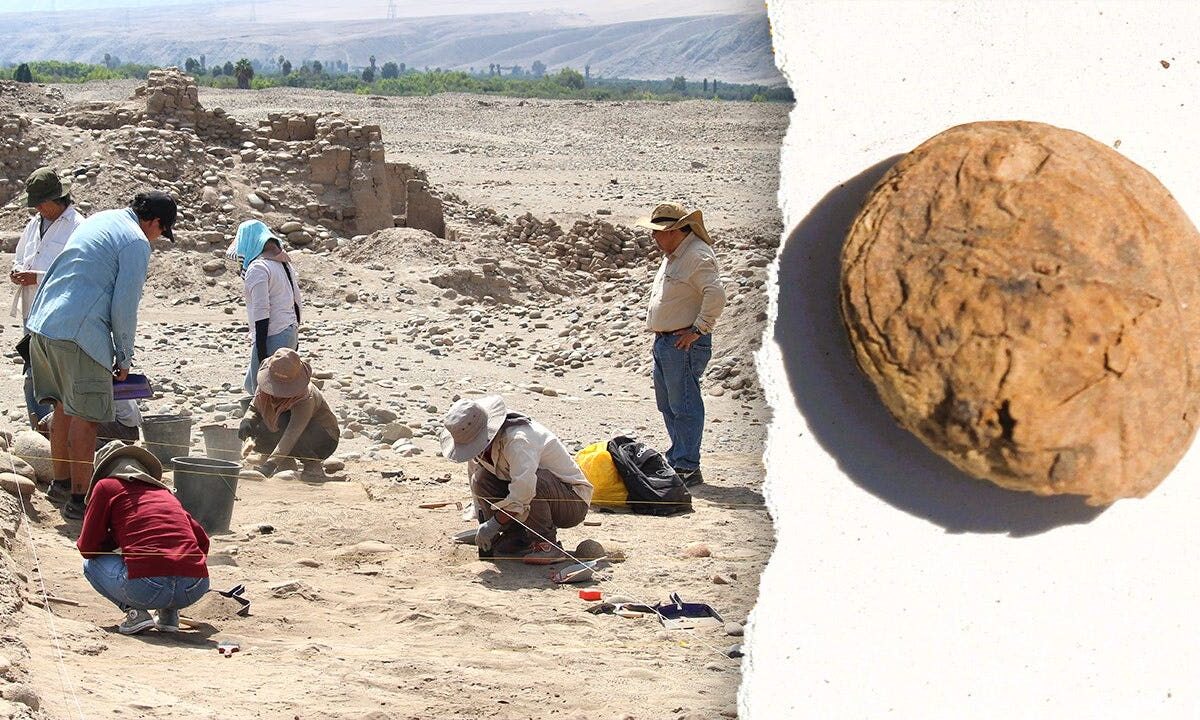
Archaeologists working at Tambo Viejo in the Acarí Valley of southwestern Peru have uncovered two small, wrinkled brownish tubers identified as chuño — traditional Andean freeze-dried potatoes. Photographs accompanying the report show the pair retaining much of their original shape and color despite centuries underground.
The finds are described in a report published in the Journal of Field Archaeology and summarized in outlets including Phys.org and Fox News Digital. Excavations at Tambo Viejo, carried out on and off since 2018, have produced material that researchers use to reconstruct food storage and administrative activities at the site.
How freeze-dried potatoes (chuño) were made and stored
The term chuño refers to a traditional Andean method of producing lightweight, durable preserved potatoes by alternating freezing and drying, typically at high elevations. Cold nights freeze the tubers, and strong daytime sun and low humidity drive off moisture. The result is a shriveled, shelf-stable product that can be stored long-term.
Lidio Valdez of the University of Calgary, lead archaeologist on the Tambo Viejo project, emphasized the environmental requirements for the technique. “Freeze-dried potatoes can be produced only at high elevations,” Valdez told Fox News Digital, noting the role of extreme daily temperature swings and aridity.
At Tambo Viejo the recovered tubers were found placed in ceramic vessels and stored underground. Subterranean storage and sealed containers would reduce exposure to pests and episodic moisture, helping preserve desiccated foods for extended periods. The report links the production environment and these storage choices to the exceptional condition of the samples.
What was found
The documented specimens are two small, wrinkled, brownish tubers that researchers identify explicitly as chuño. Laboratory observations and the excavation context are described in the Journal of Field Archaeology paper; published images show the samples in situ and after retrieval.
Researchers describe the preservation as excellent. Valdez noted the samples are reduced in size relative to fresh potatoes, likely from long-term desiccation and the region’s aridity: “The only difference is the samples found are small, and it seems that over time and due to the aridity of the region, their original size was reduced,” he said. The reduced dimensions are consistent with dehydration and centuries of burial.
Dating and site context
News reports summarize the potatoes as dating to roughly 500 years ago, placing the find within the period of the Inca Empire. The specimens come from Tambo Viejo, an archaeological complex in the Acarí Valley that excavators interpret as an administrative center where officials may have managed regional provisioning.
Tambo Viejo has been excavated since 2018 and has yielded a range of artifacts and architectural contexts that support interpretations of state use. The roughly 500-year timeline is discussed in coverage as a contextual placement tied to the site’s chronology and comparative dating; public summaries do not present a single-sample radiocarbon result for the tubers themselves.
State logistics and food supply
Valdez and colleagues interpret the presence of chuño and the storage practices at Tambo Viejo as part of broader Inca logistical systems. State-controlled warehouses at higher elevations are known from ethnohistoric and archaeological sources, and preserved foods like chuño were suitable for redistribution during labor drafts and campaigns.
“Because the Inca state carried out countless projects throughout the realm, the tasks involved thousands of workers, who had to be fed by the state,” Valdez said, explaining that officials likely mobilized preserved foodstuffs from warehouses and moved supplies via llama caravans across the network of roads and storage nodes.
Those reconstructions connect the small find at Tambo Viejo to large-scale provisioning practices. Archaeologists present these as interpretive models grounded in material evidence and comparative data rather than definitive accounts of distribution volumes or precise warehouse inventories.
What archaeologists say and interpretive limits
Researchers emphasize both the analytical value of the find and the limits of interpretation. Valdez called Tambo Viejo “such a great Inca site” for the range of materials recovered, but he also cautioned about post-depositional changes and the challenges of inferring production scale from isolated samples.
“There is no way one can tell their old age from samples,” Valdez added, underscoring uncertainty about how long-term burial and environmental conditions altered dimensions and appearance. Scholars note that claims about production volumes, specific distribution networks, or exact warehouse locations require more excavation, contextual study, and laboratory analysis.
Why it matters
Physical remains of processed foods are rare in many archaeological contexts, so the Tambo Viejo chuño provide a direct link to everyday food technologies and state provisioning strategies. The find helps illustrate how Andean communities used local climates and storage techniques to create durable staples that supported labor systems and long-distance movement of people and goods.
Beyond its immediate context, the discovery underscores broader themes in archaeological research: how small, well-preserved artifacts can illuminate large-scale social and economic behaviors, and how combining excavation, laboratory work, and cautious historical interpretation produces stronger reconstructions of past lifeways.
Source attribution:
Journal of Field Archaeology: https://www.tandfonline.com/journal/yjfa
Phys.org coverage: https://phys.org/news/2026-06-rare-year-dried-potatoes-unearthed.html
Fox News Digital coverage: https://www.foxnews.com/food-drink/archaeologists-uncover-freeze-dried-potatoes-older-us-excellent-condition