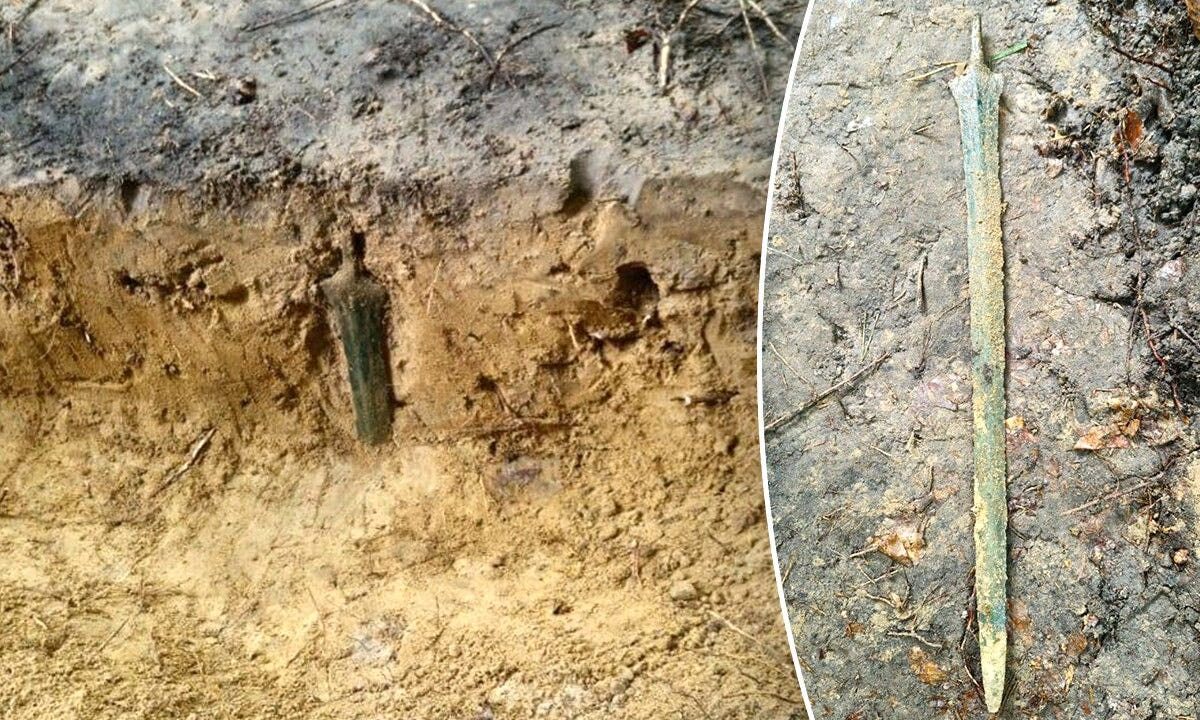
A hobbyist metal detectorist recently discovered a 2,700-year-old bronze sword standing upright in sandy soil in the Gdańsk Forest District, officials said. Pictures released by local heritage authorities show the bronze weapon protruding from the ground as staff prepared an archaeological recovery.
The Pomeranian Provincial Heritage Conservator announced the find on Facebook and posted the photos shared with reporters. Those images form a visual record of the discovery, showing the sword upright in the sand; the photographic evidence does not by itself confirm depositional circumstances, which specialists must assess.
Discovery and photos
Officials released images showing the sword shaft emerging from pale, sandy soil at the find site. The photographs, posted by the Pomeranian Provincial Heritage Conservator, depict conservation staff and the finder documenting the discovery prior to removal.
Heritage staff secured the location and recorded the find. The conservator’s post emphasized careful documentation and noted that professionals were called in to handle the recovery.
Who found it and how it was recovered
The sword was reported by Marcin Wiśniewski, a hobbyist metal detectorist who has previously uncovered Bronze Age material near Gdańsk. Wiśniewski alerted heritage officials after spotting the object.
After the report, staff from the Department of Archaeological Monuments carried out a controlled recovery using archaeological methods, working with the finder. Those methods included measured excavation, detailed on-site recording and stabilization of the corroded metal.
Officials highlighted cooperation between hobbyists and heritage teams as crucial for protecting context and avoiding damage to finds.
2,700-year-old bronze sword: dating and regional context
Provincial authorities gave an initial assessment placing the object in the Late Bronze Age, roughly 900–700 B.C. This 2,700-year-old bronze sword dating is provisional and based on early stylistic assessment; final dating and interpretation will depend on specialist study and laboratory results.
Authorities noted the sword is not the first Bronze Age weapon recovered in the Gdańsk Forest District. A conservator’s social-media post referenced two antenna-hilt bronze swords reportedly found in a peat bog at Rynarzewo in the 1920s; those pieces were transferred to the Provincial Museum in Gdańsk and later were reported lost during World War II. That loss is recorded in older accounts but requires further verification in archival records.
Officials also referenced other recent finds in Poland — including early medieval weapons from a lake in west-central Poland and a roughly 700-year-old sword recovered from the Vistula River — underscoring long and layered regional metalworking and deposition practices.
Specialist study and museum decision
Marcin Tymiński, a press spokesperson for the Provincial Office for the Protection of Monuments in Gdańsk, told reporters that specialists will examine the sword after it is transferred to a museum. “Specialists will be able to provide additional details about the weapon once it is transferred to a museum and studied,” he said in a translated statement.
The Provincial Heritage Conservator will decide which museum receives the sword. Officials have not yet announced that decision.
Conservators are expected to assess corrosion, manufacturing marks and any residues that could indicate deposition circumstances. Metallurgical analysis, microscopic wear study and any radiocarbon dating of associated organic material will help refine age estimates and interpret how the object came to rest in the sand.
Why the find matters for archaeology
Well-preserved metalwork from the Late Bronze Age can shed light on manufacturing techniques, trade networks and ritual or depositional behaviors near the Baltic coast. Each find contributes to a broader picture of prehistoric activity in northern Poland.
Because this sword was reported promptly by a hobbyist and recovered under archaeological supervision, researchers have a better chance of preserving context-related clues. As regional specialists note, context often matters more than the object alone for interpreting past behavior.
What comes next
Conservators will stabilize the metal and slow ongoing corrosion. Laboratory study may include metallurgical composition testing, microscopic analysis of use-wear, and attempts to date any organic residues or associated materials found during excavation.
After technical study, the Provincial Heritage Conservator will select a museum for the object. Curators there will decide whether the sword goes on public display or is retained primarily for research.
Expert reaction
Regional archaeologists praised the prompt, controlled recovery and the decision to involve specialists at every stage. They cautioned that photographs alone cannot resolve depositional questions and that the upright appearance in the images is a photo record, not definitive evidence of how the sword was originally placed or deposited.
Experts said final interpretation should await lab results and any stratigraphic or environmental data recovered during excavation.
Frequently asked questions
How old is the sword?
Officials initially date the blade to the Late Bronze Age, about 900–700 B.C. That age is provisional; specialists will refine dating after conservation and study.
Who found the sword and how was it recovered?
Hobbyist metal detectorist Marcin Wiśniewski reported the find. Staff from the Department of Archaeological Monuments conducted a controlled recovery with the finder present, according to the provincial conservator’s announcement.
Will the sword be put in a museum or on display?
The Provincial Heritage Conservator will decide which museum receives the sword. Curators will determine whether it is displayed or kept primarily for research following conservation.
Source attribution
Primary source: announcement and photographs posted by the Pomeranian Provincial Heritage Conservator on Facebook (provincial conservator office). Finder: Marcin Wiśniewski, a hobbyist metal detectorist. Additional reporting referenced: Fox News Digital.
Note: statements about dating and depositional context are provisional pending specialist conservation and laboratory analysis. The Rynarzewo antenna-hilt swords are described in older records as having been transferred to the Provincial Museum in Gdańsk and later reported lost during World War II; this reported loss requires archival verification.
The Nonstop News will update this story as officials release study results or further documentation from specialists and museums.