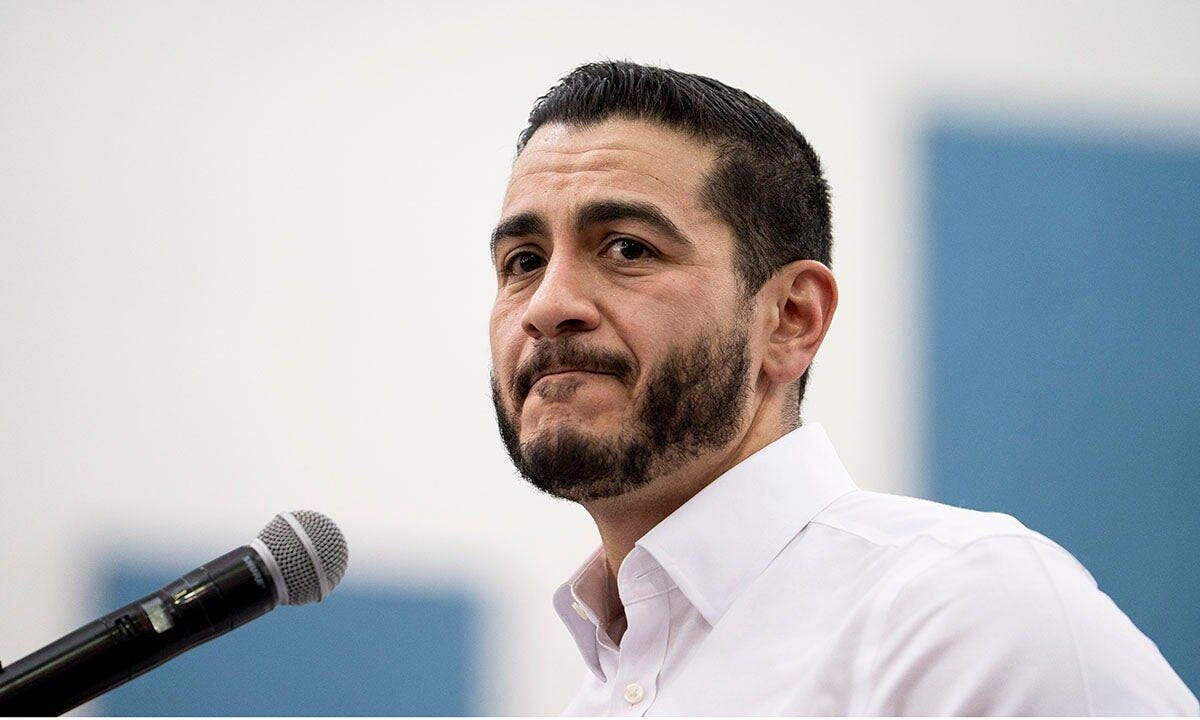
“Donald Trump is not, himself, the disease of our politics. He’s just the worst symptom of the disease of our politics,” Abdul El‑Sayed said at DeVos Performance Hall in Grand Rapids during the closing stop of “The People v. The Powerful” tour. (El‑Sayed, DeVos Performance Hall, Grand Rapids, June 2026)
He framed the event as both a celebration of opportunity and an indictment of institutions he says distort American democracy. El‑Sayed opened by noting the public supports that shaped his education and medical training before moving to policy prescriptions and critiques of political power.
What Abdul El-Sayed said in Grand Rapids
El‑Sayed repeated the disease metaphor throughout his remarks and tied it to concrete targets: wealthy donors, influential lobbies and what he described as complacent party leaders. He told the audience the system lets interests “buy and sell politicians,” and said addressing root causes must be the focus rather than only treating symptoms. (El‑Sayed, DeVos Performance Hall, Grand Rapids, June 2026)
Early in his remarks he also referenced his own arc — public university education and medical training supported in part by federal research funding — to frame his policy priorities as both personal and structural. (El‑Sayed, DeVos Performance Hall, Grand Rapids, June 2026)
Medical debt claim and policy details
One of El‑Sayed’s most specific claims concerned medical debt. He said the nation’s roughly $225 billion in outstanding medical debt could be erased for about $2.25 billion because some debts can be purchased “for a penny on the dollar.” (El‑Sayed, DeVos Performance Hall, Grand Rapids, June 2026)
That “penny on the dollar” point reflects a real market practice: some medical debts are sold on secondary markets or to charities and debt buyers at steep discounts. But policy experts, consumer advocates and investigative reporting note important caveats. While charities and some buyers can and do purchase portfolios and forgive or collect at low cost, aggregating the entire $225 billion figure and erasing it in one transaction presents legal, logistical and market barriers — including which accounts are available to buy, the veracity of debt records, state collection laws and varied ownership of debt portfolios. Independent analysts say large‑scale debt erasure would likely require a combination of private purchases, regulatory action and explicit policy authority rather than a single market transaction.
Calls to abolish ICE and institutional criticism
On immigration enforcement, El‑Sayed called Immigration and Customs Enforcement (ICE) a “rogue agency” and argued it should be abolished, saying it “normalizes paramilitary forces on our streets” and “weaponizes the idea of immigration against the Constitution.” (El‑Sayed, DeVos Performance Hall, Grand Rapids, June 2026)
He also named powerful interests he views as part of the problem, citing AIPAC as an example of influential special interests and urging structural reforms that reduce corporate and donor control over policy. Those lines tied into his broader theme that systemic reform, not personality politics, should drive the agenda.
Political alliances and campaign implications
El‑Sayed shared the stage with Rep. Alexandria Ocasio‑Cortez and Sen. Bernie Sanders at the event, underscoring his alignment with progressive, democratic‑socialist figures who favor transformative policies on health care and corporate power. Their presence signals coordination on messaging and priorities across a segment of the left.
That alignment may mobilize progressive voters but could also sharpen pushback from moderates and industry stakeholders. El‑Sayed said he viewed himself as “dangerous” to interests from health insurers to party leaders, naming Blue Cross Blue Shield and Senate leadership as examples of entrenched political power. (El‑Sayed, DeVos Performance Hall, Grand Rapids, June 2026)
Strategically, the central question for his Michigan Senate bid is whether enthusiasm from national progressive figures and events converts into broader primary support and whether his policy prescriptions can be translated into detailed proposals that survive scrutiny from moderates, regulators and insurers.
What to watch next
Watch for El‑Sayed’s upcoming stops in Michigan and rapid responses from insurers, establishment Democrats and donor groups. Expect fact‑checking and policy analysis focused on the medical‑debt claim: consumer advocates and investigative reporters will likely press for details about which debts could be bought, at what prices, and what legal authority would be needed to erase them at scale.
Also monitor how Ocasio‑Cortez and Sanders coordinate messaging with El‑Sayed going forward. Continued high‑profile alignment could help normalize bold proposals or, alternatively, intensify debates about electability in a closely watched Senate contest.
By the numbers (integrated)
- Estimated outstanding medical debt cited by El‑Sayed: roughly $225 billion (as stated at the event).
- Cost to erase that debt at “a penny on the dollar” as claimed: about $2.25 billion (as stated at the event). Experts say the practical cost and feasibility are disputed and would depend on market availability and legal constraints.
Source attribution and next steps
This article summarizes remarks delivered at DeVos Performance Hall in Grand Rapids during “The People v. The Powerful” tour. Quotations are attributed to Abdul El‑Sayed and include location and month. For the original event coverage, see the Fox News report on the event: Fox News – Socialist-backed Michigan Senate hopeful calls American politics a ‘disease’. Additional reporting and expert analysis on medical‑debt markets and debt‑forgiveness efforts have been published by consumer advocates and investigative outlets, which note significant legal and logistical hurdles to erasing all outstanding medical debt through secondary‑market purchases.
FAQ
Is it true medical debt can be bought for a penny on the dollar?
Some medical debt portfolios are sold at steep discounts, and charities and debt buyers have purchased and forgiven or collected on such portfolios. But whether the full $225 billion could be acquired at that rate is disputed. Experts point to market availability, record accuracy, ownership rights and state laws as key obstacles that make a blanket purchase unlikely without coordinated policy action.
What did El‑Sayed mean when he called politics a disease?
He used “disease” as a metaphor for systemic problems he says concentrate power in the hands of donors, lobbyists and entrenched interests. His argument was that policy should address structural drivers — campaign finance, corporate influence and institutional power — rather than focusing solely on individual officeholders.
How could these remarks affect his Michigan Senate bid?
The remarks could energize progressive activists and national allies while provoking criticism from moderate Democrats, insurers and donor networks. The impact will hinge on how El‑Sayed converts rhetoric into detailed policy plans and how opponents frame his proposals to Michigan voters.
Source: Fox News