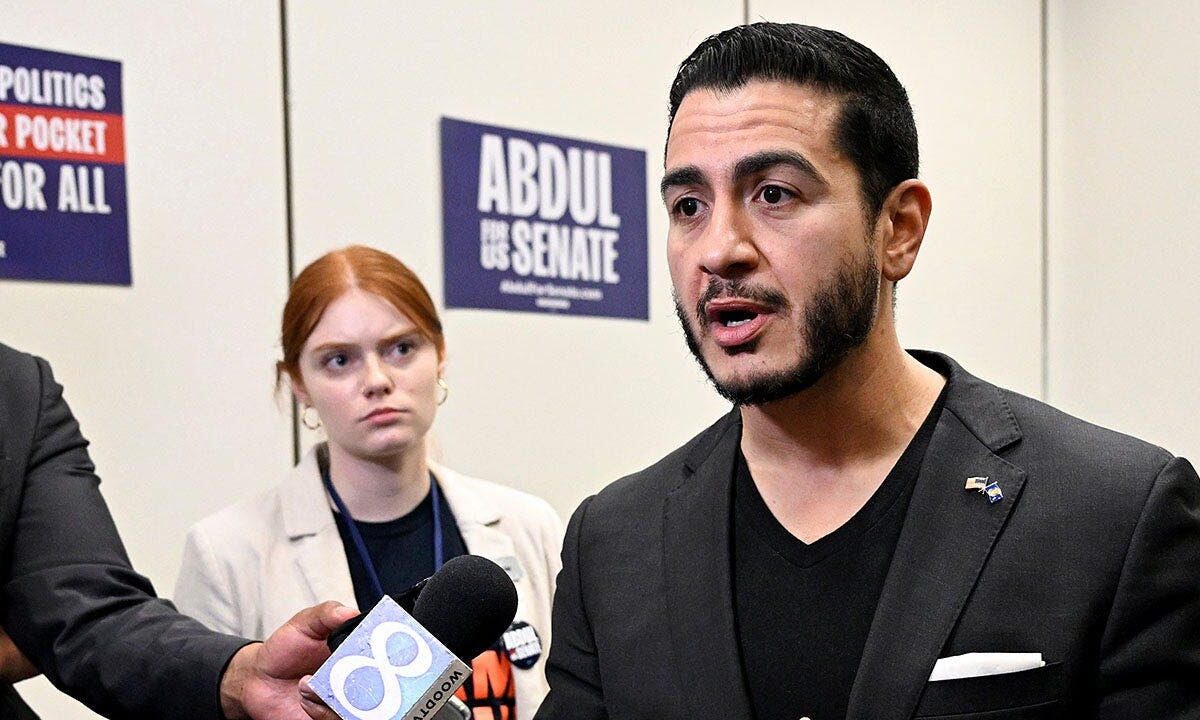
The Abdul El-Sayed physician claim drew renewed attention when Mehdi Hasan pressed the Michigan Senate candidate during a Zeteo interview, challenging how El-Sayed described his professional credentials and whether that language was fair game for opponents. The exchange, aired on Zeteo and later reported by other outlets, put the candidate’s use of the term “physician” at the center of a broader discussion about credential disclosure and campaign transparency.
What Mehdi Hasan asked on Zeteo
On air, Hasan cited attacks from opponents and asked El-Sayed to explain why he used the term “physician.” Hasan said, “You got attacked by your rivals for calling yourself a physician, not just a doctor, even though you don’t have a valid state medical license in New York or Michigan, which apparently is what you need legally to call yourself a physician.”
Hasan followed up: “Do you wish you’d just stuck to calling yourself a doctor, which you are, to avoid all of this controversy and attacks on your physician status?” El-Sayed responded by pointing to his public-health career, including his tenure as Detroit’s health director and his work on access to care and eliminating medical debt, and suggested the focus should be on his record rather than title semantics.
Records and the Abdul El-Sayed physician claim
Reporting and public-record checks cited by news outlets indicate that El-Sayed does not hold an active state medical license in Michigan or in New York. Bridge Michigan specifically reported that public licensing databases do not list an active physician license for El-Sayed in those states, and that absence is the basis for critics who say he should not present himself as a licensed clinical physician in ways that imply state licensure (Bridge Michigan).
News reports frame these findings as record-based reporting rather than as a concession from El-Sayed. Supporters and El-Sayed note he holds an M.D. degree from Columbia and that much of his public profile is rooted in public-health leadership rather than patient-facing clinical practice. Legal definitions about who may be called a “physician” vary by context: state medical licensure covers clinical practice, while academic, policy and administrative roles can involve medical expertise without a current clinical license. Reporters emphasize the records when describing the scope of the dispute.
Personal financial disclosure and the Aug. 13 extension
Separately, Bridge Michigan reported that El-Sayed sought an extension that pushed his 2026 personal financial disclosure (PFD) past the Aug. 4 primary, with a new deadline of Aug. 13. The extension and its timing have become points of contention in the primary, as opponents argue voters deserve full financial transparency before casting ballots (Bridge Michigan).
On Zeteo, Hasan asked whether the extension was intended to avoid transparency: “You sought an extension through Aug. 13, I believe, which is after the primary. Was this to avoid transparency with your voters? Why not release them before the election?” El-Sayed answered that the delay stemmed from complicated tax paperwork, including documents involving overseas property associated with his wife’s family, and said gathering those materials took additional time.
Campaigns can legally request PFD extensions under state rules; critics argue the timing remains politically fraught when an extension pushes disclosure until after a primary contest. Journalists and watchdogs typically note both the legal right to an extension and the political optics of delayed filings.
Campaign responses and political context
The licensing and disclosure items have become campaign issues in the Michigan Senate primary. Rep. Haley Stevens’ campaign has publicly pressed El-Sayed on both his use of professional titles and the timing of his financial disclosures. After a debate and subsequent coverage, Stevens’ campaign told news outlets that El-Sayed had pledged on camera to release his disclosures before the primary; opponents later emphasized that the extension pushed the formal filing date to Aug. 13.
Stevens’ campaign communications director Arik Wolk was quoted by media outlets framing the delay as concerning for voters: “Now, the clock is ticking. Abdul needs to make good on his promise to Michiganders and release his PFD immediately. What is he hiding?” That statement reflects a rival campaign’s critique and remains an allegation rather than a demonstrated failure to disclose.
Why this matters to voters
For many voters, how a candidate presents professional credentials and how quickly they disclose financial records are signals about transparency and trust. The “Abdul El-Sayed physician claim” conversation intersects both issues: it raises questions about whether campaign language accurately reflects licensure status and whether a candidate’s timeline for financial filings provides sufficient time for public review before an election.
Even when a candidate has relevant education or management experience, the precise language used in campaign bios and ads can affect perceptions. Timely PFDs give voters and watchdogs the information needed to assess potential conflicts or financial ties; conversely, extensions can fuel political criticism even when they are procedurally permitted.
What comes next
El-Sayed’s personal financial disclosure was reported to be due Aug. 13. Journalists and campaigns are likely to monitor whether that filing appears on schedule and whether it provides additional context about his finances that addresses rivals’ questions. At the same time, how El-Sayed and his campaign choose to describe his public-health background going forward may influence whether the licensing issue remains a focal point of coverage.
For voters, the immediate steps are straightforward: watch for the PFD filing on or before Aug. 13, review how the campaign describes professional credentials in future statements and ads, and look to public licensing databases and reputable reporting for confirmation of any credential claims.
Sources and attribution
This article relies on coverage of the Zeteo interview and subsequent reporting. Primary sources cited include Fox News’ coverage of the interview and related reporting, the Zeteo interview video, and reporting by Bridge Michigan that reviewed public records and the PFD extension. See the original reporting for full transcripts and document references.
Primary reports: Fox News – Left-wing host presses El-Sayed over ‘physician’ claim; Zeteo interview (YouTube); Bridge Michigan reporting.