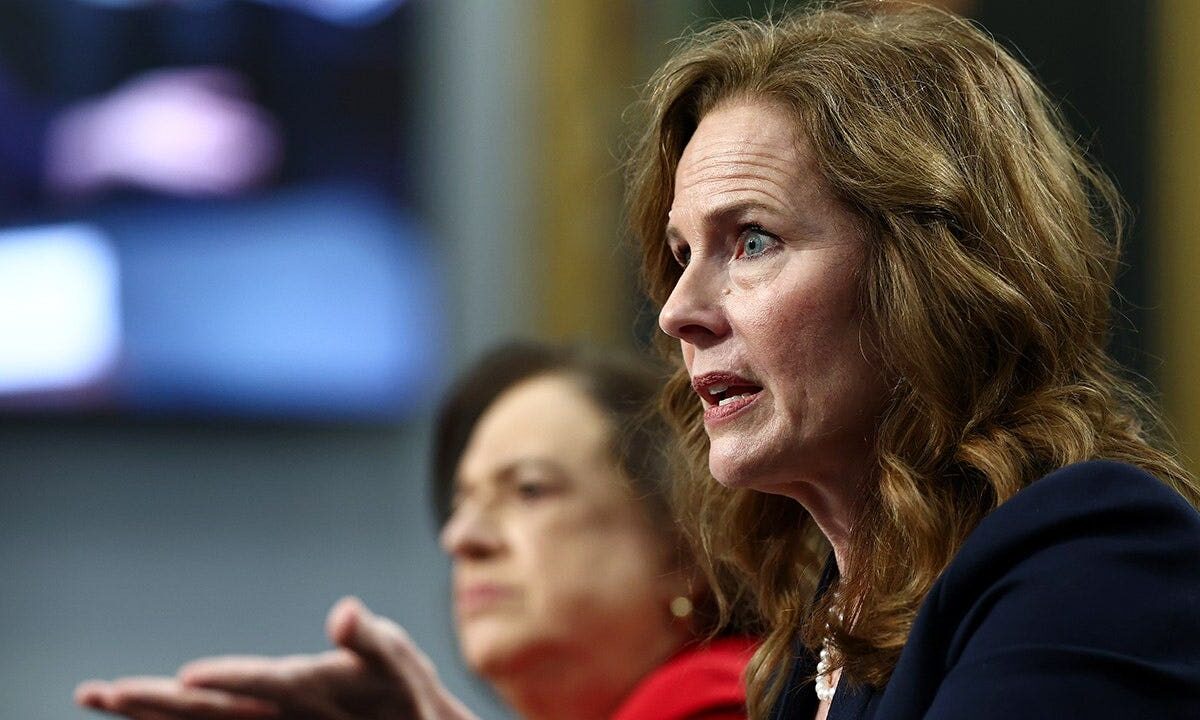
Justice Amy Coney Barrett told the House Appropriations Committee that threats to the Supreme Court have crossed into her family life, forcing security changes that even her 12‑year‑old noticed.
Barrett opened her testimony by describing a private moment made public by the intrusion of heightened security: a Supreme Court officer brought her a bulletproof vest, and when her son saw it at home he asked what it was. Barrett said the exchange showed how safety concerns had become a daily reality for justices and their families.
Amy Coney Barrett testimony to House Appropriations Committee
Speaking on Capitol Hill, Barrett delivered first‑person testimony about several episodes that convinced the court to seek expanded protection. She told members of the House Appropriations Committee that her children “have required my children to think about and see things that children should not have to see or think about,” and she described how a May swatting incident led to police converging on her neighborhood before court officers could coordinate with county authorities.
Barrett also referenced deliveries of anonymous packages that used the name of Daniel Anderl, the son of late U.S. District Judge Esther Salas, as an example of intimidation tactics now worrying the judiciary. Throughout her remarks she framed specific events as reasons the Court must request additional funds rather than as allegations about particular individuals.
How threats rose after the Dobbs leak
Barrett and Justice Elena Kagan tied the surge in hostile contacts to the 2022 leak of the Dobbs decision. Kagan, in testimony to the same committee, said the Court has seen a marked increase in threats since that period.
In Kagan’s testimony to the House Appropriations Committee, she said justices experienced a 35% increase in threats in 2026 after a roughly 25% rise the prior year; she also noted that institutional security changes accelerated following Justice Antonin Scalia’s death in 2016 (Kagan testimony, House Appropriations Committee).
Supreme Court security and the budget request
The Supreme Court asked Congress for about a 10% budget increase for fiscal year 2027 to address what court officials described at the hearing as an intensified threat environment. Court testimony detailed that roughly $16.6 million of a $20.7 million component of the request would be dedicated specifically to expanding security operations.
Court representatives told the committee that the judiciary has requested about $89 million to cover personal security costs tied to expanded protection for justices, staff and families. In testimony, officials emphasized these figures are driven by operational needs — including more security detail hours, technology and protective measures — rather than discretionary new programs (court testimony, House Appropriations Committee).
Impact on justices and families
Lawmakers heard that the security shift has practical and emotional consequences. Barrett said she appreciated the work of Supreme Court police during the swatting incident but noted the toll when ordinary household items or protective gear prompt difficult conversations with children.
Kagan recalled that early in her tenure justices did not routinely have 24/7 accompanying protection; that standard has shifted as threats grew. Testimony detailed changes in travel planning, daily routines and family arrangements made to reduce risk.
Witnesses at the hearing highlighted an array of tactics that worry the Court — anonymous packages, deceptive delivery methods and the use of public names tied to judges’ families. Panel members repeatedly framed these as part of a broader pattern rather than isolated allegations, and attributed the account details to reported incidents and the justices’ own experiences (House Appropriations Committee testimony).
By the numbers
- Requested FY2027 budget increase: approximately 10% (court testimony).
- Security‑designated portion of a $20.7M package: about $16.6M (court testimony).
- Total requested for personal security: roughly $89M (court testimony).
- Reported increase in hostile contacts in 2026: 35% (Justice Elena Kagan’s testimony to the House Appropriations Committee).
What comes next for the court’s funding request
The House Appropriations Committee’s hearing is the next formal step in congressional consideration of the judiciary’s funding plan. Committee staff will review testimony and materials, and any appropriation must be negotiated into spending bills that pass both the House and Senate and be signed by the president before funds are released.
During the hearings, members pressed justices and court officials about how requested funds would be allocated and whether administrative options had been exhausted. Those exchanges helped clarify the specific operational needs driving the figures and set the stage for follow‑up questions from appropriators as funding negotiations proceed.
For the justices, the congressional process is the mechanism for converting testimony into concrete resources. Barrett and Kagan framed their requests as responses to documented risks that have affected daily life for the Court’s members and their families, and they asked lawmakers to consider the funding in that context (Video and transcript, House Appropriations Committee testimony).
Source: Fox News (June 2026) and testimony before the House Appropriations Committee cited in that report.