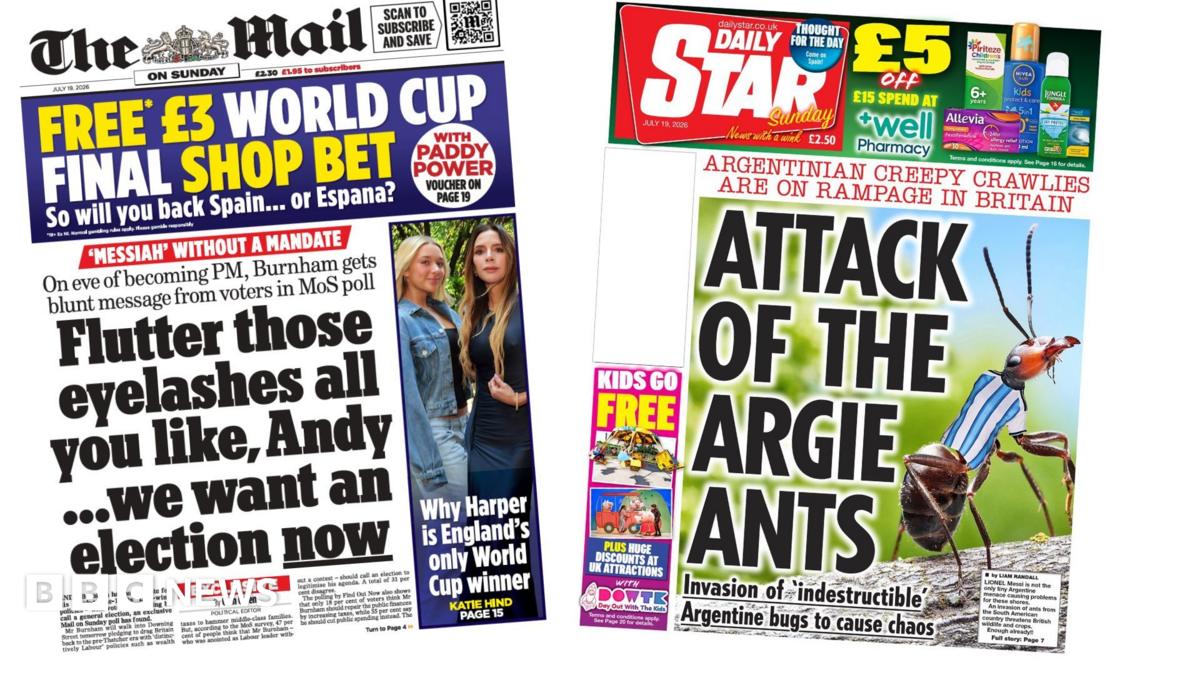
Andy Burnham dominates Britain’s front pages as he stands on the eve of becoming prime minister, with national newspapers using stark and colourful language to frame his arrival. Two quoted front-page lines — “Messiah without a mandate” and “attack of the Argie ants” — headline coverage flagged by BBC News – Top Stories and set a tone of theatricality and contest ahead of his first full day in office.
The papers’ visuals and lead lines are an immediate part of the political story: they shape public impressions before official policies or cabinet choices are fully public. Below is a short, focused roundup of what the front pages say, how editors are framing Mr Burnham’s mandate, what that could mean politically and for public reaction, and the near-term items to watch as coverage develops.
What the front pages say about Andy Burnham
Across several national titles, Andy Burnham is presented as the defining story of the day. Headlines and images vary from sharply critical to bemusedly theatrical, but the common thread is that newspapers are treating his arrival as a major moment deserving dramatic treatment. The two quoted front-page lines singled out in BBC coverage — “Messiah without a mandate” and “attack of the Argie ants” — are vivid examples of how papers prioritise tone and impact over neutral description.
Those front-page lines operate primarily as editorial devices designed to catch attention. They do not in themselves add new factual claims about governance or policy. The BBC’s Top Stories roundup highlights how colour, imagery and choice of words differ between titles and how those differences reflect editorial aims more than new reporting.
How papers frame his mandate and tone
Editors are dividing emphasis between questions about democratic legitimacy and spectacle. The phrase “Messiah without a mandate” explicitly casts Mr Burnham as a leader who might carry large expectations but, according to that headline’s framing, lack the clear, unambiguous backing some commentators consider necessary for immediate political authority. That formulation is an editorial judgement, not a verified assertion about parliamentary arithmetic or legal standing.
Labeling quoted headlines as opinion is important: headlines are crafted to convey a voice and provoke reaction. Where a paper foregrounds mandate concerns, readers should treat that as an interpretive frame. Where another title adopts surreal or combative imagery — such as “attack of the Argie ants” — the choice signals a different editorial approach, one that leans on cultural or rhetorical effects rather than straightforward description.
Read together, these frames tell us more about how editors want audiences to feel heading into the transition than they tell us about the specific mechanics of government formation. For journalists, campaigners and politicians, flagging the difference between editorial opinion and verified reporting helps maintain clarity about what is commentary and what is fact.
What this signals for Britain and politics
Front-page emphasis on mandate and spectacle suggests the opening days of Andy Burnham’s premiership will be contested in the court of public perception as much as in parliamentary business. Opponents and commentators are likely to use headline narratives about legitimacy to press early challenges in debates and media interviews. That dynamic can shape short-term polling and the tone of exchanges in the first parliamentary sittings under the new prime minister.
For the public, heavily opinionated front pages can set expectations and frame the questions voters ask about priorities and competence. For policymakers and officials, the immediate operational work remains routine: prepare formal statements, set out transition arrangements, and make clear the administration’s initial priorities. But the framing chosen by newspapers will influence the political backdrop against which such statements are received.
How the narrative evolves may depend on early substantive moves: clear, decisive policy announcements or appointments that address concerns about mandate and direction could blunt critical front-page frames. Conversely, a patchy or uncertain start could reinforce sceptical headlines in subsequent editions.
What to watch next
Expect a concentrated sequence of routine but telling developments in the next 48–72 hours. Key items to monitor include:
- The new prime minister’s first public address and whether it seeks to broaden or narrow expectations set by front pages.
- Any immediate ministerial appointments or announced priorities that indicate the administration’s direction.
- Responses from opposition leaders and whether they take up the mandate line as a central critique.
- How front pages shift in tone across the next two to three days — whether they continue to emphasise contested legitimacy or move toward substantive coverage of policy.
Because the quoted headlines are editorial characterisations, readers should weigh them alongside direct reporting of official statements and other verified facts about the transition. Tracking both the factual reporting and the editorial framings will give a fuller picture of how the new premiership is taking shape.
Source: BBC News – Top Stories — Published 2026-07-19T01:21:14.000Z