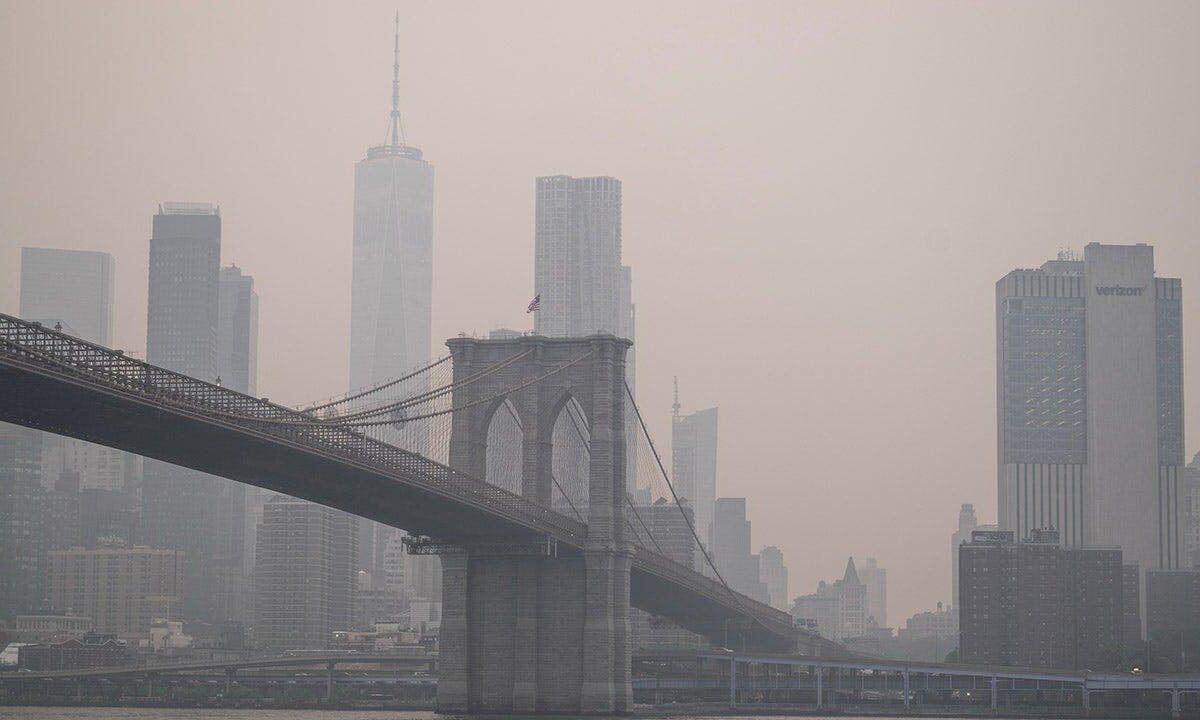
Drifting Canadian wildfire smoke has degraded air quality across parts of the United States in recent days, prompting public-health warnings and heightened political tension. The plume, carried by upper-level winds, has produced intermittent spikes in fine particulate matter (PM2.5) that officials say can aggravate respiratory and cardiovascular conditions.
What is happening now: Canadian wildfire smoke drifts south
Smoke from Canadian wildfires continues to drift across parts of the United States, reducing visibility in some areas and producing air-quality alerts in states downwind of the fires. Local air-quality monitors registered elevated PM2.5 readings during peak drift periods, prompting short-term advisories from state and local health agencies.
Officials in affected states urged people with heart or lung disease, older adults and children to limit prolonged outdoor exertion when advisories are in effect. School districts in several counties adjusted outdoor activities and athletics schedules during the worst smoke episodes. Public-health guidance emphasized that these exposures are tied to drifting wildfire smoke rather than local industrial emissions, but even temporary spikes in PM2.5 can have measurable health impacts.
Meteorologists and smoke-forecasting services tracked the plume’s movement using satellite imagery and ground-based sensors, noting that shifting winds and diurnal patterns can cause smoke concentrations to peak overnight or in the early morning. Forecasts warned of intermittent conditions over the coming days as new fires develop or existing blazes intensify in remote northern regions.
Political and economic fallout
The air-quality impacts have spilled into politics. President Donald Trump said he planned to raise the issue directly with Canada’s prime minister, Justin Trudeau, and criticized Ottawa’s forest-management practices; those remarks were reported in original Fox News coverage. The president described the repeated seasonal smoke incursions as an economic and public-health burden and suggested costs could be considered in trade discussions (as reported by Fox News).
At the congressional level, four Republican members of Michigan’s delegation sent a letter to Prime Minister Justin Trudeau pressing for measurable plans for forest thinning, fuel reduction and expanded use of prescribed burns after constituents reported renewed unhealthy air. The lawmakers framed their requests as demands for transparent timelines and accountable actions to reduce cross-border smoke.
Such accusations — including claims of “willful negligence” in forest management used by some U.S. officials and advocates — are being reported as allegations. Canadian officials had not issued a comprehensive public rebuttal to the charges at the time of reporting; observers noted that diplomatic engagement and technical discussion are more likely near-term steps than immediate trade measures.
What the Senate report found
The Senate Standing Committee on Agriculture and Forestry released a June report titled Canada on Fire after an extended study of wildfire impacts. According to the report, the committee held 17 meetings, heard testimony from 79 witnesses and received 23 written briefs during its work (Senate Standing Committee on Agriculture and Forestry, June report “Canada on Fire”).
The committee concluded that climate change is lengthening and intensifying fire seasons and that prevention and preparedness efforts have not scaled to match the growing threat. The report highlighted gaps in personnel and equipment capacity across provincial firefighting programs and emphasized that fuel management is central to reducing wildfire severity and downstream smoke impacts.
Committee findings stressed that without substantial increases in strategic fuel reduction — including prescribed burns and targeted thinning — the frequency of large, high-intensity fires and the volume of transboundary smoke will likely rise.
Expert recommendations for reducing smoke
Witnesses and experts who testified to the committee advocated a suite of fuel-management tools to reduce future smoke: prescribed fire to reestablish low-severity fire regimes, targeted mechanical thinning in high-risk stands, and planned debris removal to limit available fuel. Those approaches were presented to the committee as complementary rather than mutually exclusive.
Several witnesses also flagged firefighting resource shortfalls. Testimony included details about aging aerial firefighting fleets: committee testimony noted that 22 CL-215 water-bomber aircraft remained in provincial fleets and that at least 20 aircraft were identified by witnesses as requiring replacement or substantial upgrade to meet growing suppression needs.
Experts underscored that applying these fixes will require sustained funding, cross-jurisdictional coordination and community engagement, especially in remote northern landscapes where operations are logistically difficult and expensive.
Expert reaction
Practitioners who work on the ground told the committee that prescribed burns reduce the likelihood of extreme fire behavior when implemented under appropriate conditions, but public acceptance, smoke-management plans and trained crews are prerequisites. Researchers emphasized that adapting to a hotter, drier climate will demand both suppression capacity and proactive landscape-scale prevention.
What comes next and what to watch
Near-term diplomatic and policy moves will be important indicators. Watch for any announced calls between White House and Canadian officials and for formal exchanges that move beyond rhetoric to technical cooperation on smoke forecasting, shared monitoring and mutual response protocols.
Policy indicators to track include whether provinces or the federal government publish timelines or budgets for aircraft replacement, or roll out larger prescribed-burn programs with explicit smoke-management strategies. Congressional letters and committee follow-ups could press Ottawa for measurable benchmarks; likewise, Canadian responses that outline funding or programmatic commitments will be a key signal of whether recommendations are being taken up.
Another practical barometer will be changes to cross-border forecasting and public-health coordination: shared smoke plume alerts, synchronized advisories and joint investments in monitoring would point to a shift toward collaborative mitigation rather than escalating political blame.
Finally, follow-up reporting from the Senate Standing Committee on Agriculture and Forestry and any formal reply from the Office of the Prime Minister will clarify how Ottawa intends to respond to the committee’s recommendations and to U.S. concerns raised in recent political exchanges.
FAQ
Is Canadian wildfire smoke harmful to health?
Yes. Short-term exposure to wildfire smoke raises PM2.5 levels that can irritate lungs and worsen heart and lung conditions. Health officials recommend limiting outdoor activity, using indoor air filtration where available and following local advisories during smoke events.
Could the U.S. impose tariffs over wildfire smoke?
President Trump suggested factoring smoke-related costs into trade talks, but imposing tariffs over environmental conditions would be an extraordinary and diplomatically sensitive step. Any such move would require formal trade or legislative processes and could prompt reciprocal measures; the comments to date have been political rhetoric rather than established trade policy.
What forest management fixes do experts recommend?
Experts recommend a mix of prescribed fire, targeted thinning and strategic debris removal, alongside investments in firefighting capacity such as updated aircraft and expanded trained crews. Coordinated, landscape-scale planning and adequate funding are essential to implement these measures effectively.
Source list
- Senate Standing Committee on Agriculture and Forestry. June report “Canada on Fire” (committee released findings after 17 meetings, 79 witnesses and 23 written briefs).
- Original reporting and testimony cited by Fox News Digital: Fox News — Canadian wildfire smoke ignites cross-border feud.