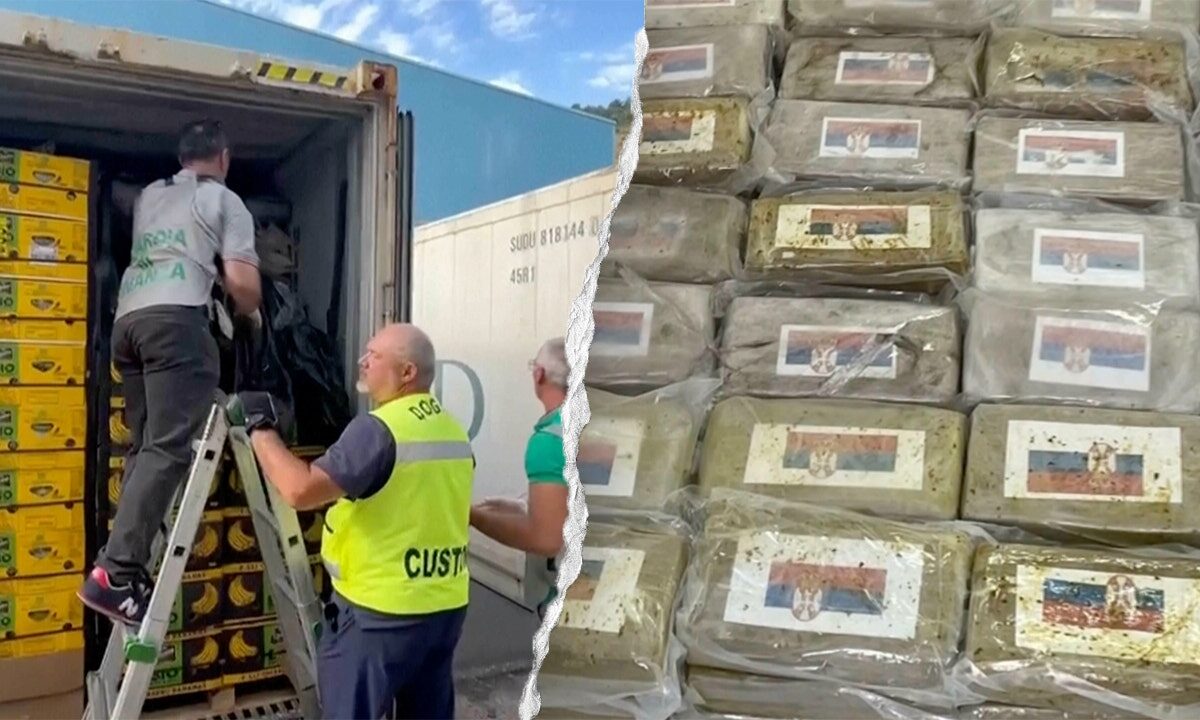
Italian authorities intercepted a cocaine haul in banana shipment at the port of Vado Ligure, seizing about 1,700 pounds of the drug packed among pallets of bananas, officials said. The load arrived in a refrigerated shipping container that departed from a major Ecuadorian port, according to Italy’s Guardia di Finanza, the agency that led the operation.
Officers discovered 650 individually wrapped packages during a targeted inspection. An on‑site field test indicated a substance consistent with a high‑purity form of cocaine; Guardia di Finanza cautioned that field tests are provisional and that laboratory confirmation — which will establish precise composition and purity — can take days to weeks.
How the cocaine haul in banana shipment was discovered
Inspectors at Vado Ligure focused attention on a refrigerated container loaded with commercial pallets of bananas. Authorities said the action combined routine port screening with intelligence‑driven selection criteria aimed at consignments arriving from South America.
The initial checks involved manifest review and nonintrusive inspection tools. After indicators raised suspicion, teams deployed canine units and performed a physical search of palletized fruit, where the packages were found hidden among the bananas rather than in structural voids of the container.
How the drugs were concealed and detected
Guardia di Finanza described the narcotics as “skillfully concealed” within banana pallets, noting packaging and placement that masked the load during cursory handling. Law enforcement officials said the concealment appeared designed to blend with legitimate produce and complicate rapid detection.
Investigators used a layered approach: nonintrusive imaging scans to detect anomalies inside pallets, trained detector dogs to pinpoint hidden narcotics, and targeted manual inspection where alerts occurred. The combination of techniques led to the removal of 650 packages for further forensic testing.
Shipping route analysis behind the bust
Authorities traced the container to a departure from one of Ecuador’s principal commercial ports and said the seizure resulted from an ongoing effort to map trafficking patterns along commercial shipping routes between South America and Europe. Vado Ligure is a major Mediterranean gateway for imports, and officials have been monitoring flows they consider vulnerable to concealment tactics.
Investigators are reviewing carrier manifests, booking records and freight‑forwarder documentation to establish where concealment likely occurred — at origin, during transshipment or closer to destination. The probe includes cross‑checking shipping data and coordinating with international partners to identify repeat consignors or suspicious routing patterns.
By the numbers
Seizure details
- Approximate weight seized: 1,700 pounds (about 650 packages)
- Container type: refrigerated shipping container carrying bananas
- Reported estimated street value: 250 million euros (nearly $290 million) — an authority estimate subject to verification
Context
- U.S. comparison: CBP officers at Pharr Port of Entry in Texas previously seized 1,173 pounds of cocaine hidden in a cabbage shipment
- That U.S. case likewise relied on canine inspection and nonintrusive imaging to locate hundreds of packages
What comes next for investigators
Packages removed from the container will be sent to forensic laboratories for confirmatory testing. Authorities made clear that field test indicators are preliminary; definitive laboratory results typically take days to weeks and will determine formal charges and case strategy.
Guardia di Finanza said the operation will feed into a broader criminal probe focused on the supply chain, including carriers, freight forwarders and port handling records. Investigators plan to pursue intelligence‑sharing with South American counterparts and other European agencies to trace the origin of the shipment and identify those responsible for concealment and distribution.
Prosecutors are expected to assess whether to bring charges against individuals or entities tied to the container’s booking and handling, and whether international mutual‑legal assistance requests will be required to obtain documents or testimony located abroad.
“The operation forms part of an ongoing and targeted effort to combat the international trafficking of narcotics,” Guardia di Finanza said in a statement, adding that the seizure underscores the need for sustained port controls and cross‑border cooperation to disrupt organized criminal networks.
Officials also emphasized that street‑value estimates provided by law enforcement are approximate and used to convey scale rather than precise market valuations. The Guardia di Finanza served as the primary source for seizure details and inspection findings; English‑language reporting of the incident was carried by media outlets including Fox News, which summarized the initial statements and provided additional context on comparable seizures elsewhere.
For context, U.S. Customs and Border Protection (CBP) has cited similar concealment methods in prior agricultural shipment seizures, reinforcing that coordinated detection tools — imaging, canine units and data‑driven targeting — remain central to port interdiction efforts.
Reporting notes: The seizure details, package count and origin information were provided by Italy’s Guardia di Finanza. Additional reporting and contextual comparison to a U.S. seizure at Pharr, Texas, were taken from media coverage of public CBP reporting and news outlets.