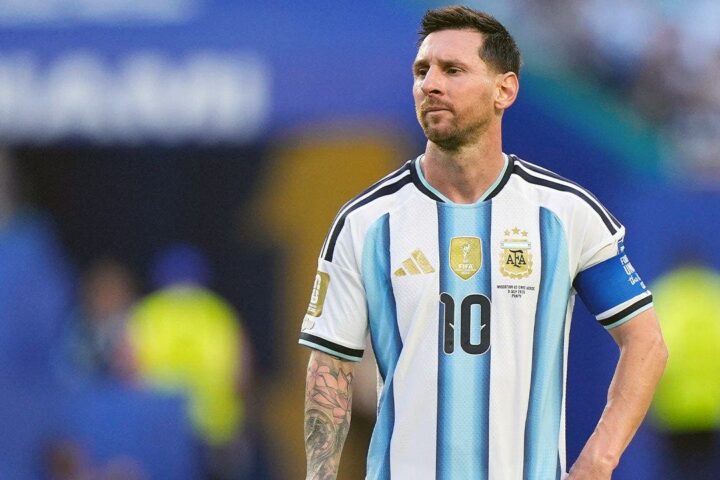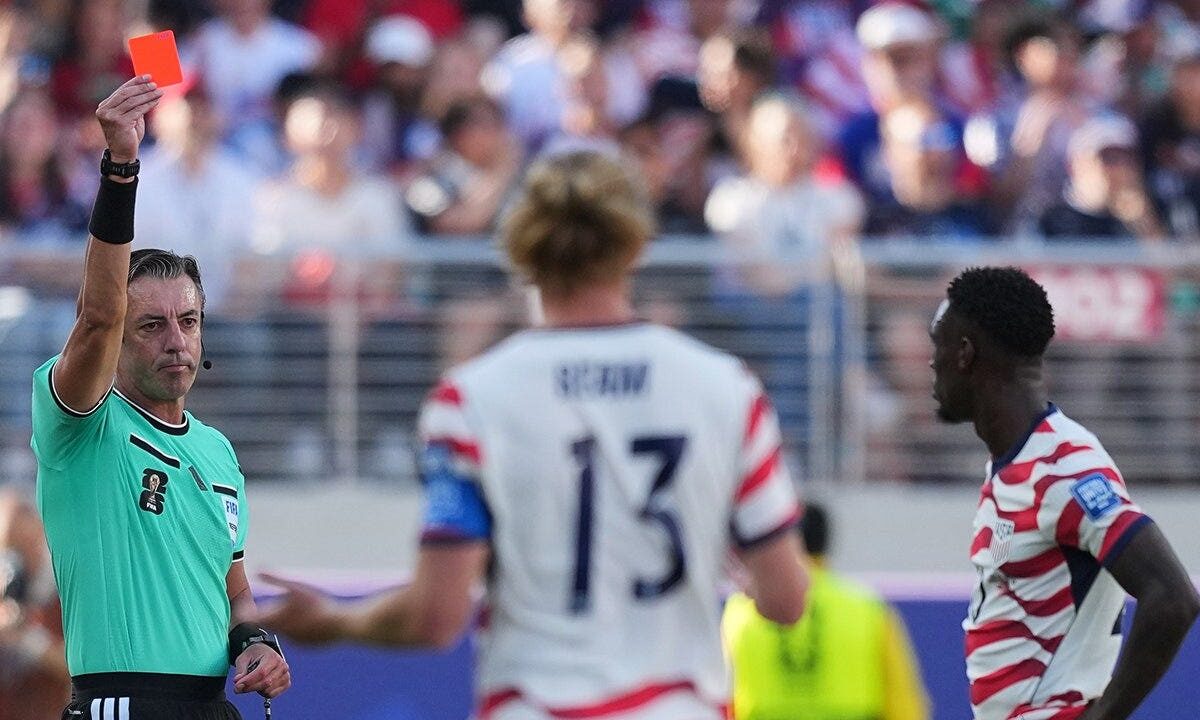
Folarin Balogun red card ended his run in that match and, according to reporting, means he will be unavailable when the United States faces Belgium in the Round of 16. The dismissal followed a video assistant referee (VAR) pitch-side review of a challenge in which Balogun’s foot landed on an opponent’s ankle; the on-field referee upgraded the original decision to a direct red.
Folarin Balogun red card: what happened on the play
The incident occurred as Balogun and an opposing defender contested a loose ball in a crowded penalty-area moment. Replays shown to the referee at the pitch-side monitor appeared to show Balogun’s cleat contact the other player’s ankle and the leg roll that followed.
Match officials stopped play and VAR intervened, asking the referee to review the footage. After the pitch-side review the referee judged the contact met the threshold for a sending-off and issued a direct red card. The decision reduced the U.S. to 10 men for the remainder of that match and immediately triggered disciplinary procedures under the tournament regulations.
The use of VAR to upgrade an on-field call was central to how the incident was handled; the process followed the protocol for reviewing potential serious foul play when the initial on-field decision is considered by the VAR team and the referee.
How FIFA rules determine the suspension
Under the tournament disciplinary regulations cited in reporting, a sending-off carries defined consequences. Article 10.5 states that “If a player or team official is sent off as a result of a direct or indirect red card (second caution), they will automatically be suspended from their team’s subsequent match.” That automatic suspension mechanism is why Balogun would miss the next fixture.
The regulations also narrow review options. Article 9.6 explains that “No protests may be made about the referee’s decisions regarding facts connected with play. Such decisions are final and not subject to appeal, unless otherwise stipulated in the FIFA Disciplinary Code.” Taken together, those rules mean the red card results in an immediate single-match ban and that contesting the basic facts of the on-field decision is largely restricted by the code cited.
According to Fox News reporting, FIFA’s application of those provisions resulted in the confirmation that Balogun will be unavailable for the U.S. Round of 16 game against Belgium.
Balogun’s response and team reaction
Balogun, in his first public comments after the sending-off, disagreed with the ruling and said the contact was not intentional. He told reporters, “First and foremost, it was totally unintentional. I think the choice of the referee was, of course, his choice, but I don’t think it was the correct call. I think a yellow card would have been fair due to it not being intentional.”
He framed his reaction around composure and responsibility, saying he wanted to set an example for young fans: “I never want to react out of anger and emotion. There’s still lots of people we’re inspiring. Little kids, boys and girls are watching. We have to show them the correct way to handle things even when you think it’s unjust,” Balogun said, as reported.
Team staff and teammates publicly expressed support for Balogun’s conduct and professionalism after the match. Coaching staff now shift attention to the immediate task of replacing his attacking presence for the knockout fixture.
What this means for the USA vs Belgium match
Balogun will miss Belgium, which forces a tactical recalculation for the U.S. coach. Losing a primary forward removes a direct goal threat and influences how the team can press, occupy defenders and finish chances in the box.
Coaches have a few standard options. They can promote a tournament substitute into the starting striker role, change formation to emphasize two forwards or a false nine, or ask a creative midfielder or wide attacker to assume greater scoring responsibilities. Each choice shifts match planning: a like-for-like replacement preserves a similar attacking profile, while a formation tweak can alter midfield balance and defensive coverage.
For Belgium, the absence of Balogun changes the scouting report and can affect how they allocate defensive resources. For the U.S., it means trusting an alternative to produce goals and maintain the team’s attacking identity under knockout pressure.
Source and next steps
According to Fox News, FIFA’s disciplinary framework has led to the application of an automatic one-match suspension in this case, and Article 9.6 limits the scope for contesting the referee’s factual determinations from the pitch. That leaves the U.S. focused on tactical and selection responses rather than procedural recourse.
If the United States advances past Belgium, the suspension would be served for the Round of 16 and Balogun would be available for subsequent matches, provided no further disciplinary action is applied.
Source: Fox News – OutKick Sports