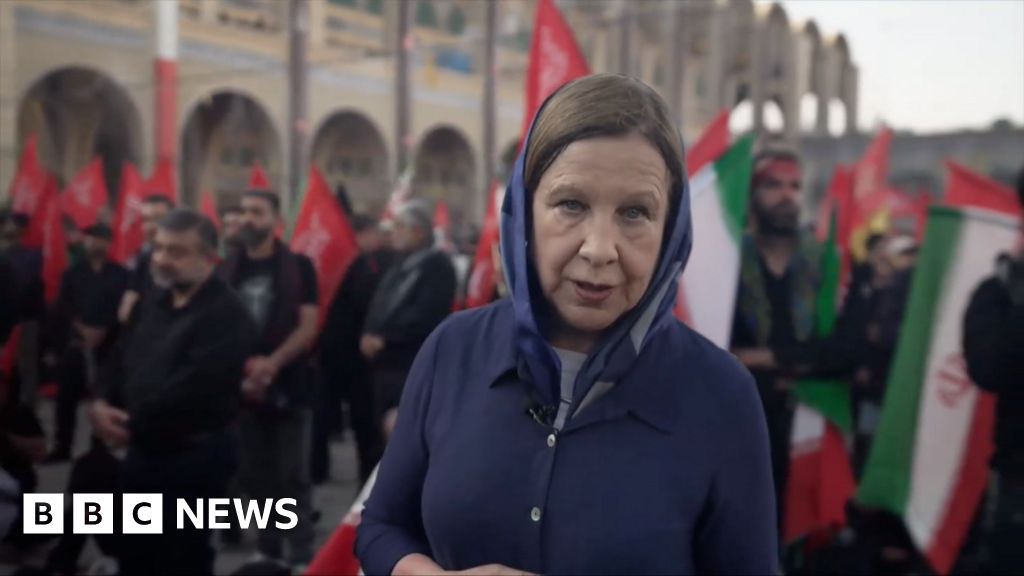
The funeral of Ayatollah Ali Khamenei is under way in Tehran. BBC chief international correspondent Lyse Doucet reported from the scene, describing large crowds, ritual gestures of honour and an atmosphere that blends private grief with public ceremony. In the first hours of coverage, journalists in the city centre saw people carrying photos and flowers, organised groups directing movement through the streets, and alternating periods of silence and loud lament from assembled mourners. BBC reporting uses the broadcaster’s wording that the events are in honour of Iran’s “former leader,” a label the BBC applies and which is publicly contested.
Funeral of Ayatollah Ali Khamenei: what we saw
Journalists arriving at the procession route reported long lines of people moving steadily toward a central site. The BBC’s on-the-ground coverage highlighted the mix of private mourning and orchestrated ceremony: individuals placing flowers, groups coordinating the flow of attendees, and clerical figures present among the crowds. Lyse Doucet, reporting for the BBC, noted how the scene repeatedly alternated between quiet reflection and collective displays of grief, and she described how ritual gestures of honour were a constant visual element.
Reporting remains primarily descriptive at this stage: accounts focus on what can be confirmed by on-the-ground observation — crowd size, gestures, the presence of organised groups and visible symbols — and note where details are not yet available, such as formal guest lists or official pronouncements released in full.
Crowd scenes and emotion
Crowds were among the clearest images coming from Tehran. Squares and major routes filled with dense groups of people, some chanting and others standing in long, moving lines to pay respects. Observers repeatedly noted the prominence of flowers, religious banners and items of personal tribute. Many attendees were visibly upset, with open displays of mourning alongside composed, ritual behaviour.
Those on the ground described a range of personal responses: some mourned openly and emotionally, others moved through the ceremony with a solemn, ritualised gait. The BBC’s coverage emphasised the communal nature of the observance while noting individual expressions of grief interwoven through the procession.
Political dimension and symbolism
Reporters and commentators watching the procession pointed to political symbolism in the public displays. Public funerals for high-profile figures can become moments for messaging: the order of ceremonial participants, the banners displayed, and the way official groups are positioned can all be read for meaning. Early reporting from the BBC flagged such symbolic elements, while cautioning that immediate appearances do not always equate to clear, long-term political consequences.
It remains too early to draw firm conclusions about any formal political declarations arising from the funeral. Journalists on site advised caution, saying that ceremonies can be staged to produce particular images and that fuller context, including statements from officials and subsequent events, will be needed before assessing wider implications.
What reporters on the ground are saying
Lyse Doucet of the BBC provided the primary on-the-ground account used in these updates. Her reporting combined descriptive detail — about crowd movement, visible symbols and the arrangement of the ceremony — with cautious interpretation about political meaning. The BBC’s reporting described the events as being held in honour of Iran’s “former leader,” a phrase used by the broadcaster; the BBC’s video headline also uses the term “former supreme leader.” We note that such labels are contested and are used here as attributions to the BBC’s coverage rather than as indisputable fact.
On-camera observations emphasised the mixture of grief and organised ceremony. Doucet and colleagues described how the crowd dynamics changed throughout the coverage window and highlighted where reporters had confirmed details and where gaps remained. For now, the BBC dispatch is the primary source for these immediate observations from Tehran.
Key takeaways
- This is a developing funeral event in Tehran described by the BBC as being held in honour of Ayatollah Ali Khamenei.
- Lyse Doucet’s on-the-ground reporting highlights large crowds, visible emotion and ritual gestures of honour.
- Observers see political symbolism in the procession, but immediate coverage offers limited detail on formal messaging or long-term implications.
- For now, the BBC News – Top Stories video and report are the primary sources for these early observations.
Background
Public funerals for prominent figures in Iran often draw broad attention because they can serve multiple purposes: personal mourning, religious observance and political signalling. In many cases, officials and organised groups use public ceremonies to project unity or convey particular messages. The BBC’s on-the-ground reporting links visible scenes in Tehran to this broader context while making clear where attributions and labels come from the broadcaster’s coverage.
Frequently asked questions
Who is Ayatollah Ali Khamenei?
The BBC’s report identifies the funeral as being held in honour of Ayatollah Ali Khamenei and refers to him using its chosen wording. For fuller biographical context and detailed profiles, readers should consult established news and reference sources.
Why is the funeral politically significant?
Large public funerals for major figures can become focal points for political expression and messaging. Early reporting from Tehran notes symbolic elements and organised groups that observers interpret as politically meaningful, but immediate coverage offers limited detail on longer-term effects.
Where is the BBC reporting from?
The BBC’s chief international correspondent Lyse Doucet filed the on-the-ground report from Tehran; the BBC video linked below contains her full dispatch.
Source attribution
Primary source: BBC News – Top Stories. Original report and video: Emotion and politics merge in Tehran at funeral of former supreme leader. The terms “former leader” and the BBC’s use of “former supreme leader” in its headline are attributed here to the BBC; such labels are publicly contested and are noted as broadcaster attributions rather than uncontested facts.