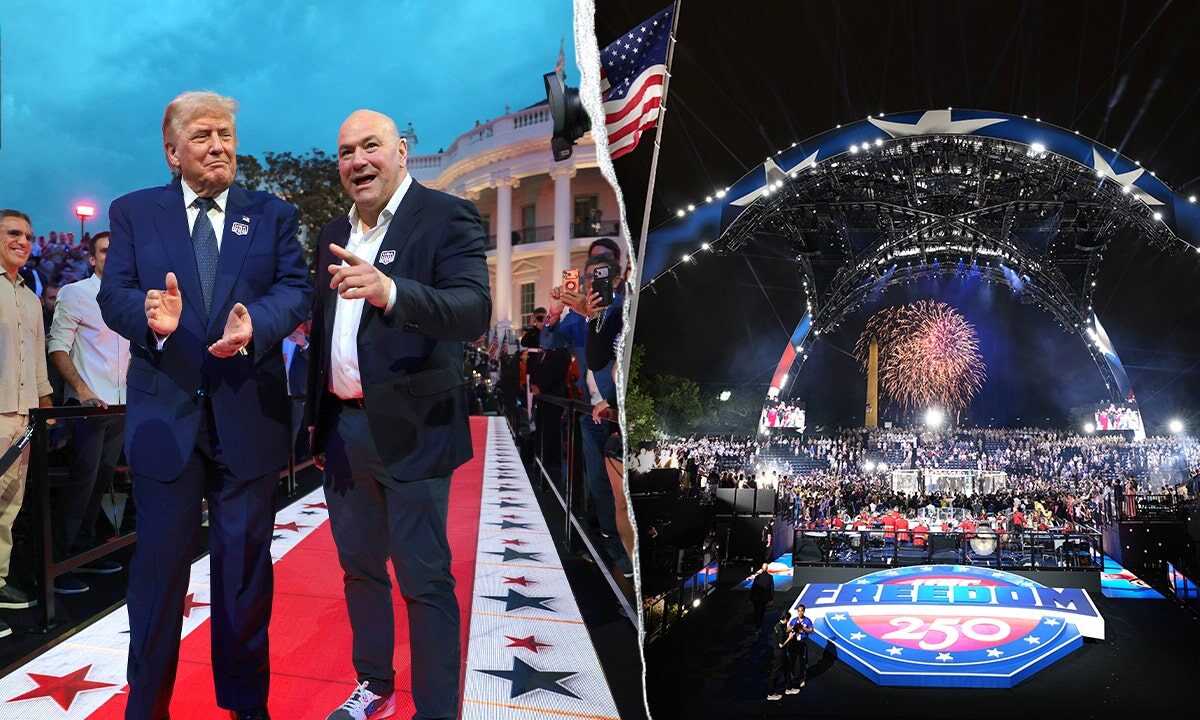
Fox Nation’s two-part documentary, UFC Fight House: The Making of the Biggest Fight in History, takes viewers inside the production of UFC Freedom 250 — an event organizers presented in the film as the first professional sporting event held on the White House lawn.
The documentary centers on the logistics, personalities and on-the-ground work that organizers say transformed an audacious idea into a live spectacle. In on-camera interviews and behind-the-scenes footage, producers and promoters describe roughly nine months of planning to design a venue, manage security and stage a broadcast-ready fight in one of the country’s most secure and symbolically charged locations.
UFC Freedom 250 on the White House lawn
The film frames UFC Freedom 250 as a milestone. Organizers in the documentary describe it as the first professional sporting event staged on the White House grounds; that characterization is presented as an organizer claim rather than an independently certified historical fact. The series follows the project from its earliest pitch through approvals, site work and the live event, showing how production priorities intersected with presidential protocol and public attention.
Fox Nation positions the White House site as both backdrop and central production challenge. Many sequences focus on negotiations over access, scheduling around official White House activities, and how planners adapted traditional arena production workflows to an outdoor presidential venue.
How the event was built: the Claw and nine months of work
A major through-line in the documentary is “the Claw,” a custom-built structure that organizers say functioned as the event’s visual anchor and provided seating for thousands. The film shows engineers, carpenters and rigging specialists working in tight sequences to reconcile sightlines, load-bearing requirements and aesthetic goals.
Organizers repeatedly reference a near nine-month timeline from concept to completion. That period, the documentary says, encompassed design, permitting, site surveys, mock-ups and multiple rehearsal runs. Production managers describe tradeoffs between speed and redundancy: crews had to stage modular seating and lighting that could be safely assembled on a historic lawn while meeting broadcast standards for camera positions and cabling.
Logistical segments in the film detail security clearances, credentialing systems for staff and attendees, coordinated transport plans for fighters and technical teams, and contingency planning for weather. Interviewed staff explain how they adapted typical arena staging practices to a high-profile, outdoor governmental setting where both aesthetics and strict safety rules were nonnegotiable.
“You just couldn’t write a better script than this. If you scripted this out like a movie, this is a documentary of what really happened. … You could never imagine that we would be asked to do an event at the White House.” — Dana White, as quoted in the Fox Nation documentary
“It was nine months of nonstop work to get the Claw ready and make sure everything met protocol,” — Craig Borsari, in the documentary
Who appears in the film and key quotes
The documentary features interviews with UFC President Dana White, President Donald Trump and production lead Craig Borsari, among others. Participants offer organizer-centric recollections of decision points, tradecraft and the political visibility that accompanied the production.
White’s on-camera remarks featured prominently in promotional clips; Trump appears and is shown endorsing the event’s scale and importance in the documentary’s narrative. Borsari and other production staff provide granular detail about engineering choices and scheduling pressure, presenting the build as a coordinated technical feat as much as a promotional one.
Viewership and platform numbers
Following the event, organizers and platforms released large audience estimates that the documentary reiterates. UFC announced an estimated 34 million total global viewers for UFC Freedom 250, while Paramount+ reported roughly 17 million viewers across its U.S. and Latin American platforms. These figures are presented in the film and publicity materials as estimates provided by the organizers and platforms; the documentary itself does not supply independent third-party verification of the combined total.
The program places those numbers in context as indicators of reach, not definitive industry-audited totals. Viewers should treat the 34 million and 17 million figures as platform- and organizer-reported; the documentary attributes them to the named sources rather than asserting them as independently confirmed metrics.
Legal context and reactions
The film does not omit controversy. Reporting connected to the project notes that a federal lawsuit at one point sought to block the UFC Freedom 250 from being held on the White House South Lawn; the documentary shows how organizers responded to legal scrutiny while continuing preparations. News coverage and the film identify Craig Borsari as the production lead handling many of the compliance and permitting conversations.
In interviews, organizers describe legal consultations, permit negotiations and adaptive scheduling intended to reduce risk and to comply with governmental requirements. The documentary frames those legal hurdles as part of production risk management rather than as resolved judicial determinations; viewers are reminded that litigation and regulatory review can evolve after the film’s release.
Quick takeaways
– The documentary provides an organizer-focused, behind-the-scenes account of mounting a large-scale sporting event on the White House grounds.
– Key production themes include the nine-month planning timeline, the engineering of the Claw structure, and coordinated security and broadcast logistics.
– Reported viewership numbers (34 million total global viewers, 17 million on Paramount+) are presented as organizer- and platform-provided estimates and are not independently audited within the film.
Background and what comes next
Fox Nation markets the two-part series as a chronicle of a historic sporting moment from the organizers’ perspective. The documentary compiles interviews, rehearsal footage and construction sequences into an account that emphasizes the scale and ambition of the project.
Future reporting, any regulatory or legal developments, and independent audience measurement releases will inform how the event and its claimed milestones are ultimately recorded in public and industry records.
Source attribution
Reporting and the documentary summarized here draw from the Fox Nation two-part film and related coverage. The article references organizer and platform estimates from UFC and Paramount+ for viewership figures. Additional reporting cited includes Fox News coverage and the UFC’s published statement announcing audience estimates.
Key sources: Fox Nation (UFC Fight House documentary); Fox News reporting: https://www.foxnews.com/media/trumps-bold-prediction-historic-ufc-white-house-fight-revealed-new-fox-nation-documentary; UFC statement: https://www.ufc.com/news/ufc-freedom-250-delivers-34-million-total-global-viewers. Paramount+ was cited in publicity materials as reporting an estimated 17 million viewers across U.S. and Latin America.